Key Takeaways
- Extruded aluminum's strength-to-weight ratio is what allows the slim, long-span structures that motorized louvered pergolas require — no comparable material matches it.
- Powder-coat finishes on aluminum resist chipping, fading, and salt-air corrosion far longer than painted wood or vinyl, with 200+ RAL colors plus wood-look finishes available.
- Breslow's R-Blade aluminum system is wind-rated up to 195 mph and Miami-Dade hurricane certified, with snow load engineered for both open and closed louver positions.
- Quality varies within "aluminum" as a category — wall thickness, documented wind/snow ratings, and integrated water management separate premium systems from thin-wall imitations.
Walk through any high-end outdoor living project built in the last decade and the roof structure is almost certainly aluminum. That's not a trend — it's the material settling into the role it's actually suited for. Aluminum pergolas dominate the premium market because the physics work in their favor: strong, light, corrosion-resistant, and precise enough to support the motorized systems that have redefined what a pergola can do. Browse real installations in Breslow's project portfolio.
Why Aluminum Owns This Category
A pergola roof in the Northeast has to survive freeze-thaw cycles, heavy wet snow, salt air near the coast, and, increasingly, the demand to actually move, as motorized louvered systems have become the category standard rather than the exception. Wood can't hold tight enough tolerances for a motor-driven louver to seal reliably for decades. Vinyl and fiberglass lack the structural strength for real spans. Steel is strong but heavy and corrodes without constant vigilance. Aluminum is the only material that checks every box at once, which is why Breslow's R-Blade™ system, and every genuinely engineered motorized pergola on the market, is built from it.
That's not a niche engineering opinion; it's the reason the category itself shifted. A generation ago, a "pergola" almost always meant a wooden lattice structure. Today, when buyers search for a motorized or adjustable pergola, they're almost always looking at aluminum systems, because that's the only material the motorized category evolved around.
Engineering: Strength-to-Weight
Extruded aluminum has an exceptional strength-to-weight ratio, which is what allows longer clear spans with slimmer structural members than wood or steel of comparable capacity. That matters for two reasons: design and performance. On the design side, slim aluminum posts and beams read as architecture rather than bulk — a lighter visual footprint against a home's existing lines. On the performance side, that same structural efficiency is what makes Breslow's R-Blade wind-rated up to 195 mph and Miami-Dade hurricane certified, with snow-load engineering considered for both open and closed louver positions. None of that happens with a heavier or less dimensionally stable material carrying the same load.
Finishes: Powder Coat and 200+ Colors
Raw aluminum isn't the finished product — the powder-coat process is what turns extruded profiles into a finished architectural system. A properly cured powder coat bonds to the aluminum substrate and resists chipping, fading, and chalking far longer than a painted wood or vinyl surface. Breslow specifies systems available in 200-plus RAL colors, plus wood-look finishes that replicate stained cedar or weathered oak grain on an aluminum core, meaning the material choice no longer forces a style compromise. Bronze, black, white, custom architectural colors matched to existing trim: the finish palette is effectively unlimited.
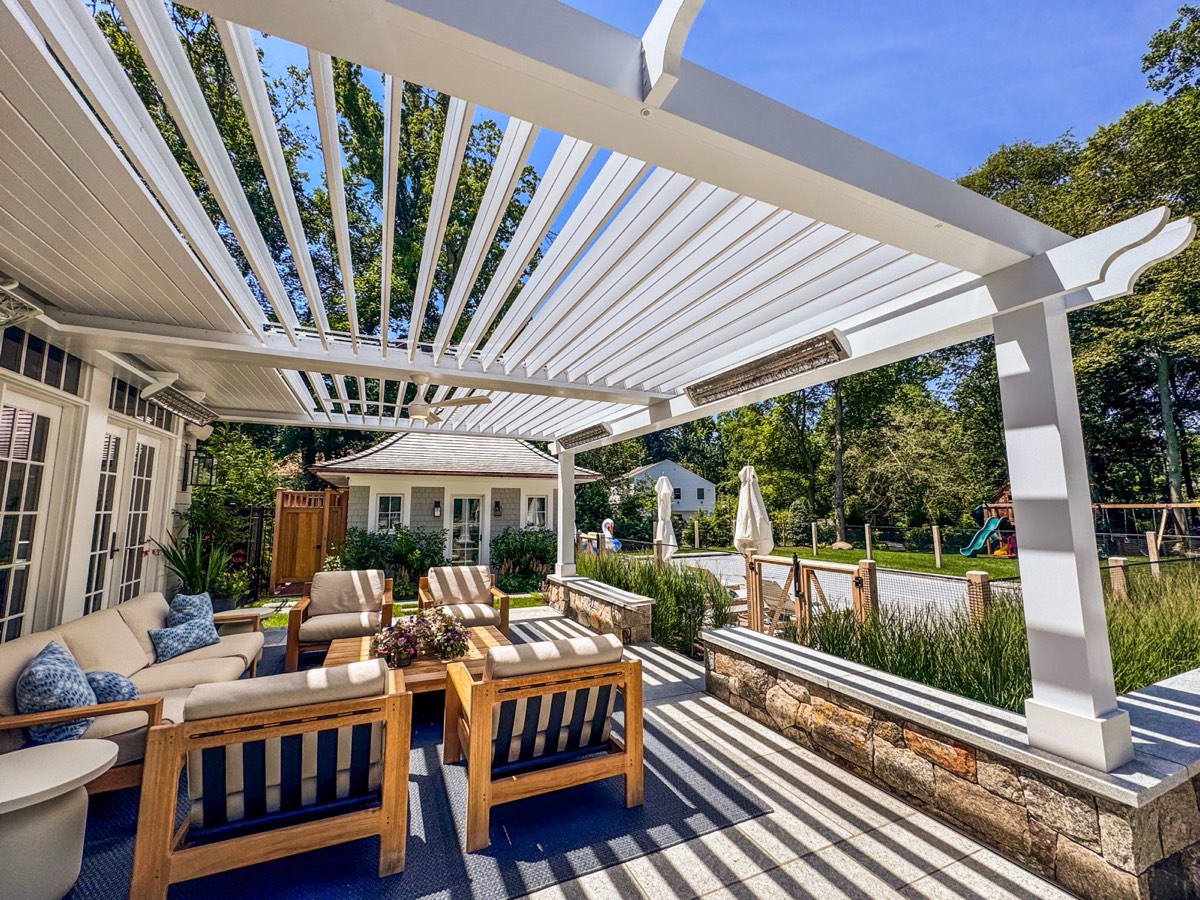
Weather: Snow, Wind, Salt Air
This is where aluminum's real value shows up over a decade of ownership rather than in the showroom. It doesn't rust the way untreated steel does, and a quality powder-coat finish holds up to coastal salt air far better than most painted surfaces, relevant for any shore-area project along the Jersey coast or Long Island Sound. Snow load is an engineering question, not a material guess: R-Blade's rating runs from 25 to 100 PSF with louvers open down to 25 to 55 PSF closed, depending on span, and every project gets site-specific engineering rather than a generic spec sheet applied blindly.
Wind performance is the headline number for most buyers, and it's the one worth reading carefully. Breslow's R-Blade is wind-rated up to 195 mph and Miami-Dade hurricane certified — the toughest wind-and-water testing standard maintained in the country — with open-louver and closed-louver ratings that differ by span, which is why a single marketing number is never the whole engineering story.
Style Range: Modern to Classic
Aluminum's design flexibility runs from crisp modern profiles with minimal sightlines to more traditional, classically detailed structures with custom trim and architectural millwork elements layered onto the aluminum frame. The same engineered core supports a clean, contemporary look on a mid-century home or a more ornamented, classical profile on a traditional colonial — the structural system doesn't dictate the style the way a single wood profile often does. Breslow's custom styles gallery shows that range across real projects rather than renderings.
Specifying Quality Aluminum
Not all aluminum pergolas are engineered equally, and this is where buyers get burned by assuming "aluminum" alone is the quality signal. What actually separates a premium system: wall thickness of the extrusion (thin-wall aluminum flexes and fatigues faster under repeated motor cycling), a documented wind and snow rating backed by real testing rather than marketing claims, integrated water management that routes rain through the posts rather than dripping off exposed edges, and a powder-coat process that's properly cured rather than a cheap spray finish. Ask for the engineering documentation, not just the color chart.
A thin-wall extrusion and a properly engineered profile can look nearly identical in a showroom sample. The difference only shows up under load, under repeated motor cycling, and after a few winters of expansion and contraction — which is exactly why documentation matters more than a swatch.
Ask your contractor: "What's the wall thickness of this extrusion, and can I see the wind and snow rating documentation?" If they can't produce paperwork, they're selling a material, not an engineered system.
Breslow builds every R-Blade project on documented Azenco engineering, starting with a design consultation on Zoom to discuss your space and a realistic investment range before anything else, followed by 3D renderings on your actual home and PE-stamped structural engineering where required.
Frequently Asked Questions
Why are aluminum pergolas better than other materials?
Aluminum combines a high strength-to-weight ratio, resistance to rot and insects, and dimensional stability that wood, vinyl, and even steel struggle to match at the same time. That combination is what allows motorized louvered systems to rotate and seal precisely for decades, which is why nearly every genuinely engineered motorized pergola on the market is built from aluminum.
Do aluminum pergolas rust or corrode?
Aluminum itself does not rust the way steel does, and a properly cured powder-coat finish adds strong resistance to fading, chipping, and coastal salt-air corrosion. Quality of the powder-coat process and wall thickness of the extrusion both affect how well a specific system performs over time.
Can an aluminum pergola look like wood?
Yes. Wood-look powder-coat finishes replicate the appearance of stained cedar or weathered oak grain on an aluminum structural core, so homeowners get the aesthetic of wood without its maintenance requirements.
What should I look for in a quality aluminum pergola?
Ask about the wall thickness of the aluminum extrusion, request documented wind and snow load ratings rather than marketing claims, confirm the system has integrated water management routing rain through the structure, and verify the powder-coat process is properly cured. These details separate a premium engineered system from a thin-wall imitation.