Key Takeaways
- Aluminum doesn't rot, warp, or host insects the way wood does — critical for a motorized system like Breslow's R-Blade that needs louvers to rotate and seal precisely for decades.
- A wood pergola typically needs re-staining or sealing every 1–3 years; a powder-coated aluminum structure needs none of that.
- Aluminum's strength-to-weight ratio allows the longer, slimmer spans that motorized louvered systems require — no true motorized louvered roof on the market is built from wood.
- Modern wood-look powder-coat finishes replicate the appearance of stained wood on aluminum, so the aesthetic no longer has to be traded for maintenance.
Wood built the first pergolas, and it's still the material most people picture when they hear the word. But a Northeast winter doesn't care what a material looks like in a catalog — it cares what happens to it after ten seasons of freeze-thaw cycles, road salt, and wet snow sitting on a roof. That's the test aluminum was engineered to pass and wood was never designed for.
The Romance of Wood, the Physics of Aluminum
Wood has real appeal: natural grain, warmth, a material that ages the way people expect an outdoor structure to age. Aluminum has a different appeal, and it's structural — extruded aluminum doesn't rot, doesn't warp with moisture, doesn't host termites or carpenter ants, and holds tighter dimensional tolerances than dimensional lumber ever will. For a motorized system like Breslow's R-Blade louvered roof, that tolerance isn't a nice-to-have — it's what lets individual louvers rotate smoothly and seal against rain year after year without binding, swelling, or sagging.
Dimensional lumber also moves with the seasons in ways aluminum simply doesn't. Wood expands and contracts with humidity, cups and twists as it dries unevenly, and settles at fastener points over time. None of that is a defect in the wood — it's just what the material does. It's also exactly the kind of movement a precision motorized system can't tolerate at scale.
Maintenance: The 10-Year Picture
This is where the two materials diverge most sharply. A wood pergola needs re-staining or sealing every one to three years to hold its finish and resist moisture intrusion, plus regular inspection for rot at joints and post bases where water collects. Skip a season and the deterioration compounds — checking, splitting, and soft spots don't reverse themselves. A powder-coated aluminum structure needs none of that: no staining, no sealing, no repainting cycle. Ten years in, a well-built aluminum pergola looks close to the day it was installed; a wood pergola on the same timeline usually needs significant refinishing or structural repair.
The labor side of that maintenance adds up too. Re-staining a large structure isn't a weekend job done once and forgotten — it's scaffolding or ladders, sanding, multiple coats, and a window of dry weather to do it in, repeated every couple of years for the life of the structure. That's a recurring cost of ownership that a powder-coated aluminum system simply doesn't carry.
Engineering: Spans, Snow, and Wind
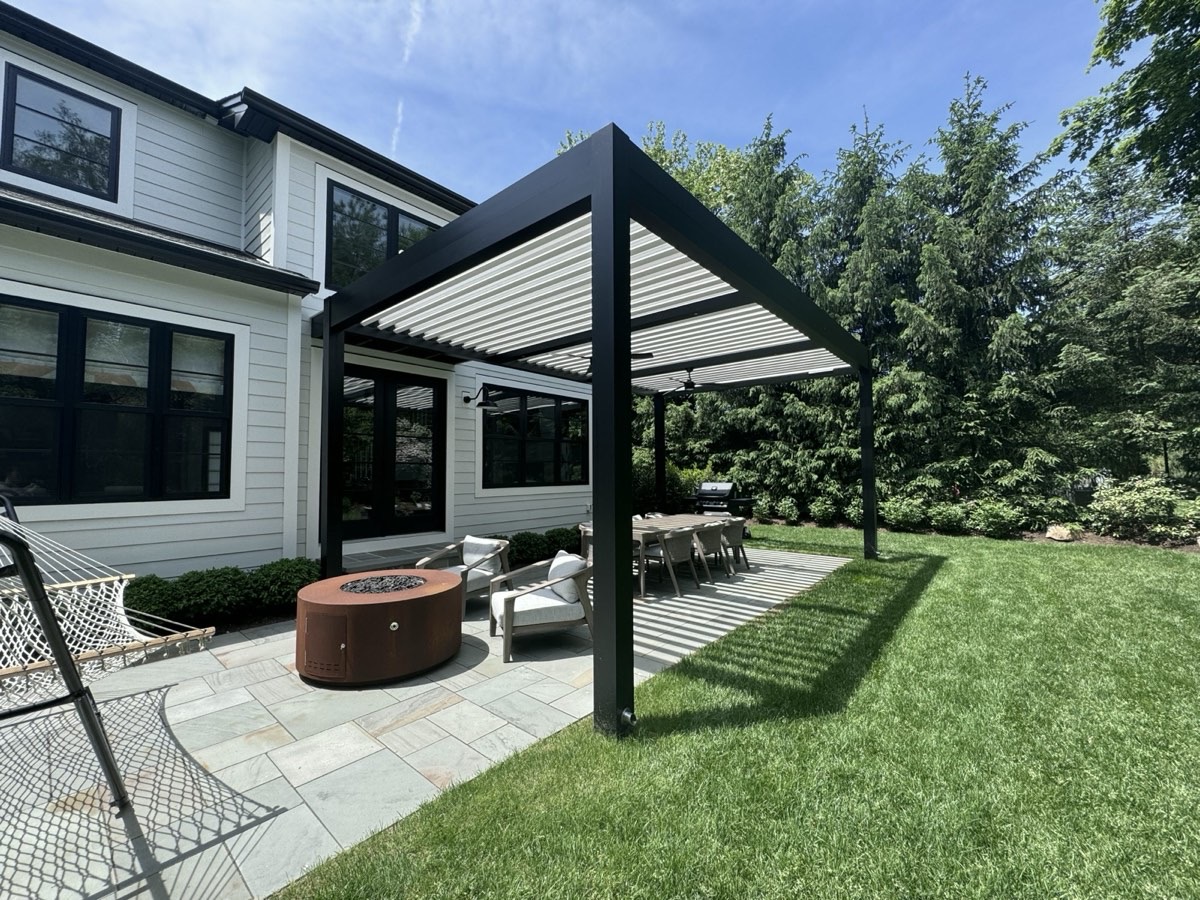
Wood pergolas typically rely on larger cross-sections of lumber to achieve structural spans, which limits design flexibility and adds visual bulk. Aluminum's strength-to-weight ratio allows longer clear spans with slimmer sightlines, which is part of why every genuinely motorized louvered roof system on the market today is built from aluminum rather than wood — the material needs to hold tight tolerances under load while moving. Breslow's R-Blade system is engineered and, where required, PE-stamped for site-specific wind and snow loads, rated wind-resistant up to 195 mph and Miami-Dade hurricane certified — a testing standard wood-frame structures aren't held to in the same way.
Snow load matters as much as wind in this climate. R-Blade is rated from 25 to 100 PSF with louvers open down to 25 to 55 PSF closed, depending on span — figures that come from documented engineering, not a general assumption about "how much a pergola can hold." Wood-frame pergolas are rarely tested to the same documented standard, which leaves the homeowner without a clear answer when a heavy nor'easter is forecast.
Wood-Look Aluminum Finishes
Style is usually the objection that keeps homeowners loyal to wood longer than the maintenance schedule justifies. The material argument used to force a style tradeoff — homeowners who wanted the warmth of wood grain had to accept wood's maintenance burden to get it. That's no longer true. Modern powder-coat and wood-look finish technology replicates the appearance of stained cedar, mahogany, or weathered oak on extruded aluminum, closely enough that most guests never notice the difference. Combined with 200+ available RAL colors for a solid finish approach, it means the aesthetic decision and the material decision no longer have to fight each other.
Lifetime Cost Comparison
| Wood Pergola | Aluminum Pergola (R-Blade) | |
|---|---|---|
| Refinishing cycle | Every 1–3 years | None — powder-coat finish |
| Rot / insect risk | Ongoing risk, especially at posts and joints | None |
| Motorized louver capability | Not structurally practical | Standard on R-Blade |
| Wind rating | Varies by design, not independently certified | Up to 195 mph, Miami-Dade certified |
| Wood-grain appearance available | Yes — natural | Yes — wood-look powder-coat finishes |
| Typical 10-year cost trajectory | Rising — recurring refinishing and repair | Flat — no recurring finish maintenance |
What We Build With — and Why
Breslow builds exclusively in aluminum for structural roof systems, and it's not a supplier preference — it's what a century of building in this climate has taught the firm. A family business doesn't get to build the same structure twice for the same client; the material decision has to be right the first time, on a home that's often meant to last for decades. Wood still has a place in custom trim and architectural detailing, where a client wants specific millwork elements that complement the aluminum structure without bearing structural load. But for the roof itself — the part that has to hold snow, resist wind, and move on command for decades — aluminum is the only material Breslow specifies. See the material in place across real Northeast homes in Breslow's project portfolio.
Ask your contractor: "What does this structure look like in year ten without any refinishing?" A wood answer and an aluminum answer to that question look very different.
Frequently Asked Questions
Is aluminum better than wood for a pergola in the Northeast?
For structural performance in a climate with freeze-thaw cycles, heavy wet snow, and road salt exposure, aluminum generally outperforms wood. It doesn't rot, warp, or need periodic refinishing the way wood does. Wood still has aesthetic appeal and a place in architectural trim details, but Breslow builds structural roof systems exclusively in aluminum.
Can aluminum pergolas look like wood?
Yes. Modern powder-coat and wood-look finish technology replicates the appearance of stained cedar, mahogany, or weathered oak on extruded aluminum, without the recurring maintenance a real wood finish requires.
How much maintenance does a wood pergola need compared to aluminum?
A wood pergola typically needs re-staining or sealing every one to three years plus ongoing inspection for rot and insect damage at posts and joints. A powder-coated aluminum pergola needs no refinishing cycle at all.
Why are motorized louvered pergolas always made of aluminum?
Motorized louvers need to rotate and seal precisely against rain for years without binding, swelling, or sagging. Aluminum's dimensional stability and strength-to-weight ratio make that possible in a way wood's natural expansion, contraction, and moisture absorption does not.