Key Takeaways
- "Automatic sun shades" covers three different products — motorized awnings, motorized screens, and louvered pergolas — that solve different problems.
- Motorized awnings shade a patio overhead and retract fully; motorized screens close vertical openings on the sides of an already-covered space.
- A louvered pergola replaces the seasonal decision entirely, offering a permanent structure engineered up to 195 mph and Miami-Dade certified.
- Many homeowners end up combining a louvered roof overhead with motorized screens on the sides rather than choosing just one option.
"Automatic sun shades" is one of those search terms that covers three genuinely different products, and most people typing it in haven't yet figured out which one they actually need. A motorized awning, a motorized screen, and a louvered pergola are all automatic in the sense that a motor and a remote — or a sensor — does the work, but they solve different problems, at different price points, for different parts of the house. Here's how to tell them apart before you start comparing quotes. The confusion is understandable — walk down the aisle at a home show or scroll through a few contractor websites and you'll see all three marketed under nearly identical language, with photos that don't always make the mechanical difference obvious.
What People Mean by "Automatic Sun Shades"
In practice, the term gets used for three distinct categories: retractable fabric awnings that project out over a patio, motorized screen shades that drop down to close a vertical opening, and motorized louvered roofs that form a permanent overhead structure. All three can be operated by remote, wall switch, or app, and all three can respond automatically to wind or sun sensors. The overlap in language is real; the overlap in function is smaller than it looks.
Understanding which bucket a specific product falls into before you request a quote saves a genuine amount of time, since a contractor who only installs one of the three will naturally frame their pitch as though it's the only sensible answer.
Option 1: Motorized Retractable Awnings
A motorized retractable awning is the classic answer to overhead sun on a patio: lateral arms extend a fabric canopy on demand and retract it fully when it's not needed or when weather turns. Somfy motors with wind and sun sensors are now standard across the lines we carry — SummerSpace, Aristocrat, and NuImage — making this the right call for homeowners who want seasonal shade without a permanent structure overhead.
Sizing follows the geometry of the patio rather than a fixed standard — width covers the seating area, and projection is set by the angle of the sun you're actually trying to block, which varies by orientation and time of day.
Option 2: Motorized Screen Shades
Motorized screen shades solve a different problem: closing a vertical opening rather than shading an overhead space. Mesh options range from solar shading to insect protection to full privacy screening to wind-rated fabric that stays put in a gust. Breslow's systems use concealed motors and recessed tracks, so the hardware disappears into the structure instead of hanging exposed on the outside of a porch or pergola.
Mesh grades matter as much as the frame here: a fine insect mesh behaves differently in wind than an open-weave privacy screen, and matching the mesh to the actual problem — bugs, glare, or sightlines — is most of what separates a screen system that gets used daily from one that gets left retracted.
“You get some sunlight in — as opposed to a fixed roof where it just blocks it off completely. But you're always rainproof too.”
— Homeowners, Fairfield County CT · watch real client clips
Option 3: Louvered Pergolas
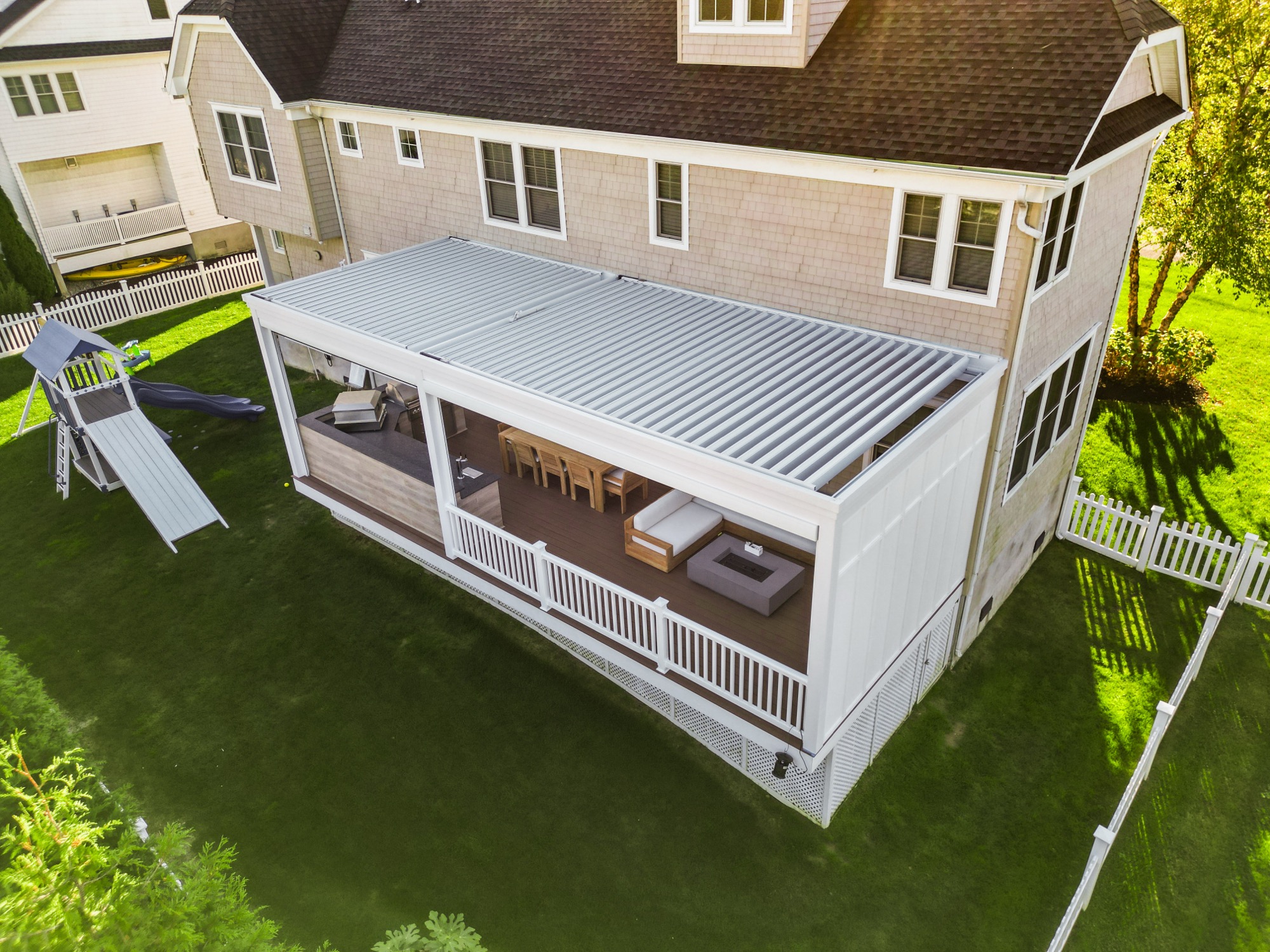
A motorized louvered pergola isn't really an add-on shade device — it's a permanent architectural roof that happens to give you total control over light and rain. The Azenco R-Blade we install opens fully for sun, tilts for filtered light, or seals completely against rain, and it's engineered to a wind rating up to 195 mph, Miami-Dade hurricane certified. It's the option that removes the seasonal decision entirely rather than automating it.
The mechanism itself is straightforward in concept: individual aluminum blades rotate on a shared axis, driven by a single motor, so the entire roof opens, tilts to a partial angle, or seals flat in one continuous motion rather than as a set of independent panels.
Comparison Table: Cost, Coverage, Wind, and Seasons
| System | What It Covers | Wind Approach | Season of Use |
|---|---|---|---|
| Motorized Retractable Awning | Overhead patio shade, retracts fully when not in use | Wind sensor triggers automatic retraction | Spring through fall; typically retracted ahead of storms |
| Motorized Screen Shade | Vertical openings — sun, insect, privacy, or wind mesh | Track-retained mesh, sensor-triggered retraction | Extends an already-covered space into shoulder seasons |
| Louvered Pergola (R-Blade) | Full permanent overhead structure — open, tilt, or seal | Engineered rating up to 195 mph, Miami-Dade certified | Year-round, independent of forecast |
Investment scales the same direction as permanence. Retractable awnings in this market typically run from a few thousand dollars installed to five figures for a large, fully motorized system; screen shades price per opening based on count and mesh type; a louvered pergola is a larger investment because it's a permanent structure, not an add-on — see published pergola pricing for real ranges. None of these numbers are precise quotes — they're a way to think about where a project is likely to land before a design conversation gets specific about your actual opening, mesh choice, or structure size.
Matching the Option to Your Space
If you have an open patio and want seasonal overhead shade without committing to a permanent structure, a retractable awning is usually the right first conversation. If you already have a covered porch or pergola and want to add insect protection, privacy, or wind resistance to the sides, screen shades solve that specific problem. If you're building new, replacing an aging structure, or want a space that performs the same way in July and October without you doing anything, a louvered pergola is the option built for that. Many of our clients end up combining two of the three — a louvered roof overhead with screens closing the sides; browse our project portfolio to see real examples of each combination.
It's also worth asking, before comparing quotes, whether the space in question is one you'll use for a season or one you expect to use for decades — that single question does more to sort these three options than any spec sheet will.
Ask your contractor: is this shade a one-season fix, or a structure you'll still be using in twenty years? The honest answer usually decides which of these three is right for your space.
Frequently Asked Questions
What's the difference between an automatic awning and a motorized screen?
A motorized awning is overhead fabric shade that projects out from the house to cover a patio. A motorized screen is a vertical mesh that drops down to close a side opening. They solve different problems and are often used together rather than as substitutes for one another.
Can I combine a louvered pergola with motorized screens?
Yes, and it's one of the most common combinations we install. The louvered roof handles sun and rain overhead, and screens close the sides for wind, insect, or privacy control, turning the space into a usable room rather than an open patio.
Which automatic sun shade option costs the least upfront?
A standalone motorized retractable awning generally has the lowest entry point of the three. Screen shades price per opening based on count and mesh type. A louvered pergola is the largest investment because it's a permanent architectural structure rather than an add-on shade device.
Do all of these systems work with a smartphone app, or just a remote?
Modern motorized systems typically offer remote, wall switch, and app control, along with wind and sun sensors for automatic response. Exact control options vary by manufacturer and system, so it's worth confirming what's included during your consultation.