Key Takeaways
- Fabric problems (persistent mildew, fading, torn seams) and frame problems (bent arms, a sagging pitch) call for different fixes — diagnose before you repair.
- A motor or wind sensor that no longer responds reliably is usually nearing the end of its service life, not experiencing a one-time glitch.
- When two or more major components fail at once, replacement often costs less over time than a string of repairs.
- Modern motorized awnings — with Somfy motors, wind/sun sensors, and protective cassettes — solve problems an older system was never built to handle.
An awning rarely fails all at once. It fails in stages — a stiffer joint here, a slower motor response there, a mildew stain that won't fully lift no matter how hard you scrub — until one day you're calling around for a repair and the honest answer is that repair isn't really the question anymore. After decades of installing and servicing retractable awnings across the Northeast, we've learned to read those stages early. Here are the seven signs worth watching for, and how to tell which side of the repair-or-replace line you're actually standing on.
Fabric: Fading, Tears, and Mildew That Won't Clean
Fabric is usually the first thing to show its age. Solution-dyed acrylics hold color far longer than printed fabrics, but years of UV exposure still soften the tone, and constant flexing at the roller and seams eventually opens small tears that spread under wind load. The clearest tell, though, is mildew that survives a proper cleaning. If the fabric's water-repellent finish is intact, mold sits on the surface and rinses away. If it's gone, mold takes hold in the weave itself — and no amount of scrubbing brings that finish back.
That distinction matters because it changes what a professional is actually looking for during an inspection. Surface mold rinses off with mild soap and a soft brush, leaving the fabric's texture and color intact. Fabric where the finish has failed often keeps a chalky, faded cast even after cleaning, along with small pinholes or fraying right at the stitch lines — the spots that absorb the most repeated stress every time the awning opens and closes.
Frame: Bent Arms and a Sagging Pitch
Aluminum arms are engineered to hold consistent tension across the full extension of the fabric. When one arm bends, corrodes at a pivot point, or simply loses tension from years of cycling, the whole assembly starts to sag on one side. You'll notice it before you can explain it — the awning just doesn't sit level anymore, or it takes more force to retract than it used to. That's a structural symptom, not a cosmetic one, and it rarely improves with adjustment alone.
Powder-coated aluminum resists most of what Northeast weather throws at it for a long time, but the coating is a shell, not a permanent shield. Once it chips at a joint or a mounting bracket, moisture gets underneath and corrosion spreads from that single point outward. On a frame that's been in service for a decade or more, that kind of localized corrosion is often what's actually behind a pitch that's drifted out of level, even when the arms still look serviceable from a distance.
Motor and Mechanism Failures
Motorized systems add convenience, but the motor and its sensors are also the components most likely to fail outright rather than gradually. A motor that hesitates before responding, a remote that works intermittently, or a wind sensor that no longer triggers automatic retraction before a gust are all signs the electronics are nearing the end of their service life — not a one-time glitch to wait out.
It's worth distinguishing a wiring or connection issue, which a technician can usually resolve on-site, from a motor or circuit board reaching true end-of-life, which can't. The giveaway is consistency: a connection problem tends to be intermittent and repeatable under the same conditions, while a motor nearing failure tends to get progressively slower or noisier over weeks, not days.
Repair or Replace: The Math
A single fabric recover or a motor swap can be a reasonable repair when everything else on the awning is sound. The math changes when two or more major systems — fabric, frame, and motor — are failing at the same time. Retractable awnings in this market typically run from a few thousand dollars installed for a simple manual system to five figures for a large, fully motorized, sensor-equipped setup. Serial repairs on an aging structure can quietly approach that second number without ever delivering a system that performs like one.
Add up a fabric recover, a frame repair, and a motor replacement performed as three separate service calls over two or three years, and the total often lands close to — or past — the cost of a single new system installed correctly the first time, with a fresh warranty on every component instead of a patchwork of ages and unknowns.
Ask your contractor: are we replacing what failed, or are we replacing what's about to fail next? A repair that only answers the first question is a repair you'll likely pay for twice.
What's Changed in Awning Tech
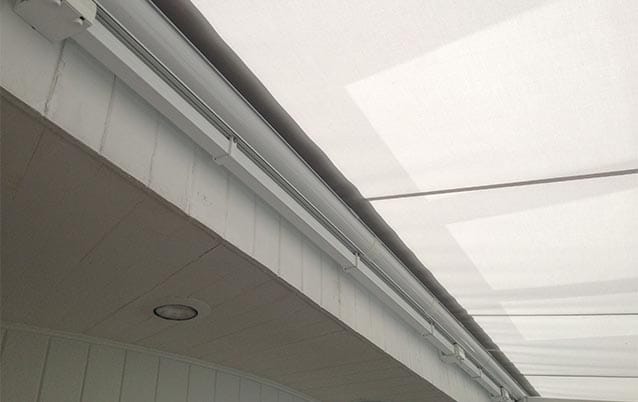
The systems we install today solve problems an older awning was never built to handle. Somfy motors now pair with both wind and sun sensors as standard, retracting automatically before a gust rather than waiting for a remote command. Semi- and full-cassette designs enclose the fabric when it's not in use, cutting down on the UV and moisture exposure that ages older open-frame systems fastest. Across the lines we carry — SummerSpace, Aristocrat's Slim-Fit, Estate, and Manor models, and NuImage — that combination of protected fabric and sensor-driven automation is standard, not an upgrade.
Control has changed just as much as the hardware. Where an older system might offer only a hardwired wall switch, current setups pair a handheld remote with app control and, in many installations, integration into a broader smart-home routine — so the awning responds to weather on its own instead of waiting for someone to notice a storm rolling in.
Getting an Honest Assessment
The fastest way to know which side of the repair-or-replace line you're on is an assessment from the team that installs and maintains these systems every day, not a guess based on how the awning looks from the patio. Breslow services every product it installs for the life of that product, and our team can tell you within one visit whether you're looking at a fabric problem, a frame problem, or a system that's simply reached the end of its useful life. That assessment typically covers the fabric's finish and stitching, the frame's tension and alignment at every arm, and a functional test of the motor, remote, and any wind or sun sensors — the same checklist our team runs on a new installation, just in reverse. If replacement is the right call, our current retractable awning lineup is built to outperform what's coming down.
Frequently Asked Questions
How long does awning fabric typically last before it needs replacing?
Quality solution-dyed acrylic fabric can hold its color and strength for many years with proper care and periodic cleaning, but constant UV exposure and humidity eventually wear down both the color and the water-repellent finish. Once cleaning no longer restores the fabric's look or performance, a recover or a new system typically makes more sense than continuing to treat it.
Can I just replace the fabric and keep my existing frame?
Sometimes. If the frame and motor are structurally sound and compatible with current fabric options, a recover can be a reasonable repair. If the frame is also bent, sagging, or corroded at the pivot points, recovering the fabric only delays a replacement that's already due.
Is it cheaper to repair my awning or replace it entirely?
A single, isolated repair is almost always cheaper upfront. But when fabric, frame, and motor are failing at the same time, the cost of repeated repairs can approach what a new, fully integrated system costs, without ever delivering the performance of one.
Does Breslow service awnings it didn't originally install?
Our team can assess most existing retractable awning systems, though awnings we installed benefit from a full service history on file. Either way, an in-person assessment is the most reliable way to know what you're actually working with.