Key Takeaways
- An awning is a fabric system that retracts out of sight; a louvered pergola is a permanent aluminum structure engineered to stay in place.
- Louvered pergolas shed rain and carry a documented wind rating up to 195 mph, Miami-Dade certified; awnings rely on a sensor to retract before wind becomes a problem.
- Real, published pergola pricing runs from about $65,000 to $190,000–$220,000 or more; awnings occupy a market range from a few thousand dollars to five figures installed.
- Breslow installs and services both categories, so the right recommendation depends on how the space is used, not which product costs more.
Two Different Answers to the Same Sun
An awning and a louvered pergola solve the same basic problem — too much sun, not enough shade — from opposite directions. An awning is a fabric solution: it rolls out when needed and disappears when it isn't, mounted to a wall that already exists. A motorized louvered pergola is a structure: aluminum, engineered, permanent, with louvers that open and close rather than fabric that extends and retracts. Breslow installs both, which means there's no incentive here to steer anyone toward the more expensive option. The honest answer is that each one is right for a different kind of yard, budget, and use case.
This question comes up constantly during design consultations, usually framed as "which one is better." It's the wrong question. A louvered pergola isn't a nicer awning, and an awning isn't a starter pergola — they're built for different relationships with the same patch of sky, and the right answer has more to do with how the space gets used than which product sounds more impressive.
Where a Retractable Awning Wins
Awnings make sense when the goal is shade on demand over an existing patio or deck, without adding a permanent structure to the property. They mount to a wall that's already there, install in a matter of weeks rather than months, and retract completely out of sight when not in use — which matters for anyone who doesn't want a fixed roofline changing the look of the house year-round. For a straightforward deck, a secondary seating area, or a homeowner who isn't ready for a full structural addition, a retractable awning is very often the right call.
Where a Louvered Pergola Wins
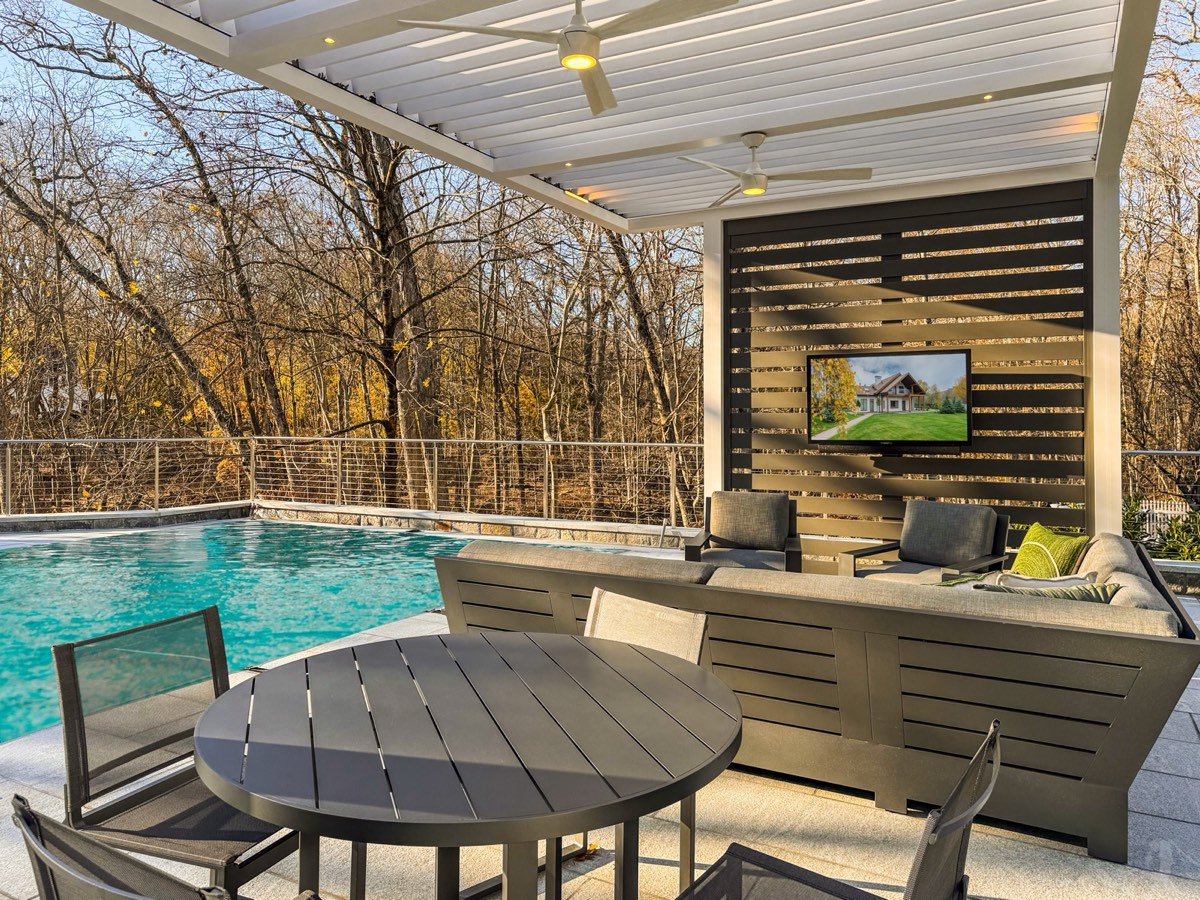
A louvered pergola earns its cost when the goal is a genuine outdoor room rather than seasonal shade. Because the louvers rotate closed, the structure sheds rain instead of just blocking sun — which means it works in a downpour, not only on a bright afternoon. It's also a permanent architectural addition: it can carry lighting, heating, and screens, and it's engineered to a wind and snow load rather than relying on a homeowner to retract it before weather turns. For anyone building toward year-round use — an outdoor kitchen, a covered dining space, a room that gets used from spring through fall — a pergola is doing a different job than an awning was ever built to do.
It's also the answer for homeowners who don't want to think about the weather at all once the structure is in. An awning still asks someone to make a call — retract before a storm, extend when the sun's out. A louvered pergola with a wind sensor of its own simply operates as part of the house, closed against rain and open when the sky allows it, with the permanence of an architectural feature rather than an accessory.
“You get some sunlight in — as opposed to a fixed roof where it just blocks it off completely. But you're always rainproof too.”
— Homeowners, Fairfield County CT · watch real client clips
Cost Comparison
The two categories don't compete on price, and pretending otherwise does buyers a disservice. Breslow's published louvered pergola pricing runs from roughly $65,000 for a compact system up to $190,000–$220,000 for a large multi-bay structure, depending on size, site work, and integrations. Retractable awnings occupy a different budget entirely — this market typically runs from a few thousand dollars installed for a straightforward residential system to five figures for a large, fully motorized, multi-opening installation. Neither number is complete without a look at the actual space, which is why Breslow scopes both categories the same way: a Zoom consultation first, a real number after.
| Factor | Retractable Awning | Louvered Pergola |
|---|---|---|
| Structure type | Fabric, mounted to existing wall | Permanent aluminum structure |
| Rain protection | Retract before rain; not weatherproof extended | Sheds rain with louvers closed |
| Wind behavior | Retracts automatically via wind sensor | Engineered wind rating up to 195 mph, Miami-Dade certified |
| Typical investment | Few thousand to five figures installed | ~$65,000 to $220,000+ depending on scale |
| Best fit | Existing patio or deck, seasonal shade | Year-round outdoor room, kitchens, permanent architecture |
Wind and Weather Ratings
This is where the two categories genuinely diverge. A quality motorized awning is built to retract before wind becomes a problem — the sensor is the safety system, not the fabric. A louvered pergola is engineered to stay in place through it: the Azenco R-Blade Breslow installs carries a wind rating up to 195 mph, Miami-Dade hurricane certified, with both open- and closed-louver ratings documented for a licensed engineer to review. Neither approach is wrong — they're built around different assumptions about how the structure behaves in weather, and both work as designed when installed and used correctly.
Ask your contractor: does this system publish a closed-louver wind rating, or only an open one? A structure that doesn't publish both isn't being fully transparent about how it performs.
How to Decide in One Afternoon
The fastest way to settle this isn't more research — it's a conversation about how the space actually gets used. A few honest questions do most of the work: Is this space used year-round or mainly in warm months? Does the household want a permanent architectural change to the house, or something that disappears when not in use? Is the goal shade, or genuine weather protection that holds up in a downpour? The answers usually point toward one category or the other well before a designer ever draws a line on paper.
A free design consultation, done first over Zoom, walks through the site, the budget range, and what a realistic timeline looks like for either option, with no pressure to land on the more expensive one. Breslow installs and services both categories, which means the recommendation that comes out of that call is based on the yard, not the margin.
Frequently Asked Questions
Is a pergola better than an awning?
Neither is universally better — they solve different problems. An awning is a fabric system that shades an existing patio and retracts out of sight; a louvered pergola is a permanent structure that sheds rain, carries a wind rating, and creates a year-round outdoor room.
Can I have both an awning and a pergola?
Yes. Many properties use both: a louvered pergola over a primary entertaining space and a smaller retractable awning over a secondary window, deck, or seating area that doesn't need a full structure.
Which one handles rain better?
A louvered pergola. Its louvers rotate closed to shed rain, so it continues to protect the space in a downpour. A retractable awning should be retracted before sustained rain or storms rather than left extended.
Is a retractable awning cheaper than a pergola?
Generally, yes. Retractable awnings in this market typically run from a few thousand dollars installed to five figures for large, fully motorized systems. Breslow's published louvered pergola pricing starts around $65,000 and can reach $190,000 to $220,000 or more for large multi-bay structures.