Key Takeaways
- Black and dark bronze are now the two most-requested finishes on new louvered pergolas, chosen for the contrast they create against greenery, stone, and glass.
- Azenco's library of 200+ RAL colors includes multiple true blacks and dark bronzes, all applied as a powder-coat finish engineered for UV and weather resistance.
- Dark colors do absorb more solar heat than light ones, but extruded aluminum dissipates it quickly — the frame itself isn't at meaningfully greater risk than a lighter finish.
- Matte and satin finishes have overtaken high-gloss black for most modern homes, reading as architecture rather than as a painted accessory.
Ask a Breslow designer which finish gets requested most on a new louvered pergola, and for several years running the answer hasn't been a warm cedar tone or an architectural white. It's been black, or its close cousin, dark bronze. Walk a recently finished terrace, rooftop, or pool deck anywhere in the tri-state and the pattern holds: homeowners who once matched a new structure to their existing trim are now choosing something that reads as its own piece of architecture, standing in deliberate contrast to everything around it. It's a shift that shows up in almost every design consultation now, often before a designer even raises the topic of color.
Why Black Won Modern Outdoor Design
The shift tracks a broader move in residential architecture toward black-framed windows, dark standing-seam roofs, and matte-black exterior hardware — details that read as intentional rather than decorative. A pergola sits at eye level and holds that same job outdoors. A light-colored structure tends to recede into the background of a yard; a dark one asserts itself as a built element, the way a steel beam or a window mullion does inside a modern home. For homeowners investing in a permanent structural addition, that presence is often the point: a $75K–$150K structure should look like it was designed on purpose, not selected to blend quietly into the background.
There's also a practical dimension to the trend. A dark structure photographs better against most Northeast landscaping — the deep green of mature trees, the gray of bluestone or travertine, the blue of a pool — which matters to homeowners who plan to entertain in the space and want it to look considered in every season, not just in bright midsummer light.
Contrast: Making the Landscape Pop
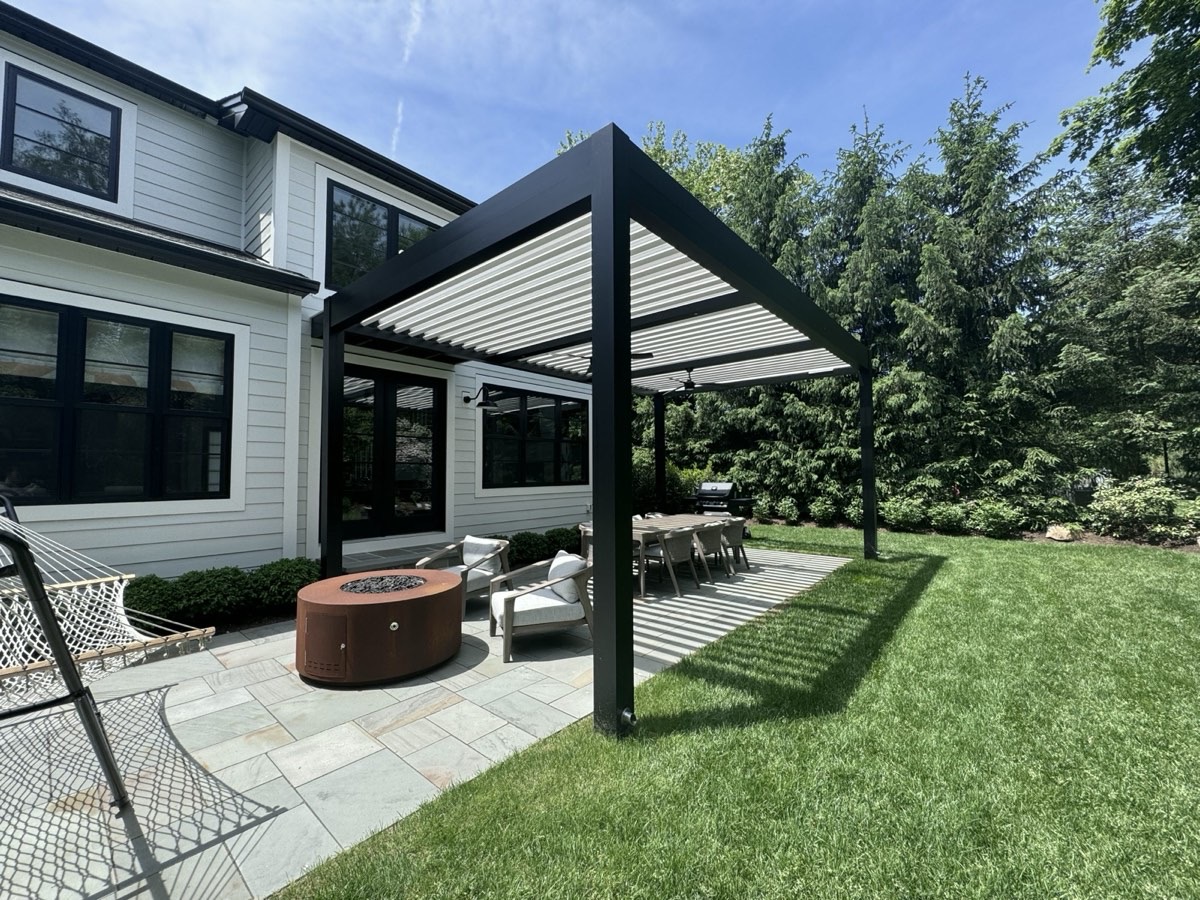
Color theory does a lot of the work here. Greenery, stone, and water all read more vividly against a dark backdrop than a light one — the same reason a black picture frame makes a photograph look sharper than a white mat does. A matte black or dark bronze R-Blade louvered pergola becomes a frame for the landscape around it: the lawn looks greener, the pool looks bluer, and stone paving reads with more depth. Lighter finishes flatten that contrast, blending with the sky and the siding instead of setting the scene apart from it.
Matching Windows and Rooflines
The other driver is simpler: more homes now have black-framed windows, black gutters, and dark roofing to begin with. A structure finished to match those existing sightlines looks like it was designed alongside the house rather than added afterward — which, done well, is exactly the goal of good structural integration. Homeowners building on a transitional or modern home with dark trim increasingly ask for the pergola to disappear into that same palette rather than stand out as a separate, lighter-colored addition.
The Heat Question, Honestly
This is the objection every homeowner raises, and it deserves a straight answer rather than a marketing dismissal. Dark colors do absorb more solar radiation than light ones — that part isn't a myth, it's basic physics. What gets exaggerated is what that means for the structure itself. Extruded aluminum dissipates heat quickly, and the powder-coat finishes used on a quality system are engineered to hold up under direct sun without the surface becoming a functional problem for the frame. In practice, a black structure doesn't require different maintenance or carry a shorter service life than a lighter one. Where the difference is genuinely noticeable is at contact points sitting in full midday sun — a railing cap or handrail, for instance — the same way a black car's hood runs hotter than a white one's. It's a comfort consideration at the margins, not a reason to avoid the finish.
Matte, Satin, and Textured Finishes
Sheen matters as much as color. High-gloss black had a moment years ago and now reads, in current design, closer to patio furniture than architecture. Matte and satin finishes have taken over for a reason: they absorb light rather than reflecting it, which is what makes a structure look like a permanent architectural element instead of a painted accessory. Textured powder-coat options go a step further, adding a fine surface grain that hides fingerprints and minor marks better than a smooth finish does — a practical advantage on handrails and lower posts that get touched constantly. Azenco's library of more than 200 RAL colors includes several true blacks and dark bronzes across multiple sheen levels, which is enough range to match almost any window, roof, or hardware finish already on the house.
Black or Dark Bronze: Choosing Between the Two
The two most-requested dark finishes aren't actually the same color, and the distinction matters more than it looks like on a small sample chip. True black reads as the most modern option — the closest thing to a black-framed window or a matte-black light fixture, and the choice most often paired with clean-lined, minimal-profile homes. Dark bronze sits a shade warmer, closer to an aged iron or dark walnut tone, and tends to read better against brick, stone, and traditional or transitional architecture where a stark black can look slightly out of place. Neither is objectively better; the right one depends on the undertones already present in your roofline, windows, and hardscape, which is exactly why a designer walks the property with samples rather than deciding from a swatch book alone.
Dark Structures in the Portfolio
The projects we've built in matte black and dark bronze span rooftops, pool terraces, and traditional backyard patios alike — proof that the finish works across architectural styles, not just on strictly modern homes. Our project portfolio includes a range of dark-finished structures set against brick, stone, and shingle exteriors, and our custom styles gallery is a useful place to see how the same finish reads differently depending on the home behind it before committing to a color.
Ask your contractor: is this a true powder-coat finish engineered for direct sun exposure, or a standard paint that will chalk and fade within a few seasons?
Color is one of the last decisions in a design process that starts with structure, engineering, and site conditions — but it's the one that determines how the finished pergola actually reads against your house every day. Seeing it against real siding, real stone, and real sky, rather than a sample chip, is worth the extra step before signing off.
Frequently Asked Questions
Does a black pergola get too hot to touch?
Dark colors do absorb more solar heat than light ones, which is basic physics rather than a myth. What's exaggerated is the effect on the structure itself: extruded aluminum dissipates heat quickly, and a quality powder-coat finish is engineered to hold up under direct sun without becoming a functional problem for the frame. The main place it's noticeable is at contact points sitting in full midday sun, similar to a black car's hood running hotter than a white one's.
Will a black finish fade faster than a lighter color?
Fading is primarily a function of finish quality, not color. A genuine powder-coat finish, properly applied, is engineered to resist UV fading and chalking regardless of color. A lower-quality paint finish is more likely to fade over time in any color, black included, which is why it's worth confirming the finish type before comparing color options.
What's the difference between matte black and glossy black finishes?
Matte and satin finishes absorb light rather than reflecting it, which reads as a permanent architectural element rather than a painted accessory — the reason they've largely replaced high-gloss black in current design. Textured powder-coat options add a fine surface grain that also hides fingerprints and minor marks better than a smooth finish, which matters most on handrails and lower posts that get touched often.
Does a black pergola work with a traditional-style home, or only modern homes?
Both. Dark finishes have been installed across rooftops, pool terraces, and traditional backyard patios set against brick, stone, and shingle exteriors, not just on strictly modern homes. The finish creates contrast against landscaping and architecture regardless of the home's overall style, which is why it's worth viewing samples against your own siding and stone before choosing a color.