Key Takeaways
- Clearance and ventilation requirements for any fire feature vary by jurisdiction, fixture, and fuel type — there's no universal number, which is why your designer scopes this during consultation rather than guessing.
- Gas fire features burn cleaner and produce far less smoke, spark, and ember than an open wood fire, making them the more practical choice near or under any covered structure.
- Fire tables — contained, table-height gas features — are the most common and practical fire integration for a covered outdoor room, doubling as furniture.
- Some fire features, particularly larger wood-burning pits, are better designed as a separate zone entirely outside the structure's footprint rather than underneath it.
A fire feature is one of the most requested additions to an outdoor living space, and one of the few where the right answer genuinely depends on the details rather than personal preference alone. Fuel type, fixture design, and where the flame sits relative to a roof overhead all change what's sensible — and getting this wrong isn't a cosmetic mistake, it's a safety one.
Fire and Roofs: The Honest Rules
There's no single number that applies everywhere — clearance and ventilation requirements for a given fire feature depend on the specific fixture, its manufacturer specifications, the fuel it burns, and the code enforced in your particular town. Any source claiming a universal clearance distance for "a pergola" is oversimplifying a question that's genuinely case-by-case. The honest approach is to treat fire placement as an engineering and code question that gets answered for your specific project, not a rule of thumb applied blindly from a blog post or a showroom brochure.
This is worth stating plainly because it cuts against how fire features are often marketed: as a simple accessory that drops into any outdoor room. In reality, the roof material overhead, the structure's clearance dimensions, wind exposure at that specific spot in the yard, and the fixture's own certified specifications all factor into whether a given placement is appropriate, which is exactly why this decision belongs in the design conversation rather than an afterthought once furniture is being selected.
Gas vs. Wood Under a Structure
The fuel type is the first fork in the decision, and it matters more than almost anything else. Gas fire features — fire tables, fire pits, and linear burners — burn cleaner and far more predictably than an open wood fire, producing a contained flame with minimal smoke, no flying sparks, and no drifting embers. An open wood fire, by contrast, throws sparks unpredictably, produces heavy smoke that has nowhere clean to go under a roof, and burns far less consistently in terms of flame height. For any feature near or under a covered structure, gas is generally the more practical and controllable choice; a wood-burning fire is better suited to open ground, away from any overhead structure entirely.
Part of what makes gas the more practical choice under cover is how predictable it is to operate. A gas feature ignites and extinguishes on command, holds a consistent flame height, and doesn't require managing embers after the fact the way a wood fire does — all of which matters more, not less, when there's a roof structure and furniture in close proximity rather than open sky above.
| Consideration | Gas Fire Feature | Wood-Burning Fire |
|---|---|---|
| Smoke output | Minimal, clean-burning | Significant, and directional depending on wind |
| Sparks and embers | None — contained flame | Common, can drift with wind or airflow |
| Flame control | Adjustable, consistent, easy to extinguish | Variable, harder to control or extinguish quickly |
| Best placement | Can often be integrated near or under a covered structure, per code and manufacturer specs | Best suited to open ground, away from any roof or overhead structure |
Clearances and Ventilation (General)
Whatever the fuel type, any fire feature needs open-air ventilation and a clearance zone that the manufacturer specifies for that exact product, informed by local code. This is precisely the kind of detail that changes fixture to fixture and town to town, so it's not something to guess at from a general guide — it's something your Breslow designer scopes exactly during your consultation, working from the manufacturer's documentation and whatever your jurisdiction requires. Where a gas line needs a permit, Breslow handles or assists with that process as part of the overall project.
Fire Tables: The Practical Favorite
For most covered outdoor rooms, a gas fire table is the feature that shows up most often, and for good reason. Contained at table height, it functions as both a heat source and a piece of furniture, works naturally into a seating or lounge arrangement, and carries a meaningfully lower ember and spark risk than an open pit. It's the fixture that tends to make the most sense integrated directly into a lounge zone under a covered structure, precisely because the flame is contained rather than open.
When Fire Belongs Outside the Footprint
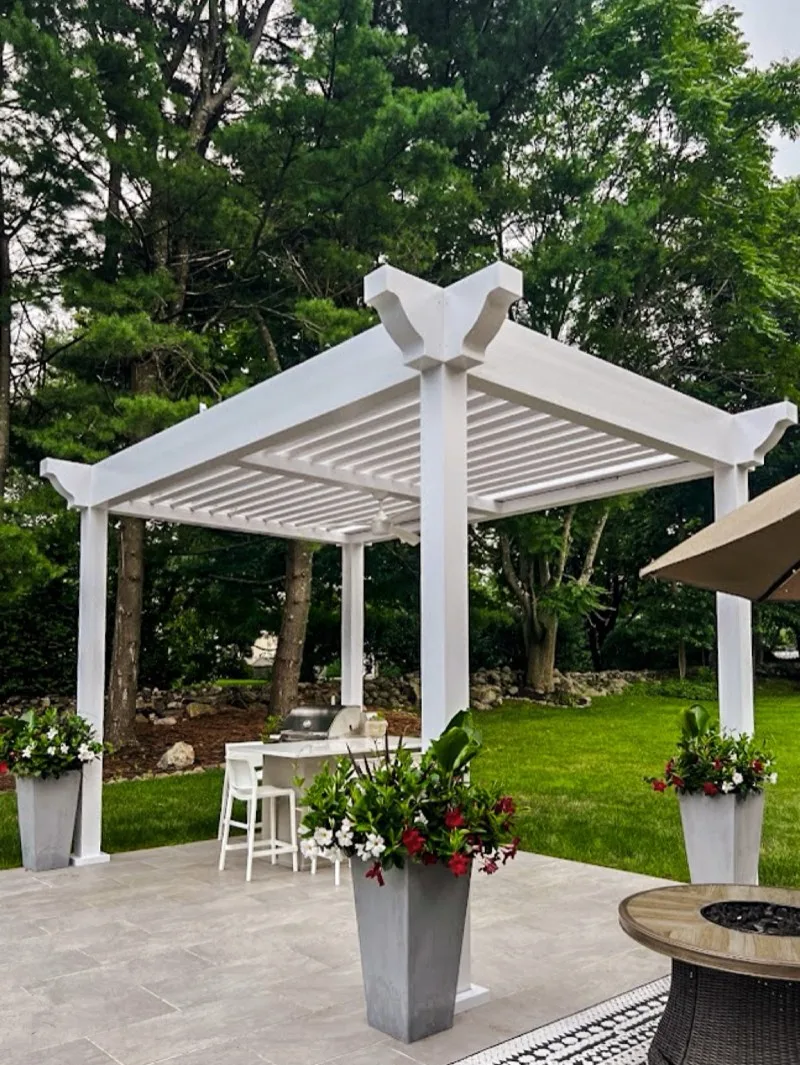
Not every fire feature belongs under a roof, and that's a legitimate design outcome, not a compromise. A larger wood-burning fire pit, or any open-flame feature a homeowner specifically wants, is often better designed as its own gathering zone entirely outside the structure's footprint — an open patio or lawn area a short distance away, built as a second destination on the property rather than squeezed under the same roof as the dining or lounge area. On estate-scale projects, this often means designing two distinct zones: a covered, all-weather living space, and a separate open-air fire zone nearby.
There's a design upside to this separation beyond safety. Two distinct gathering spots, a covered dining and lounge room and an open fire lawn a short walk away, give a property two genuinely different evening experiences rather than one space trying to be both at once. Guests naturally migrate between them over the course of an evening, which is often a better outcome than compressing every function into a single footprint.
Ask your contractor: "What are this specific fixture's manufacturer clearance requirements, and has that been checked against local code for my property?" If the answer is a generic rule of thumb, keep asking.
Design It Safe From Day One
Fire features work best when they're part of the initial design conversation, not decided after the structure is already built. Bringing it up during your first design consultation lets placement, gas line routing, and clearance be engineered into the plan alongside everything else, rather than treated as an afterthought squeezed in wherever there happens to be room.
Frequently Asked Questions
Can you put a fire pit under a pergola?
It depends on the fire feature and fuel type. Gas fire features, especially contained fire tables, are generally the more practical option near or under a covered structure, while larger wood-burning fire pits are often better sited as a separate zone outside the roof's footprint due to smoke, sparks, and embers.
Is a gas fire table safer than a wood fire pit under a roof?
Gas fire features burn cleaner and produce far less smoke, spark, and ember output than an open wood fire, which is why they're generally the more practical choice in proximity to any overhead structure. Clearance requirements still apply and vary by fixture and jurisdiction.
What clearance does a fire feature need from a pergola roof?
Clearance requirements vary by the specific fire feature, its manufacturer specifications, fuel type, and local code, so there's no single universal number. This is exactly the kind of detail a designer scopes during your project consultation rather than something to guess at.
Do I need a permit for a gas fire feature?
Gas line work for a fire feature often requires a permit, and where permits are needed, Breslow handles or assists with the process as part of the overall project scope.