Key Takeaways
- An uncovered hot tub is exposed to rain, snow, leaves, and sun that degrade water chemistry and covers faster — a roof structure protects the investment as much as it improves comfort.
- A motorized louvered roof like Breslow's R-Blade™ can open to vent steam and close to block rain, snow, or wind — a real advantage over a fixed solid roof in a spa application.
- Motorized screens with concealed motors and tracks add privacy for soaking without visible hardware cluttering the structure.
- Hot tubs are a genuinely four-season feature in the Northeast, and pairing one with a covered, screened structure extends comfortable use well beyond summer.
A hot tub sitting fully exposed on an open patio works, technically, but it's rarely the version anyone pictures when they imagine using it. Steam rising into cold night air, privacy from the yard next door, somewhere for a towel that isn't soaked by the next rainstorm — these are design problems, and they're solved by the structure above the water, not the water itself.
Why Spas Want a Roof
An uncovered hot tub or pool spa is at the mercy of whatever the sky is doing. Rain and snow add unwanted water and debris, direct sun degrades vinyl covers and accelerates chemical breakdown in the water, and falling leaves turn a five-minute skim into a daily chore. A structure overhead changes all of that, and it does something else just as valuable: it makes the spa read as a designed part of the property rather than an appliance dropped onto a patio slab.
There's also a comfort argument that has nothing to do with maintenance. Stepping in and out of hot water in direct sun or cold wind is a different experience than doing it under cover, where the transition between the water and the towel doesn't involve fighting the weather. That's a small thing on paper and a significant one in practice, especially for a feature meant to be used regularly rather than occasionally.
Steam, Ventilation, and Louvers
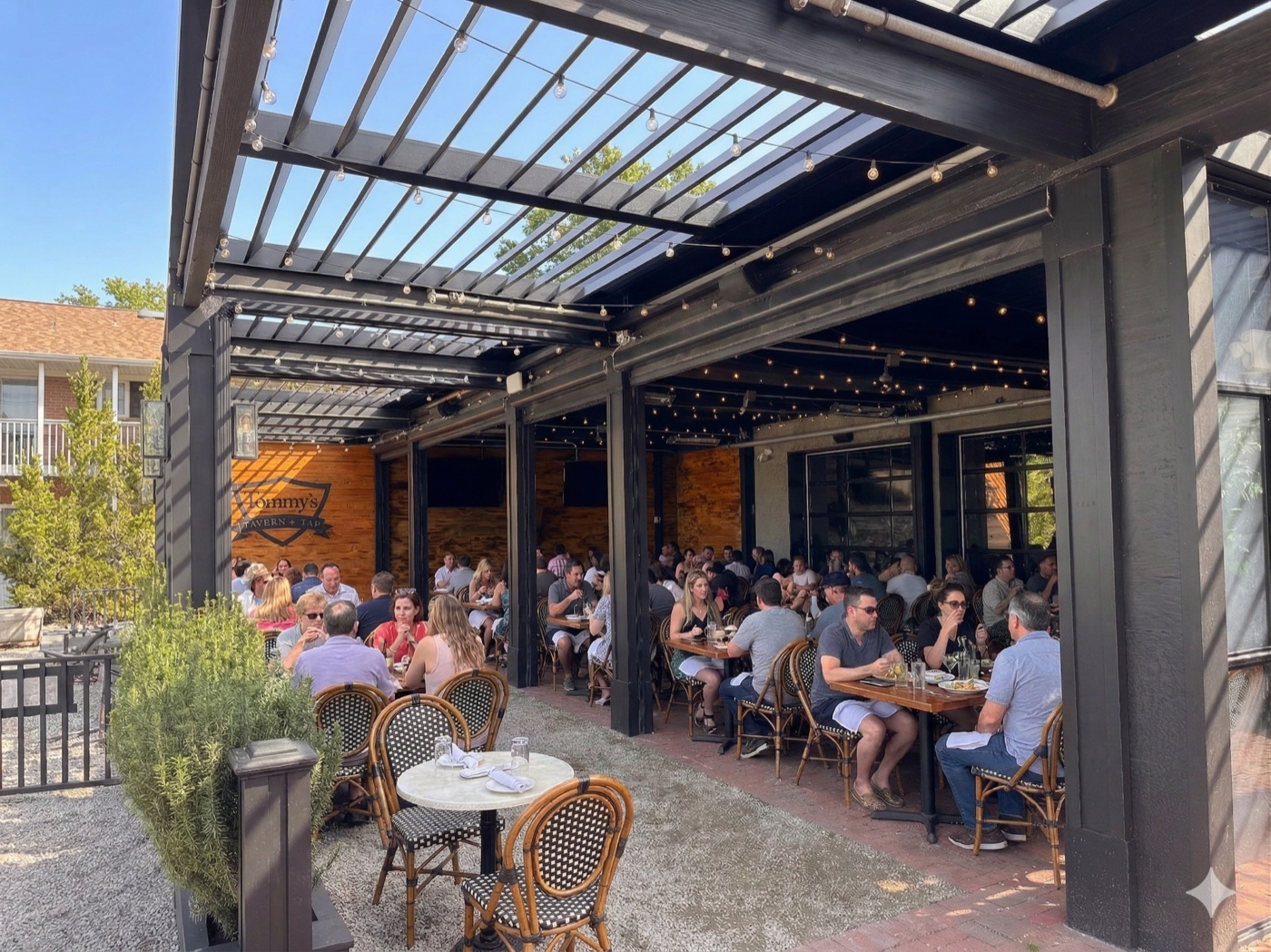
Anyone who has stepped into a hot tub on a cold evening knows the steam rising off the water needs somewhere to go. Under a fixed, solid roof, that moisture has nowhere to escape and can linger as condensation on the underside of the structure. A motorized louvered system like Breslow's R-Blade solves this directly — the louvers can be opened to let steam and humidity vent naturally, then closed again once you're out of the water, or when rain, snow, or wind moves in. That flexibility, opening for ventilation and closing for weather protection on the same structure, is one of the clearest practical arguments for an adjustable roof over a fixed one in any wet-zone application.
This is a case where the fixed-versus-adjustable decision has a genuinely correct answer rather than a matter of taste. A solid roof over a hot tub either traps moisture against its underside indefinitely or requires supplemental ventilation to compensate; a louvered roof handles the same problem simply by opening. It's one of the clearest examples of a structure earning its cost through function rather than looks alone.
Privacy Screening for Soaking
Few outdoor activities call for privacy the way soaking in a hot tub does, particularly on properties with neighboring sightlines, elevated decks, or pool areas visible from the street or an adjacent yard. Motorized screens, built around Breslow's concealed-motor and hidden-track approach, can be integrated directly into the sides of the structure to close off sightlines on demand, without leaving visible hardware bolted to the posts when the screens are open. That's a meaningfully different result than a permanent lattice or fence panel, which commits to blocking the view whether you want it blocked or not.
The flexibility matters as much as the privacy itself. A family that wants an open view of the yard during the day and full screening for an evening soak gets both from the same structure, rather than choosing one compromise and living with it year-round.
Four-Season Spa Culture
A hot tub is one of the few outdoor features that genuinely gets more use in the cold months than the warm ones — there's a particular appeal to soaking outside while snow is falling that a summer pool simply doesn't replicate. Pairing that four-season use case with a structure that provides shelter, ventilation, and privacy screening turns an occasional-use feature into something a household actually relies on from October through April, not just June through August.
This is also where a shared structure earns its keep across the calendar. The same roof sheltering summer pool lounging can close and screen off a winter spa session, which means the investment in the structure itself serves the property in every season rather than sitting idle for half the year.
Poolside Placement Principles
Placement relative to the pool matters as much as the structure itself. A roof positioned to provide afternoon shade over lounge seating serves a different purpose than one built directly over a spa meant for evening use, and the two don't always belong in the same spot. Proximity to a changing or lounging structure, such as a cabana, is worth planning alongside the spa itself so the whole pool zone functions as one connected space rather than a scattering of separate features. Material choices near chlorinated or saltwater pools also deserve attention — corrosion-resistant hardware and finishes hold up better than standard fixtures in a chemically active, frequently wet environment.
Setback from the water's edge is also a practical site consideration, both for safety around the pool deck and for keeping footings clear of pool equipment, plumbing, and the deck's own structural requirements. This is exactly the kind of detail a Matterport measurement visit is built to catch before design finalizes anything.
Ask your contractor: "Can the roof over my spa open for steam ventilation and close for weather, and how is the screening integrated for privacy?" A fixed, solid roof with no screening plan answers neither question well.
Wet-Zone Projects
Pool and spa zones are among the most site-specific projects Breslow designs, because placement, ventilation, privacy, and materials all have to be solved together rather than one at a time. The portfolio reflects that range of estate pool and spa integrations, and every one of them started with the same first step: a conversation about how the space actually gets used, at what time of day, and in what season.
Frequently Asked Questions
Should a hot tub be covered by a pergola?
Covering a hot tub protects it from rain, snow, falling leaves, and constant sun exposure, all of which degrade water chemistry and cover materials faster than a sheltered spa experiences, while also making the space more comfortable to use in more weather.
Does steam from a hot tub cause problems under a roof?
It can under a fixed solid roof, where rising steam and moisture have nowhere to go. A motorized louvered roof, like Breslow's R-Blade, can be opened to vent steam and closed again for rain, wind, or privacy, which is one of the practical advantages of an adjustable system over a fixed one.
How do you add privacy to an outdoor hot tub area?
Motorized screens with concealed motors and tracks can be integrated into the structure around a hot tub or pool zone, providing privacy from neighboring sightlines without adding visible hardware to the architecture.
Can a hot tub be used year-round under a pergola?
Yes. Hot tubs are naturally a four-season feature in the Northeast, and pairing one with a covered, screened structure extends comfortable use into the colder months significantly compared to an uncovered spa.