Key Takeaways
- Motorized screen pricing depends mainly on opening size and count, mesh type, and whether the tracks and motor are concealed or surface-mounted.
- Concealed motors and tracks — Breslow's differentiator — generally cost more than surface-mounted systems because the screen has to be designed into the structure, not bolted on afterward.
- Mesh isn't one-size-fits-all: sun, privacy, insect, and wind-rated meshes solve different problems and are often mixed across openings on the same project.
- New-build integration is more straightforward than retrofitting an existing structure, though both are possible.
What Drives Motorized Screen Pricing
There's no published Breslow price list for motorized screens, and honestly, there shouldn't be — the variables move too much project to project. In this market, motorized retractable screen systems typically run from a few thousand dollars installed for a single opening up to five figures for a fully integrated, multi-opening system with concealed motors and premium mesh. Where your project lands in that range comes down to a handful of concrete factors, not guesswork.
The number of openings and their size is the biggest driver — a single 10-foot opening is a different project than screening four sides of a pergola. Mesh selection, motor and track concealment, and integration with an existing or new structure all move the price from there. Reviewing the category overview at /motorized-screens/ is a good starting point before a consultation, since it lays out the range of what's possible before you're pricing a specific opening.
Concealed vs. Surface-Mounted Systems
This is the single biggest price and appearance variable in the category. Surface-mounted screen systems bolt the track and motor housing onto the face of a beam or post — functional, but visible, with hardware you see every time you look up. Concealed systems recess the tracks into the structure itself and hide the motor within the post or beam, so the screen simply appears to retract into the architecture with no visible mechanism at all.
Concealed integration is Breslow's differentiator in this category, and it costs more for a straightforward reason: it has to be engineered into the structure from the design stage, not added as an afterthought once the pergola or porch is already built. The payoff is a cleaner sightline — no track rails, no motor boxes, nothing breaking up the architecture.
The cost gap between the two approaches isn't really about the screen fabric or the motor itself — those components can be similar either way. It's about labor and design time: concealed tracks mean routing conduit and recessed channels through the structure during fabrication, coordinating with the structure's engineering, and planning access for future service without exposing hardware. Surface-mounted systems skip most of that coordination, which is exactly why they cost less and show more.
Ask your contractor:
"Will the screen tracks and motor be visible once installed, or are they recessed into the structure? Ask to see a finished example, not just a rendering — the difference is obvious in person."
Mesh Choices: Sun, Privacy, Insects, Wind
Mesh selection is where function gets specific:
- Solar mesh reduces glare and heat gain while preserving a partial view through the weave — useful on west-facing openings that catch afternoon sun.
- Insect mesh is a finer weave focused specifically on keeping bugs out while maximizing airflow and visibility.
- Privacy mesh is denser, reducing sightlines from a neighboring property, a street, or a pool deck — an increasingly common request on tighter suburban lots.
- Wind-rated mesh pairs a reinforced weave with stronger track retention, worth prioritizing on exposed decks, elevated terraces, or coastal properties where wind load on a screen is a real structural consideration, not a comfort issue.
Many projects mix mesh types across different openings on the same structure — solar mesh on the sun-exposed side, insect mesh where airflow matters more, privacy mesh facing a neighbor. That flexibility is part of what a proper design consultation works out before anything is ordered.
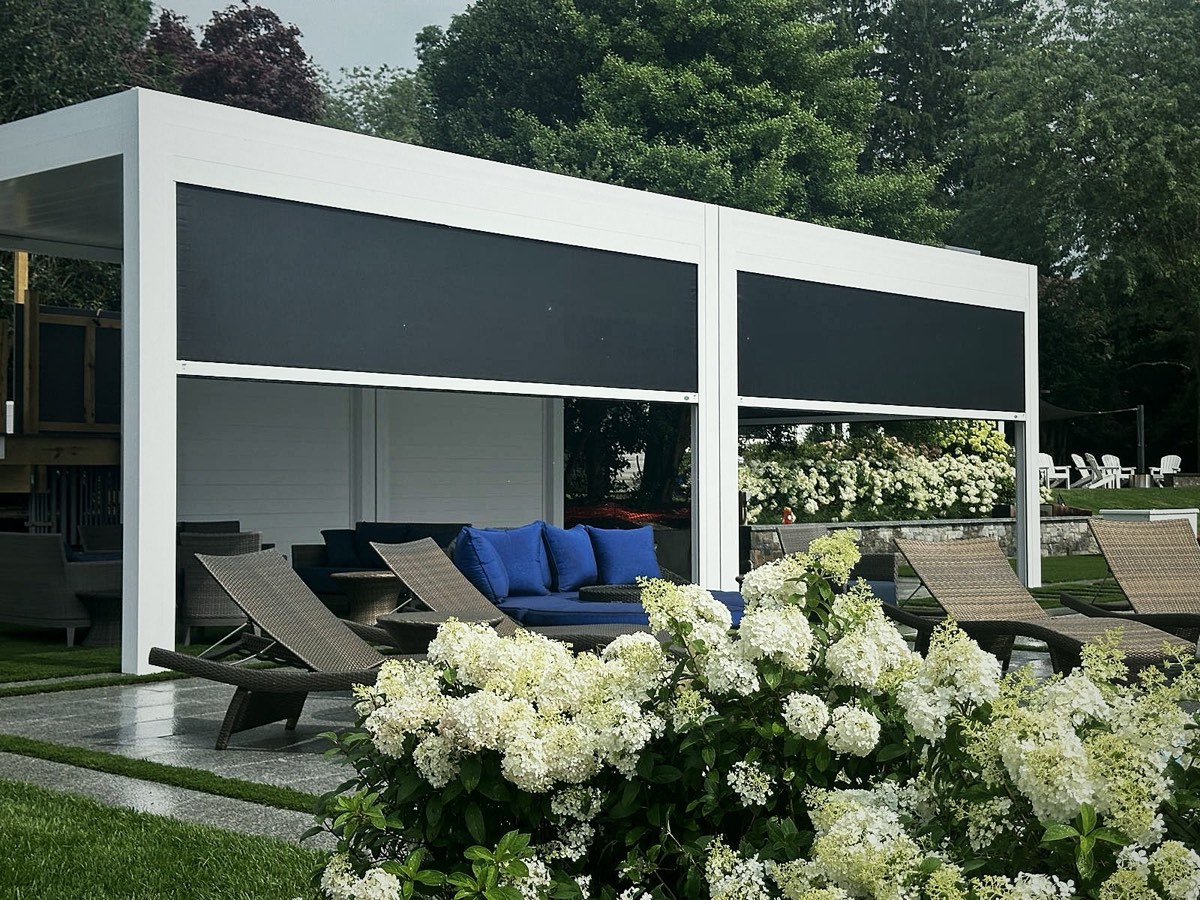
Integrating Screens Into a Pergola
Screens do their best work paired with a motorized louvered roof rather than standing alone. Under an Azenco R-Blade, screens handle the vertical plane — wind, insects, low sun, privacy — while the louvers handle the roof plane above. Designed together, the result is a space that can go from fully open to fully enclosed without adding a single piece of visible hardware to the architecture. Designed separately, or added years apart, the same result is possible but usually costs more and looks less resolved.
See examples of pergolas and screens designed together in our portfolio.
| Factor | Lower cost | Higher cost |
|---|---|---|
| Openings | Single opening, modest width | Multiple openings, wide spans |
| Mounting | Surface-mounted track/motor | Concealed tracks and motor within structure |
| Mesh | Standard insect or solar mesh | Premium privacy or wind-rated mesh |
| Timing | Designed in at new build | Retrofit onto an existing structure |
New Build vs. Retrofit
Concealed screens are most straightforward to achieve when they're part of a new structure's design from day one — the posts and beams are built with the recessed track and motor cavity already accounted for. Retrofitting screens onto an existing pergola or porch is possible, but depending on the original construction, it may mean surface-mounted hardware instead of full concealment, or some structural modification to create room for a concealed track. Neither is a dead end — it's simply a detail your designer needs to see the existing structure to answer accurately.
If you're planning a new pergola and think screens might be in your future even if not on day one, it's worth raising during the design consultation regardless. Building in the recessed track cavity from the start — even if the mesh and motor go in later — is far less disruptive than opening up a finished structure down the road.
Scoping Your Openings
The only way to turn any of this into a real number is to look at your actual openings — their width, height, sun exposure, and whether they're part of a new structure or an existing one. That's exactly what a Zoom design consultation covers: walk the space (or share it over video), talk through mesh and mounting options, and leave with a realistic range before anything is ordered. From there, most projects install in 4 to 6 weeks, with 3 to 5 days on site.