Key Takeaways
- Motorized patio screens roll open and closed by remote, wall switch, or app, converting an open structure into an enclosed room in seconds without permanent walls.
- Mesh options are chosen by need — sun control, insect protection, privacy, or wind resistance — and can be combined within one opening.
- Breslow's install differentiator is concealed motors and recessed tracks, hidden inside the structure rather than bolted to its surface.
- Screens integrate into new R-Blade™ pergolas at the design stage or retrofit onto existing patios and porches, installed by Breslow's own crews.
A patio with a roof over it solves half the weather problem. The other half — wind, insects, low afternoon sun, and the neighbor's sightline — is what motorized screens are built to close off, without turning an open structure into a permanently enclosed room. Done well, a motorized screen system disappears when it's not needed and does real work the moment it's deployed.
What Motorized Screens Actually Are
Motorized screens are retractable mesh panels, mounted at the openings of a pergola, porch, or patio structure, that roll up into a housing when not in use and roll down to close the opening on command. Unlike a fixed screen panel, which is either installed or it isn't, a motorized screen is a variable: open for airflow and an unobstructed view, closed for insects, wind, low sun, or privacy, adjusted in seconds from a remote, a wall switch, or an app.
Breslow installs motorized screens as part of new R-Blade™ pergola projects and as standalone additions to existing structures — the mechanics are the same either way, but the mounting approach differs, which we cover below.
Most homeowners come to motorized screens after living with a structure for a season or two and noticing exactly where the gaps are: the side that catches the evening breeze and every mosquito with it, the opening facing the neighbor's patio, the west wall that turns dinner into squinting through glare at six o'clock. Screens are a targeted answer to a specific, already-identified problem, which is why they're just as often added a year after a pergola is built as they are specified on day one.
Mesh Types and What Each Solves
Not every opening needs the same mesh, and most quality systems let different meshes be specified per opening within a single project.
| Mesh Type | Primary Purpose | Best Suited For |
|---|---|---|
| Insect mesh | Keeps bugs out while preserving airflow and sightlines | Dining and lounge openings used at dusk |
| Solar/sun mesh | Reduces glare and heat gain from low-angle sun | West- and south-facing openings |
| Privacy mesh | Reduces visibility from outside while allowing airflow | Openings facing neighboring properties or the street |
| Wind-rated mesh | Holds tension and resists billowing in exposed conditions | Elevated patios, waterfront, and open exposures |
Many projects mix two or three of these across different openings of the same structure — solar mesh on the sun-exposed side, insect mesh facing the yard, privacy mesh toward the property line.
Concealed Motors and Tracks: The Difference
This is the detail that separates a well-integrated system from an obvious add-on. Many motorized screens on the market use a visible motor tube bolted to the face of a beam and exposed tracks running down the outside of each post. It works, but it reads as hardware attached to the structure rather than part of it.
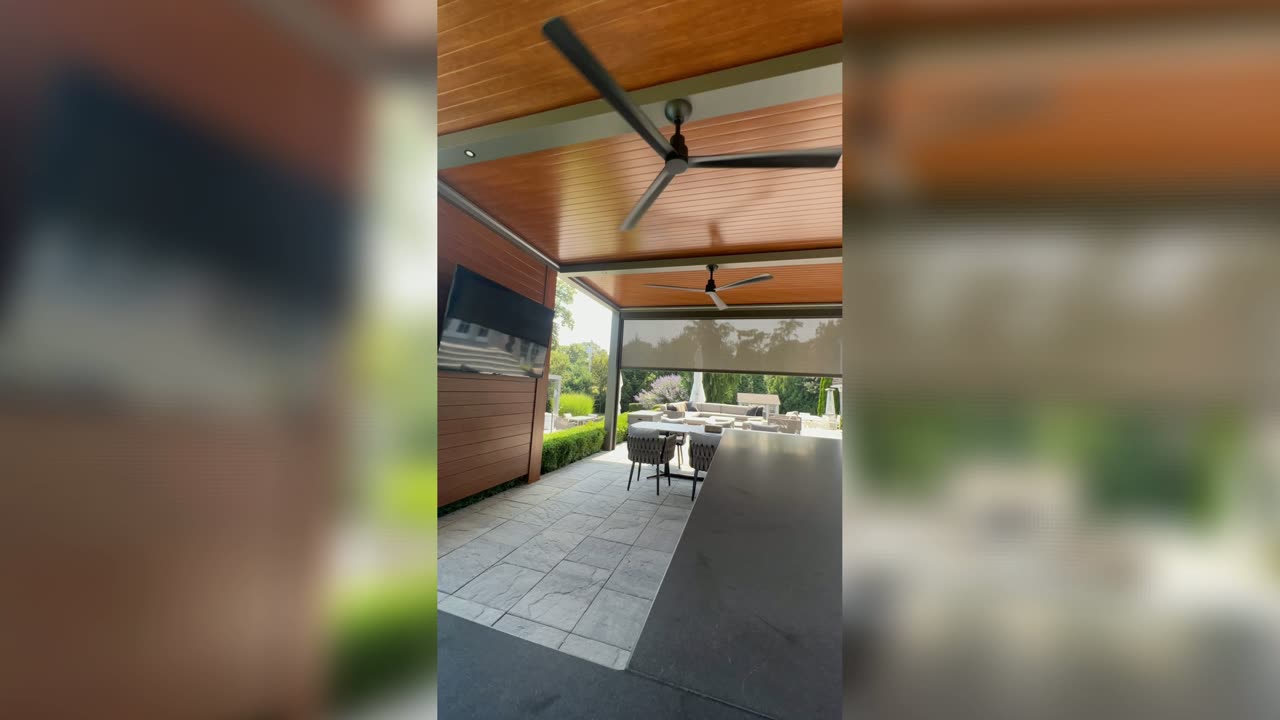
Breslow's approach conceals the motor housing inside the structural beam and recesses the tracks into the posts themselves, so the screen rolls into the architecture rather than in front of it. When the screen is open, there's nothing visible to bolt-on; when it's closed, only the mesh itself shows. We cover this in more depth in our motorized screens overview.
Integrating with Pergolas and Porches
New-construction R-Blade™ pergolas can have screen channels designed into the extrusion from the start, which is the cleanest possible integration — the structure and the screen system are engineered together. Existing porches and patios don't have that advantage, but they're not excluded: Breslow custom-fabricates mounting brackets and housings sized to the existing framing, keeping the hardware as unobtrusive as the structure allows.
The number of openings matters as much as the structure type. A single-bay pergola might only need one or two screened sides, while a larger multi-bay structure or a wraparound porch can call for screens on every opening, each sized independently and each capable of operating on its own schedule rather than as one all-or-nothing system.
Controls and Automation
Every motorized screen we install runs off a remote at minimum, with wall-switch and app control available depending on the project's broader automation. Sensor automation is where the system starts protecting itself: wind and rain sensors can retract screens automatically in weather that would otherwise stress the mesh or the motor, rather than relying on someone remembering to bring them in before a storm.
For projects that already have a broader smart-home or lighting automation plan, screen control typically joins the same app and the same scenes — a single "evening" setting can lower screens, dim lighting, and bring up heat together, rather than treating each system as its own separate remote to hunt for.
What Quality Installation Looks Like
Screens are only as good as the opening they're measured for. Quality installation starts with precise measurement of each opening — width, height, and any irregularity in an existing structure — followed by custom fabrication rather than a stock-size panel forced to fit. Breslow's own crews handle installation, typically three to five days on-site for a full structure once the project is scheduled, four to six weeks out from order confirmation. No subcontractors move through the job; the same crew that measures is accountable for the fit.
Fabrication happens in-house as well, which matters more than it sounds like it should. A screen system built from Breslow's own steel and aluminum fabrication capability is sized to the exact opening rather than adapted from a limited catalog of stock widths, and any adjustment discovered on-site can be resolved by the same team that built the parts, not routed back through a separate supplier.
Ask your contractor: can an individual screen panel be serviced or replaced without disassembling the track system around it?
A screen system built into the structure, serviced by the company that installed it, tends to stay invisible in the best sense — there when you need it, gone when you don't, and never the reason a project looks unfinished. If you're scoping openings for a new or existing structure, schedule a Zoom consultation and we'll walk through mesh and mounting options together.
Frequently Asked Questions
What are motorized patio screens?
Motorized patio screens are retractable mesh panels mounted to the openings of a pergola, porch, or patio structure. They roll up into a housing when open and close on command from a remote, wall switch, or app, turning an open-air structure into an enclosed room without permanent walls.
Can motorized screens handle wind and rain?
Wind-rated mesh options are built to hold tension in exposed locations, and many systems include wind and rain sensors that automatically retract the screens in weather that could stress the mesh or motor, rather than relying on manual reaction time.
Can motorized screens be added to an existing patio or porch?
Yes. While new-construction pergolas can have screen channels engineered into the structure from the start, existing porches and patios can be retrofitted with custom-fabricated mounting brackets and housings sized to the existing framing.
What's the difference between concealed and surface-mounted screen systems?
Surface-mounted systems bolt a visible motor tube and exposed tracks to the outside of the structure. Concealed systems house the motor inside the beam and recess the tracks into the posts, so the hardware disappears into the architecture rather than sitting on top of it.