Key Takeaways
- Radiant infrared heat warms people and surfaces directly, not the surrounding air — which is why it works outdoors where a furnace approach never could.
- Breslow installs radiant heating from Bromic and Infratech, selecting the model and configuration based on the space, not a single default.
- Electric infrared mounts cleanly under a roof with no venting; gas infrared often delivers more output but needs its own gas line and clearance planning.
- Heating is most effective when designed alongside the structure it mounts to, with zoning and controls planned from the start rather than added later.
Why Radiant Heat Changed Outdoor Rooms
Outdoor heating used to mean a freestanding propane column parked at the edge of a patio, heating mostly the air around it and losing most of that warmth to the wind within a few feet. Radiant infrared heat works on a completely different principle: it warms people and surfaces directly, the same way sunlight does, rather than trying to heat the open air around them. That's why a mounted infrared heater under a roof can make a genuinely comfortable seating area on a 45-degree evening, in a way ambient heating never reliably could outdoors.
Once a structure has a roof to mount to — a covered patio, a motorized louvered pergola — radiant heat stops being an accessory and becomes part of the room's actual design, planned in from the start rather than bolted on as an afterthought.
The Brands We Install and Why
Breslow installs radiant infrared heating from Bromic and Infratech. Both are established manufacturers with a real track record in outdoor and commercial heating applications, and we specify between them based on the specific project — mounting configuration, coverage area, aesthetic, and whether electric or gas fits the space better. We don't default to one brand across every project; the right heater depends on the room, not the catalog page.
Electric vs Gas Infrared
Electric infrared heaters run off a dedicated electrical circuit, need no gas line or venting, and turn on instantly at the flip of a switch or a remote command — which makes them a clean fit for mounting directly under a finished roof structure where you don't want visible gas lines. Gas infrared units typically deliver more total heat output per fixture and can be the better call for larger or more open areas, but they require a gas line run to each unit and, depending on the model, some clearance for venting.
Neither is universally better. The right choice comes down to your utility access, how the structure is built, and how much heat output the space actually needs.
| Factor | Electric infrared | Gas infrared |
|---|---|---|
| Utility required | Dedicated electrical circuit | Gas line to each fixture |
| Startup | Instant, switch or remote | Instant, may involve pilot/ignition |
| Mounting | Clean, no venting needed | May need venting clearance |
| Typical use case | Roof-mounted, defined seating zones | Larger or more open areas |
Retrofitting the wrong type into an existing structure is the mistake to avoid — if the gas line isn't already run to a location, converting from electric to gas after the roof is finished is a materially bigger job than deciding up front.
Ask your contractor:
"Where exactly will each heater mount, and what clearance does it need from the roof structure and any nearby seating? If that hasn't been mapped to my actual layout, the heater count is a guess."
“For the two end heaters, I keep them on the high setting… it's more than adequately hot. Sometimes it's almost too hot.”
— Homeowners, Norwood NJ · watch real client clips
Mounting and Clearances Under a Roof
Mounting a heater to the underside of a structure isn't as simple as picking a spot and drilling — clearance to combustible materials, distance from seating, and the structure's own wiring or beam layout all factor into where a fixture can actually go. This is exactly why heating gets planned during structure design rather than after installation: retrofitting electrical or gas runs into a finished roof is a far more disruptive fix than routing them in during the build.
Zoning and Smart Controls
Larger outdoor rooms rarely need every heater running at once — a dining zone might warrant full heat on a cool night while a lounge area a few feet away stays comfortable with less. Zoning heaters to separate circuits, paired with remote or app-based controls, lets you run only what the moment calls for instead of heating the whole space uniformly regardless of where people actually are.
The Months You Get Back
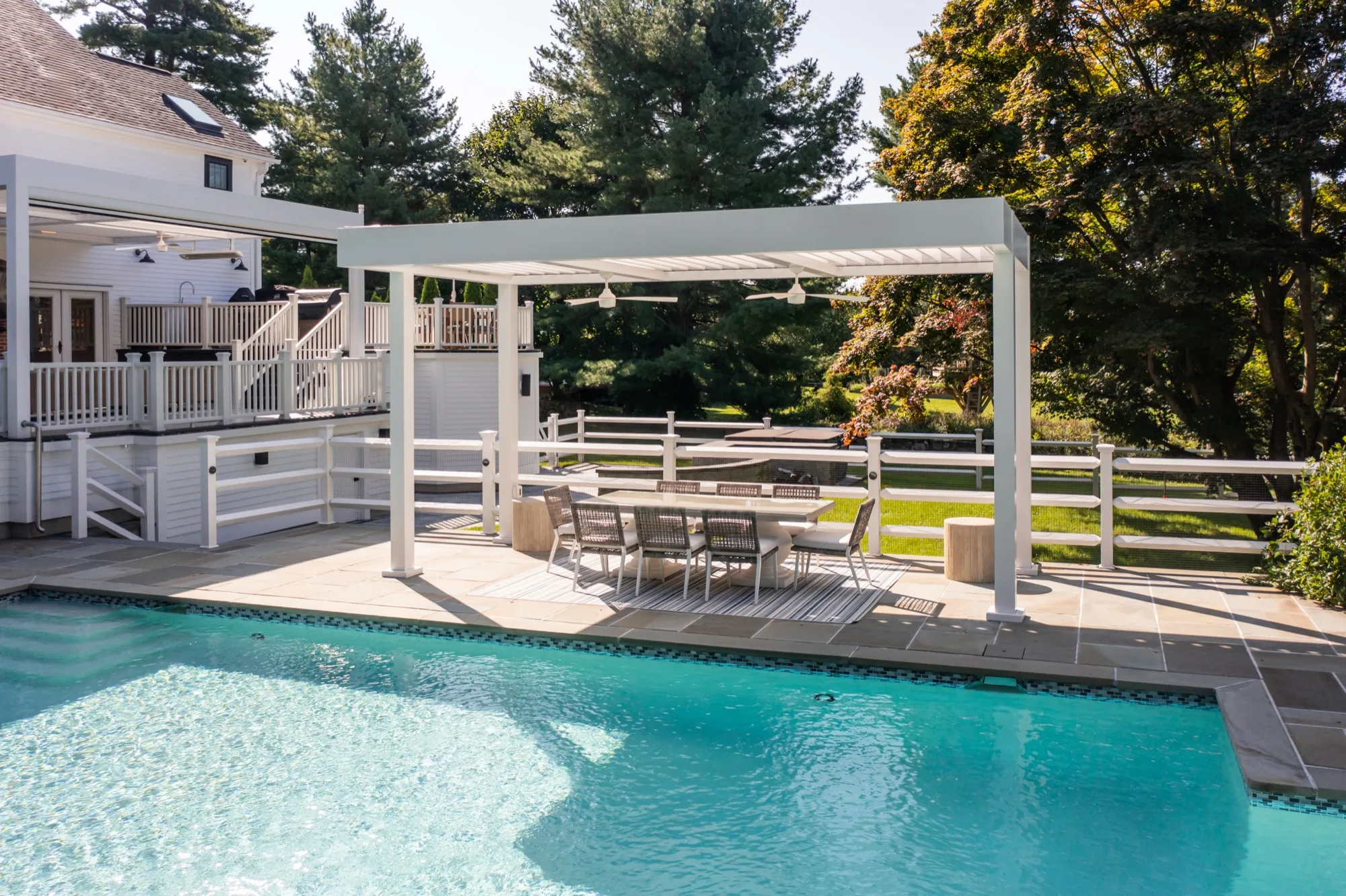
The honest case for outdoor heating isn't novelty — it's calendar math. A patio or covered structure that's only comfortable from June through August is unused for most of the year in this climate. Add properly planned radiant heat and the same space extends comfortably into fall evenings and, for many clients, well into spring. Paired with a structure like an R-Blade motorized louvered pergola that can close its roof against wind and precipitation, heating is one of the more direct ways to turn a three-month space into something closer to year-round use.
None of this works well as an afterthought. Heaters retrofitted onto an existing patio after the fact usually end up compromised — mounted where the electrical happened to be easiest, not where the seating actually is. Heating planned alongside the structure, the layout, and the kitchen (if there is one) gets to sit exactly where it's needed, at the fixture count the space actually calls for. Browsing finished structures in our portfolio is a useful way to see how heating gets built into a roofline rather than added as an afterthought. If you're planning heating into a new or existing structure, that's exactly the kind of layout conversation a design consultation is built for.