Key Takeaways
- Freeze-thaw cycling — not cold itself — is what actually destroys outdoor kitchens, working into hairline cracks and joints all winter long.
- Cabinetry and counters need to be specified for full exterior exposure from the start; furniture-grade wood and standard cabinet boxes don't hold up.
- Water and gas lines need proper winterizing every fall — draining, isolating, and emptying anything that holds standing liquid.
- A kitchen built under a covered, closable structure spends far less time under direct snow load and moisture than one left fully exposed.
Freeze-Thaw Is the Real Enemy
Cold alone doesn't ruin an outdoor kitchen. What ruins it is the repeated cycle of water finding a hairline crack, freezing, expanding, and widening that crack — then thawing and doing it again the next week. A Northeast winter can put a counter or a joint through dozens of these cycles in a single season, and it's relentless in a way a single hard freeze never is. It's also mechanical stress most homeowners never see happening — the damage occurs overnight, in the dark, at temperatures nobody's outside checking on.
This is why a kitchen that looks fine after its first winter can start showing real damage by its third or fourth — the cracking is cumulative, and it's invisible until it isn't. Materials chosen for how they look on installation day, rather than how they perform after five winters, are the ones that fail first. The same logic applies to metal hardware: hinges, brackets, and fasteners that aren't corrosion-resistant will show rust and stiffness well before the cabinetry around them shows any visible wear.
Cabinetry and Counters That Survive
The materials that hold up share one trait: they're engineered for the exterior, not adapted for it. Dense, sealed natural stone or engineered stone rated for outdoor use resists moisture penetration far better than porous or improperly sealed alternatives. Marine-grade or fully outdoor-rated stainless steel — specified as such on the spec sheet, not just labeled "stainless" — resists the pitting and corrosion that indoor-grade stainless develops once it's cycling through real weather.
Cabinetry is where corners get cut most often. Furniture-grade wood, and cabinet boxes built for indoor kitchens and simply moved outside, swell, warp, and delaminate within a few seasons. A cabinet system designed for the exterior — sealed seams, built-in drainage so water doesn't pool inside the box, weather-resistant substrate — is not an upgrade in this climate. It's the baseline.
Ask your contractor:
"Is this cabinet line rated for full exterior exposure, or is it an indoor line adapted for outdoor use? If they can't point to a spec sheet, assume the latter."
Appliance Choices for Cold Climates
Appliances face the same freeze-thaw pressure as cabinetry, plus mechanical stress from repeated temperature swings. Refrigeration units and ice makers need components rated to handle real cold, not just splash resistance. Grills and burners built with outdoor-rated stainless and sealed electronics tolerate winter idle time better than units finished to look good rather than perform long-term. When in doubt, the manufacturer's own outdoor-rating documentation is the source of truth — not the finish.
“Also in the winter, when it's a little chillier out, if you lower all the shades, put the heaters on, you can sit out here when it's 40 degrees with a light sweater and you're perfectly comfortable.”
— Homeowners, Norwood NJ · watch real client clips
Winterizing Water and Gas Lines
Every fall, water lines feeding a sink or beverage center should be drained and shut off at the source — standing water left in a line is exactly the freeze-expand cycle described above, applied directly to your plumbing. Gas lines should be inspected and isolated at the shutoff valve where the system allows it. Anything with a reservoir — an icemaker, a beverage refrigerator with a water line — needs to be fully emptied, not just powered down.
The exact winterization steps vary by how your specific kitchen was built, which is why we walk clients through the process directly rather than handing over a generic checklist. If your kitchen was installed by someone else and you're not confident in the winterizing steps, our service team can walk the system with you before the first hard freeze.
The Coverage Advantage
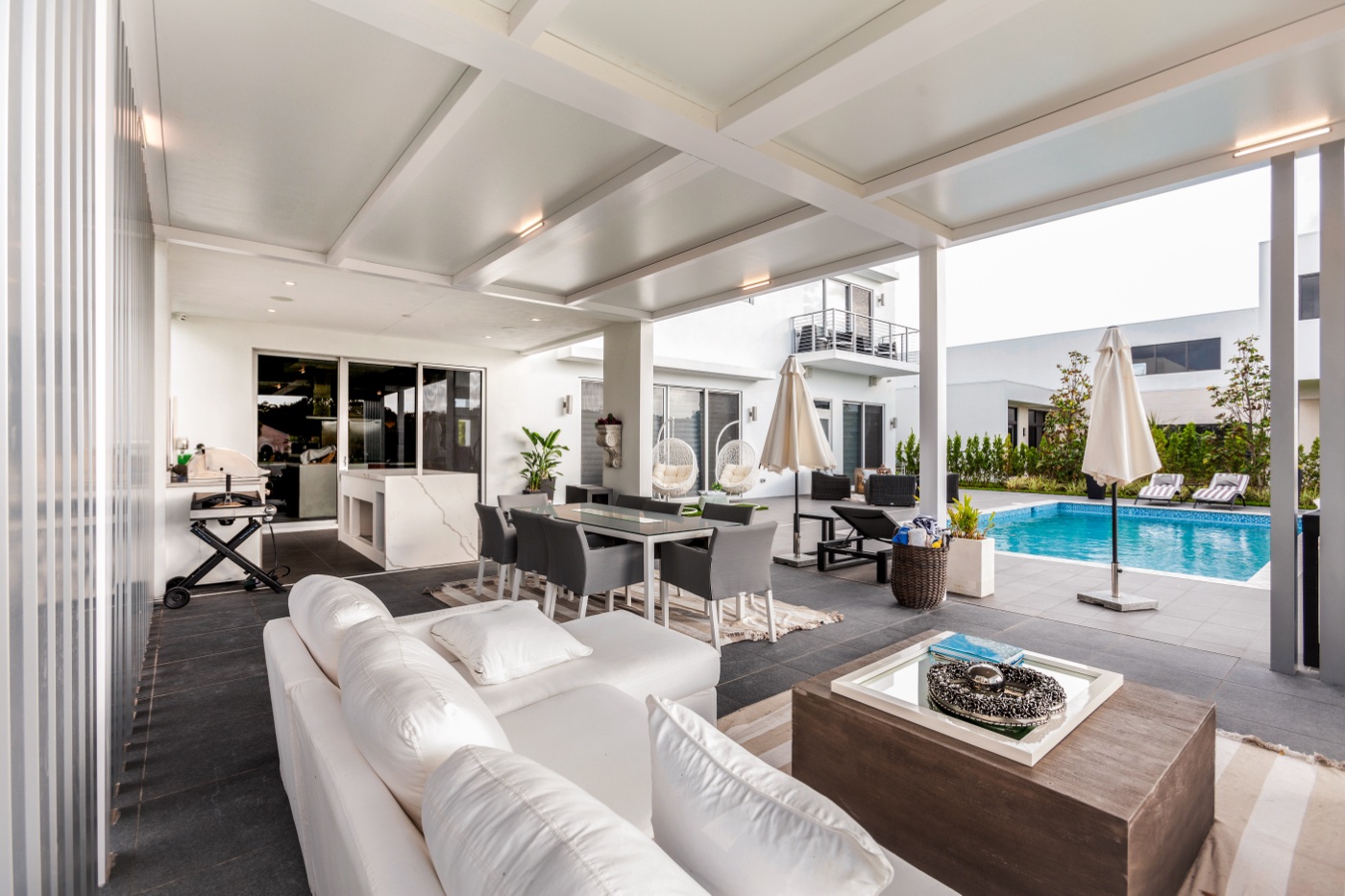
The single biggest lever for extending the life of an outdoor kitchen is keeping it out of direct snow load and standing precipitation as much as possible. A kitchen sitting fully in the open takes the full brunt of every storm; a kitchen under a covered structure — particularly one with a motorized louvered roof that closes ahead of weather — spends the winter mostly shielded, opening back up on the clear days when it's actually useful. That difference in cumulative exposure is a large part of why covered kitchens hold their finish and function longer than open ones.
| Setup | Winter exposure | Typical wear pattern |
|---|---|---|
| Fully open kitchen | Direct snow, ice, and precipitation all season | Fastest fading, cracking, and cabinet hardware corrosion |
| Partially covered (fixed roof) | Reduced direct load, but no seasonal flexibility | Slower wear, but no way to open up on clear days |
| Motorized louvered roof | Closes ahead of storms, opens on clear days | Slowest cumulative wear; structure adapts to conditions |
Built for February, Enjoyed in July
The kitchens that still look and perform like new after a decade are, without exception, the ones specified with winter in mind from day one — not retrofitted after the first round of damage shows up. Browsing real, installed projects in our portfolio is a good way to see what materials and coverage decisions actually hold up over years, not just on installation day. A kitchen designed for the worst week of February is the one you'll still be entertaining around every July for years to come.
None of this requires overbuilding or over-spending — it requires specifying the right grade of stone, stainless, and cabinetry the first time, and deciding early whether the kitchen sits under a structure that can close against winter weather. Getting those decisions right at the design stage costs far less than correcting them after a few hard seasons have already done the damage.