Key Takeaways
- Breslow's published tiers imply a per-square-foot range of roughly $175–$230, and the number does not fall in a straight line as size increases.
- Small structures carry the same fixed costs — motors, controls, engineering — over less area, which pushes their per-foot number up, not down.
- Large multi-bay structures spread those fixed costs further, but still require heavier engineering for the additional span, which keeps the per-foot number from collapsing either.
- A per-square-foot figure is a sanity check, not a quote — attachment, site work, and integrations move the real number more than size alone.
"What's your price per square foot?" is a fair question for flooring or drywall. For a motorized, engineered, structurally rated outdoor room, it's a question that produces a technically true number and a practically useless one. Here's what the real tiers at /cost/ actually imply per foot, and why the math misleads anyone trying to use it to budget.
The Per-Square-Foot Trap
Per-square-foot pricing works when a product is basically the same material repeated at scale — more flooring is just more flooring. A louvered pergola isn't that. A meaningful share of the cost is fixed regardless of size: the motor and control system, the engineering review, the permitting process, the electrical rough-in. Divide a number that includes those fixed costs by square footage, and the result depends heavily on how big the structure happens to be, not on any consistent "rate."
It's the same reason a small kitchen renovation can carry a higher per-square-foot cost than a large one — the appliances, plumbing, and electrical work don't shrink just because the room is smaller. A motorized pergola has its own version of that: the motor, the sensor, the control wiring, and the engineering review cost roughly the same whether the structure covers 320 square feet or 640.
What Our Real Tiers Imply Per Foot
Using Breslow's published size tiers, here's what each footprint works out to on a per-square-foot basis:
| Footprint | Approx. Size | Investment Range | Implied $/sq ft |
|---|---|---|---|
| 16 × 20 ft | ~320 sq ft | From ~$65,000 | ~$203 |
| 20 × 20 ft | ~400 sq ft | ~$75,000–$90,000 | ~$188–$225 |
| 20 × 23 ft | ~460 sq ft | ~$90,000–$105,000 | ~$196–$228 |
| 20 × 32 ft | ~640 sq ft | ~$115,000–$135,000 | ~$180–$211 |
| 48 × 23 ft, 3-bay | ~1,100 sq ft | ~$190,000–$220,000 | ~$173–$200 |
Notice the shape of that curve. It doesn't fall in a straight line as size increases — it moves up slightly through the mid-size tiers before trending down at the largest footprint. Anyone who tells you a single flat per-foot rate applies across all sizes hasn't actually run the numbers against real installed projects. To be clear about where these numbers come from: every figure in the Implied $/sq ft column above is simple division — the published investment range for that tier, divided by its approximate square footage — not a separate per-foot rate Breslow publishes or quotes on its own.
Why Bigger Isn't Linearly Cheaper
Two forces are working against each other here. Spreading fixed costs — motors, controls, engineering, permitting — over more square footage does lower the per-foot number somewhat as size increases. But a bigger structure also means a longer span, and longer spans need heavier structural members and more rigorous engineering to hold the same wind and snow ratings. Those added structural costs partly offset the fixed-cost efficiency, which is why the per-foot number doesn't simply collapse as the project gets larger. It also explains why a small, heavily customized structure can carry a higher $/sq ft than a straightforward mid-size one.
A multi-bay structure, like the 48×23 ft three-bay tier, changes the math again: it's really three connected spans rather than one long span, which is structurally more efficient than trying to cover the same total area with a single oversized bay. That's part of why the largest tier in our table shows the lowest implied per-foot cost — not because the project is simpler, but because the engineering is smarter about how the load is distributed.
“It adds tremendous value to the house… it's just been a really, really good purchase.”
— Homeowners, Norwood NJ · watch real client clips
Where Per-Foot Pricing Gets Abused
The most common misuse: quoting a low headline $/sq ft figure calculated on the largest, simplest structure in a company's portfolio, then applying it to a smaller, more customized project where it doesn't hold. The reverse also happens — a high per-foot number from a small custom job gets used to scare a buyer away from a larger, more efficient structure that would actually cost less per foot. Either way, the number is being used to shortcut a conversation that a real quote requires.
The same trick shows up when comparing a motorized, engineered louvered system to a basic fixed wood pergola kit. The kit's per-foot number looks dramatically lower, but it's not pricing the same thing — no motor, no integrated drainage, often no PE-stamped engineering behind it. A fair per-foot comparison only means anything when both numbers include the same scope of work.
Ask your contractor: "Is your per-square-foot number based on a real installed project close to my size, or is it a marketing average?" If they can't point to a comparable project, the number isn't reliable for your budget.
A Better Way to Budget
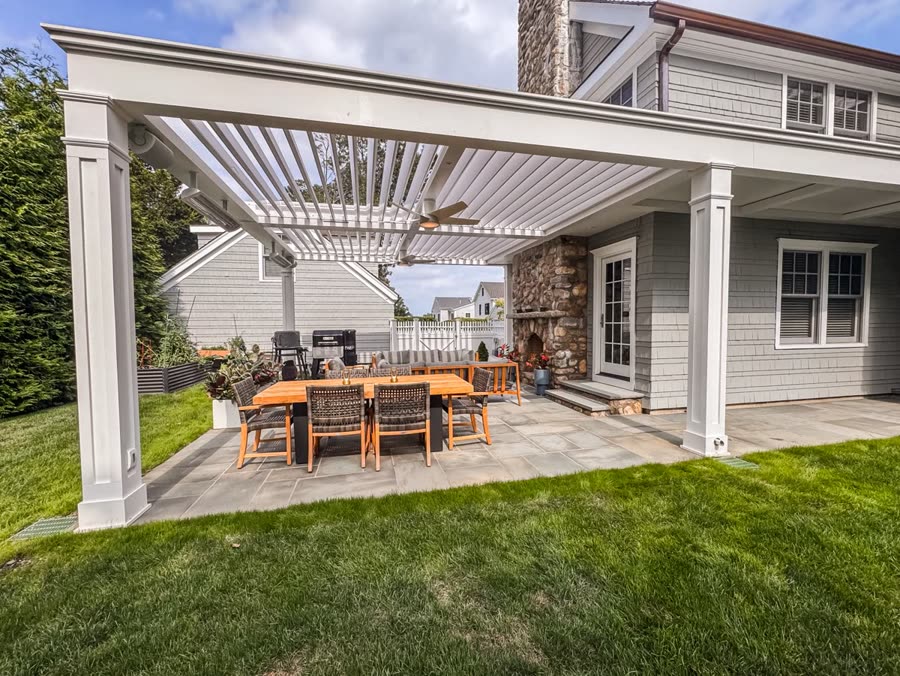
Start from the published size tiers, which reflect real projects Breslow has designed, engineered, and installed, then adjust for your specific situation: attached versus freestanding, the condition of your site, any custom trim or architectural integration, and whether you want screens, heating, or lighting built in from the start. Most residential projects land in the $75,000–$150,000 range once those factors are added; the overall range across our territory runs from $50,000 to multi-million dollars for larger estate and commercial work.
Financing through Synchrony and HFS is available for qualified buyers if the number lands above what you'd planned to pay in cash — see /financing/ for how that process works. Either way, the tier table above is a far more reliable starting point than any single per-square-foot figure quoted without context.
Scope It Properly in One Call
A per-square-foot number can get you in the right neighborhood before you make a call. It cannot replace a real conversation about your specific site. Design consultations start on Zoom — we walk through your space, your style direction, and give you a realistic range in that first call, no site visit required to begin. If it's a mutual fit, a designer visits with a Matterport scanner for precise measurements before any number is finalized.
Frequently Asked Questions
What does a pergola cost per square foot?
Based on Breslow's published tiers, a motorized louvered pergola runs roughly $175 to $230 per square foot depending on size, with smaller and mid-size structures often landing at the higher end of that range rather than the lower end.
Why don't bigger pergolas cost less per square foot?
Fixed costs like motors, controls, engineering, and permitting are spread over more area on a larger structure, which lowers the per-foot number somewhat. But bigger spans also need heavier structural members and more complex engineering, which raises the per-foot number. The two effects partly cancel out, which is why the curve isn't a straight downward line.
Can I use a per-square-foot number to budget my project?
Only as a rough starting sanity check, not as a quote. A per-square-foot figure can't account for whether your structure attaches to the house, what the site work involves, or which integrations like screens or heating you want, all of which move the real number significantly.
What's a better way to estimate pergola cost?
Start from Breslow's published size tiers at breslow.com/cost/, which reflect real installed projects, then scope your specific site, integrations, and trim on a design consultation. That produces an actual range for your property rather than a multiplied estimate.