Key Takeaways
- A pergola's lighting plan matters as much after dark as the structure does during the day — evenings are when most owners actually use the space.
- Breslow installs the Azenco R-Blade™ system, which allows LED integrated directly into the louver blades and support beams, so the light source disappears into the architecture rather than bolting on afterward.
- The best-lit outdoor rooms layer three types of light — ambient, task, and accent — on separate dimmable zones, not one overhead switch.
- Lighting is easiest and least expensive to get right when it's wired in during construction, alongside the same control that runs your louvers.
Most of the design conversation around a pergola happens in daylight — louver angles, shade patterns, how the roofline sits against the house. But the space that actually gets used most, on a typical evening, is the one lit after the sun goes down. A structure that looks architectural at 2pm and looks like a floodlit parking lot at 9pm hasn't been fully designed. Lighting isn't a finishing touch; it's half the room.
Lighting Is Half the Room
Ask most homeowners what they picture when they imagine using their new outdoor space, and it's rarely a bright Tuesday afternoon — it's a dinner, a gathering, a quiet evening after the kids are down. That means the lighting design deserves the same attention as the structural design, not a single porch light and a string of bulbs added after the fact. A portfolio of well-built structures photographed only in daylight misses the point of what most owners actually built them for.
Integrated LED: Built In, Not Bolted On
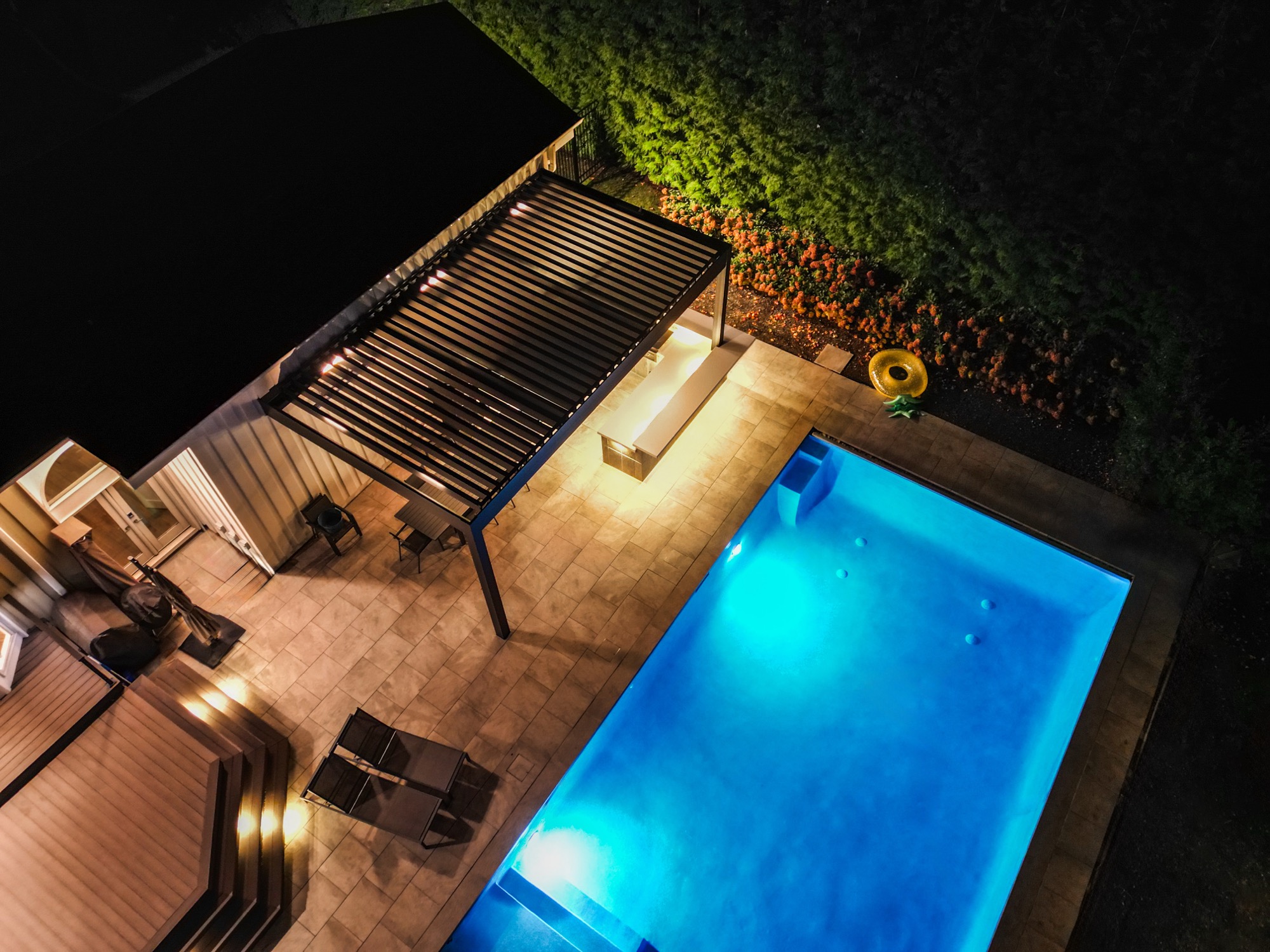
The clearest sign of a properly designed lighting plan is that you can't easily see where the light is coming from. Breslow installs the Azenco R-Blade system, which allows LED to be integrated directly into the louver blades and structural beams, so the fixtures become part of the architecture rather than surface-mounted hardware competing with it. That approach also protects the fixtures themselves — recessed and structurally integrated lighting isn't exposed to weather the way a clip-on fixture is, which matters for anything expected to run for years without a service call.
Color temperature is worth deciding deliberately rather than leaving to a default. A warmer, lower-temperature white reads as residential and inviting, closer to candlelight than a retail showroom, and it's almost always the better fit for a dining or lounge area meant for relaxed evenings. Cooler, brighter tones have their place near a kitchen or grilling station where clear task visibility matters more than atmosphere, which is exactly why a single fixed color temperature across the whole structure rarely serves every zone equally well.
The Three Layers: Ambient, Task, and Accent
A room that's lit well, indoors or out, almost never relies on a single light source, and an outdoor living space is no different. Ambient light sets the overall glow and mood of the space — usually the integrated LED running through the structure itself. Task light focuses on where people actually work: a kitchen prep area, a bar, a dining table where you want to read a menu without squinting. Accent light does the quiet work of highlighting what's worth highlighting — a stone wall, a specimen tree, the edge of a pool — and gives the whole space depth instead of one flat wash of brightness. Structures designed with all three layers read as considered; structures with only one almost always look like an afterthought once the sun sets.
Picture a typical evening under a finished structure: the integrated beam lighting stays low and warm as ambient fill, a focused task fixture illuminates the outdoor kitchen counter while someone finishes plating, and a narrow accent beam grazes up the trunk of a mature tree at the edge of the property. None of those three jobs can be done well by the same fixture, which is exactly why layering, not brightness, is what separates a considered lighting plan from a single floodlight aimed at the yard.
Dimming and Zones
The difference between a lighting plan that works for a quiet Tuesday and one that works for a summer party is rarely more fixtures — it's zoning and dimming. Splitting the space into independently controllable zones (dining, lounge, perimeter, accent) means the same structure can be dialed down to a warm glow for two people or brought up for a crowd, without redesigning anything. This is a wiring decision as much as a design one, which is why it needs to be planned early rather than patched in later.
Because most R-Blade installations run roughly 3 to 5 days on site with Breslow's own crews, low-voltage lighting runs and dimmer zones are far easier to route through open posts and beams before the structure is closed up than to fish through it afterward. A homeowner who raises zoning as a question during the design consultation, rather than after the crew has left, ends up with meaningfully more control for very little added cost.
Smart Control Integration
Most motorized louvered systems already run on remote or app control for opening and closing the roof itself, and lighting is a natural extension of that same control layer rather than a separate system with its own remote. Tying lighting scenes into the same interface that already manages your louvers keeps the whole space simple to operate — one control approach for weather response and one for ambiance, rather than a drawer full of remotes.
The practical benefit shows up in small daily habits: a single scheduled scene that brings up the perimeter and accent zones automatically at dusk, or a preset that dims everything but the task lighting once dinner service winds down. None of that requires anyone to remember which switch does what — it's built into how the space is meant to be used, on the same control surface as the roof itself.
Ask your contractor: "Is the lighting wired into its own dimmable zones, and can it be controlled from the same system that runs my louvers?" If the answer is a single switch on one circuit, the lighting plan hasn't actually been designed.
Designing for 9pm
The most useful thing a homeowner can do during design is picture the space at night, not just in the afternoon renderings. Where will people actually sit after dinner? Where does the eye go once the sun is down? A structure engineered around these questions, with wiring run during construction rather than an extension cord added later, is the difference between a space that photographs well in daylight and one that gets used every night of the week. It's a five-minute conversation during your design consultation that changes how the entire project performs for the next several decades of evenings.
Frequently Asked Questions
Can lighting be built into a louvered pergola?
Yes. Breslow installs the Azenco R-Blade system, which can integrate LED lighting directly into the louver blades and structural beams, so the light source is part of the architecture rather than a fixture added afterward.
What's the difference between ambient, task, and accent lighting outside?
Ambient lighting sets the overall mood and general glow of the space, task lighting focuses on specific work areas like a kitchen or dining table, and accent lighting highlights architectural features, posts, or landscaping. A well-designed outdoor room layers all three on separate dimmable zones rather than relying on one overhead source.
Should I plan lighting before or after the pergola is built?
Before, whenever possible. Wiring for layered, zoned lighting is far simpler and less expensive to run during construction than to retrofit afterward, which is why lighting should be part of the initial design conversation, not an afterthought.
Can pergola lighting be controlled with a smart device?
Most modern motorized pergola systems already use remote or app control to open and close the louvers, and lighting can be tied into that same control approach so a homeowner can adjust brightness and zones without separate switches.