Key Takeaways
- A sunroom is a fully conditioned addition — comfortable year-round, but permanently enclosed and typically requiring a full building permit and possible tax reassessment.
- A louvered pergola paired with motorized screens stays open-air in summer and closes down for wind, rain, and bugs in the shoulder seasons — without sealing the space permanently.
- A louvered pergola and screen system is not a substitute for a heated sunroom in deep winter; it's engineered to extend spring-through-fall comfort, not replicate an insulated room.
- Published Breslow pergola pricing typically runs $75,000–$150,000 for a fully engineered, custom-installed residential project.
Two ways to buy more seasons
Northeast homeowners chasing more usable months outside land on two very different answers to the same problem. One is a sunroom: a permanent addition, built like the rest of the house, that stays comfortable regardless of what's happening outdoors. The other is a louvered roof paired with motorized screens: an open-air structure that closes down for weather and opens back up the moment it clears, rather than sealing the space permanently. Both extend the calendar. They do it in fundamentally different ways, at fundamentally different costs.
The question tends to surface after a family has already lived with a bare patio through a few Northeast seasons — enough springs cut short by wind, enough fall dinners moved indoors early, enough mosquito-heavy July evenings — that "more usable months" becomes the actual design brief, rather than an afterthought to a kitchen remodel or a pool addition.
What a sunroom really involves
A sunroom is, structurally, a small addition to the house — foundation or slab, insulated walls, windows, a conditioned roof, often tied into existing HVAC or its own mini-split system. That's a genuine year-round room, usable in January exactly as it is in July, and it typically requires a full building permit process rather than the lighter review an open structure often qualifies for. In many jurisdictions, adding conditioned square footage can also change how the home is assessed for property tax purposes — a question worth raising with your local assessor before committing, since that detail varies by town and we don't build sunrooms ourselves to speak to it definitively.
The other real cost of a sunroom is what it does to the outdoors themselves: once built, the space is enclosed, permanently, whether or not you wanted a room with walls in July. You gain a heated room and lose the open-air experience the yard was giving you before.
What a louvered pergola + screens delivers
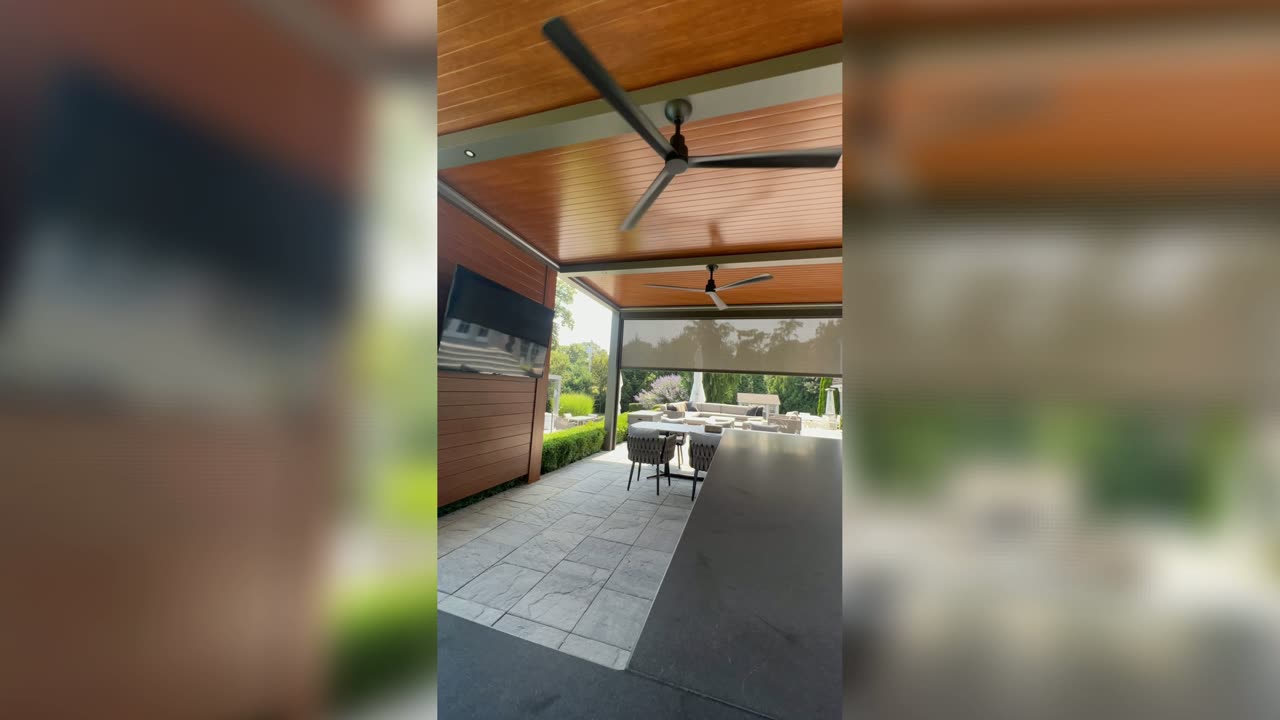
A motorized louvered pergola takes the opposite approach. The aluminum louvers on the Azenco R-Blade™ system open for full sun and close to shed rain on command, while motorized screens mounted around the perimeter add wind-blocking, bug-free enclosure without sealing the space in glass and drywall. The combination is what pushes a three-season pergola much closer to sunroom-level comfort while keeping the openness a sunroom gives up entirely — open in July, screened and closed against wind in October, put away behind concealed tracks the rest of the year. Pair it with radiant heat and the usable window extends further still; see how far that goes on our year-round living page.
“Also in the winter, when it's a little chillier out, if you lower all the shades, put the heaters on, you can sit out here when it's 40 degrees with a light sweater and you're perfectly comfortable.”
— Homeowners, Norwood NJ · watch real client clips
Cost comparison
| Sunroom Addition | Louvered Pergola + Screens | |
|---|---|---|
| Structure type | Enclosed, conditioned addition | Open-air structure, closes on demand |
| Permitting | Full building addition permit | Typically lighter review; handled or assisted by Breslow where required |
| Property tax impact | Often reassessed as conditioned space (check locally) | Varies by jurisdiction; generally treated differently than a sealed addition |
| Summer use | Requires A/C to stay comfortable | Fully open-air, natural airflow |
| Shoulder-season use | Comfortable as built | Comfortable with screens closed, plus optional heat |
| Deep winter use | Comfortable if heated and insulated to code | Not intended for deep winter enclosure |
| Typical residential investment | No canonical Breslow figure — outside our scope | ~$75,000–$150,000 typical, per published pergola tiers |
The winter question, honestly
We'll say plainly what a lot of outdoor-living marketing won't: a louvered pergola with screens is not a substitute for a heated, insulated sunroom in a true Northeast January. The louvers and screens are engineered for wind, rain, and snow shedding — real weather protection — but the assembly isn't a sealed, insulated envelope, and radiant heaters extend comfort rather than replicate an indoor room's climate control. If the goal is a fully conditioned space usable in a blizzard, that's a sunroom's job. If the goal is dramatically more usable months than a bare patio — spring through late fall, comfortably, with the option to fully open the space back up on the best days of the year — that's exactly what a louvered pergola and screen system was built for.
Ask your contractor: "In July, does this space feel like an outdoor room or an indoor one?" A sunroom will always answer "indoor." A louvered pergola answers "outdoor" — until you close it.
Which fits your house and life
The honest way to choose is by asking what you actually want more of. Families wanting a genuine year-round room — a home office, a playroom, a space indistinguishable from the rest of the house in February — are better served by a sunroom addition. Families wanting to reclaim the outdoors itself for more months, keep the open-air feeling in summer, and add real weather protection in the shoulder seasons without permanently closing anything in tend to land on a louvered pergola with screens. Either way, the numbers deserve a real comparison rather than a guess — our cost page lays out published pergola pricing, browse completed louvered pergola and screen projects in our project portfolio, and a design consultation can walk through both paths against your specific home.
Frequently Asked Questions
Is a louvered pergola cheaper than building a sunroom?
Generally the two aren't built to the same price point because they deliver different things — a sunroom is a fully conditioned addition to the house, while a louvered pergola is an open-air structure that closes on demand. Published Breslow pergola pricing typically runs from about $65,000 to $150,000 or more depending on size, while sunroom costs vary too widely by scope and region for us to state a figure since we don't build them ourselves.
Can a louvered pergola with screens be used in winter?
It's designed to extend comfortable use through spring, summer, and fall, and with radiant heat, well into the shoulder seasons — but it isn't a substitute for a heated, insulated sunroom in a deep Northeast winter. A sunroom is the better fit if year-round conditioned comfort is the primary goal.
Does a sunroom addition require a permit?
Yes, a sunroom is typically treated as a full building addition and requires a complete permitting process, and in many jurisdictions it may also affect how the home is assessed for property taxes as conditioned square footage. A louvered pergola generally involves a lighter review, which Breslow handles or assists with where required.
What's the main advantage of a louvered pergola over a sunroom?
A louvered pergola keeps the space genuinely open-air in good weather — real sun, real airflow — while still closing down for rain, wind, and bugs when needed. A sunroom is permanently enclosed, trading that openness for consistent year-round conditioning.