Key Takeaways
- Motorized privacy screens create seclusion on demand along the sides of a pergola or patio, without the permanence of a solid wall.
- Privacy mesh comes in a range of opacity grades — from light-filtering weaves that soften a sightline to near-opaque weaves that block it almost entirely.
- Side screening integrates into the same structure as roof louvers, so a pergola can go from fully open to fully enclosed on demand.
- Architectural privacy walls, built in matching materials and colors, are a permanent complement to — or upgrade path beyond — motorized screening.
Privacy Without Building a Wall
Privacy problems on residential lots rarely show up all at once. A new house goes up next door with a second-story window that suddenly overlooks your patio. A deck gets built higher than the last one. A pool goes in and the yard that used to feel private now feels like it's on display at certain hours. The instinct is to build a wall or a fence, and sometimes that's the right call — but a solid structure is permanent, can look heavy next to an open pergola, and locks in a decision before you've lived with the sightline for a season.
A motorized privacy screen is a genuinely different kind of answer. It's not a compromise version of a wall — it's a separate tool that gives you seclusion exactly when you want it and an open, unobstructed structure the rest of the time. For most residential projects, that flexibility turns out to matter more than homeowners expect going in.
Solid perimeter walls also tend to raise questions a fence wouldn't — height limits, setback requirements, and sometimes a fuller permit review depending on the town and the wall's location relative to a property line. None of that makes a wall the wrong choice, but it does mean the decision carries more weight and more lead time than dropping a screen, which is one reason so many homeowners choose the more flexible option first and reserve a permanent wall for the one sightline that truly never changes.
Mesh Opacity Grades Explained
Privacy mesh isn't one product — it's a spectrum. On one end, light-filtering weaves soften a direct sightline without blocking it completely, useful when you want to take the edge off a neighbor's view without feeling boxed in. On the other end, denser, near-opaque weaves reduce visibility through the screen to almost nothing while still technically passing some air, unlike a solid panel. Where you land on that spectrum is a real design decision, not a default setting — a designer should walk you through actual samples held up against your specific sightline, not just a swatch card indoors.
Side Screening on Pergolas
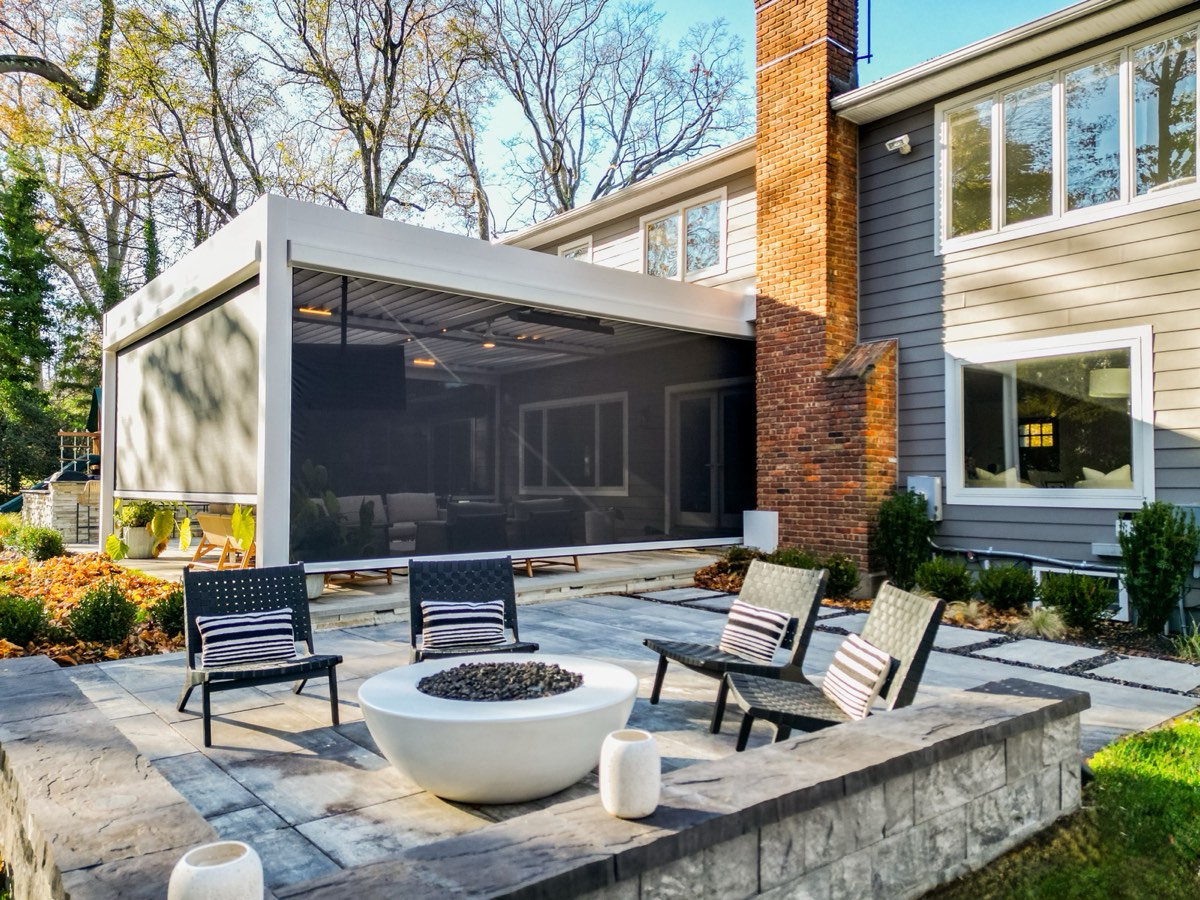
The most common application is vertical screening along the open sides of a structure, working alongside the roof louvers rather than instead of them. The tracks recess into the posts, and the motor sits concealed within the frame — the same concealed-motor approach used on Breslow's motorized screens generally, applied here to the vertical plane instead of a horizontal opening. Raise the roof louvers for sun and drop a side screen for privacy, and the structure can move fluidly between fully open, partially screened, and fully enclosed without a single visible piece of hardware changing the way it looks.
It's also common to mix mesh types across the same structure's different sides — a denser privacy weave facing a neighbor's yard, standard insect mesh on the side that just needs bugs kept out, and no screen at all where a private view is worth keeping unobstructed. Because each side runs on its own motor and track, there's no reason every opening on a structure has to behave the same way.
Ask your contractor:
"Can I see an opacity sample held up against my actual sightline, at the time of day I'll actually be using the space? A screen looks different at 2pm than it does at dusk, and a rendering won't tell you that."
Pool and Spa Privacy
Poolside and spa zones raise their own version of the privacy question — not just from a neighbor's window but from a deck, a street, or a second home on the same property. A screen dropped around a portion of a pool pavilion or spa structure creates a private soak or a quiet lounge session without permanently walling off a space that's meant to feel open the rest of the time. It's one of the more common requests we see on multi-structure estate properties documented across the portfolio, where a pool zone and an entertaining zone sit close enough together that privacy timing actually matters.
Timing matters as much as placement here. A pool zone that's fully open and social during a Saturday afternoon gathering can screen off in minutes for a quiet evening soak once the crowd's gone home — the same structure serving two very different moods without any physical reconfiguration.
Privacy Walls: The Architectural Option
Where a permanent solution genuinely fits the property better, an architectural privacy wall — built in the same aluminum finishes and colors as the surrounding structure — is the other half of this conversation. Unlike a bolted-on fence, a properly designed privacy wall reads as part of the architecture: matched RAL color, matched profile, sometimes slatted for partial airflow and sometimes solid where full blocking is the goal. Many estate properties end up using both — walls where the sightline problem is constant and unchanging, screens where the need for privacy comes and goes with the time of day or the season.
Height is usually the first variable worked out during design — tall enough to genuinely block the sightline in question, but proportioned so the wall reads as part of the structure rather than a fortification bolted onto the yard. Matching color and profile to the pergola or the house's trim is what keeps that balance believable up close, not just from across the lawn.
Designing Seclusion In
The right answer is specific to your lot, your neighbors, and how you actually use the space — which is exactly what a Zoom design consultation is for. A Breslow designer maps the real sightlines on your property, from the angles that matter and the ones that don't, and puts together a plan that mixes screens, walls, or both, before anything is priced or ordered.
Frequently Asked Questions
How much privacy do outdoor privacy screens actually provide?
It depends on the mesh opacity grade selected — lighter weaves soften a sightline without fully blocking it, while denser, near-opaque weaves block visibility almost completely while still allowing some airflow. A designer can walk through samples against your actual sightline to match the grade to how much seclusion you want.
Can privacy screens be added to the sides of an existing pergola?
Yes, in many cases. The concealed, recessed-track approach Breslow prefers is most straightforward when planned into a structure's design from the outset, but retrofitting screens onto an existing pergola's sides is possible, sometimes with surface-mounted hardware instead of full concealment depending on the original construction.
What's the difference between a privacy screen and a privacy wall?
A privacy screen is a motorized mesh that retracts completely when you don't need it, giving you an open structure most of the time and seclusion on demand. A privacy wall is a permanent architectural element — solid or slatted panels built in materials and colors that match the structure — that stays in place year-round. Many properties combine both, screens where flexibility matters and walls where a fixed sightline block makes more sense.
Do privacy screens block airflow and natural light?
Some reduction is inherent to any mesh dense enough to limit sightlines, but privacy mesh is engineered to balance opacity against airflow — it's not a solid barrier. Lighter privacy grades preserve more breeze and light; denser grades trade some of that for more complete seclusion. This is exactly the kind of tradeoff a design consultation works through before you choose.