Key Takeaways
- This Fairfield County, CT homeowner leaves their louvers open by default — the rain sensor handles the rest.
- If they're away when weather turns, the sensor closes the roof automatically, without anyone touching a remote.
- Closed, the R-Blade's louvers shed water the way a solid roof would — the sensor just triggers that position on time.
- Sun and airflow are still fully available any time it's clear; the sensor only matters when rain actually starts.
"We usually leave it here and then if we're gone for the day and it starts to rain, the sensors close it for us."
— Homeowners, Fairfield County CT
One of the more practical questions homeowners bring to a design consultation isn't about aesthetics — it's a logistics question. What actually happens to outdoor furniture, cushions, and electronics if a storm rolls in while everyone's at work, or out for the afternoon, or away for the weekend? A structure that requires someone to physically close it before rain arrives only protects the space when a person happens to be around to do that. This Fairfield County, CT homeowner describes exactly how that scenario plays out with an automatic sensor in the clip above.
The Everyday Scenario Homeowners Worry About
It's not a dramatic storm that causes most of the damage to outdoor cushions and furniture — it's the ordinary afternoon shower that starts while nobody's home to notice. A homeowner leaves for the day with the louvers open to let the space breathe, the sky clouds over around 3pm, and by the time anyone's back, everything underneath has already been sitting in rain for an hour. That's the exact gap this homeowner is describing closing.
How the Rain Sensor Actually Works
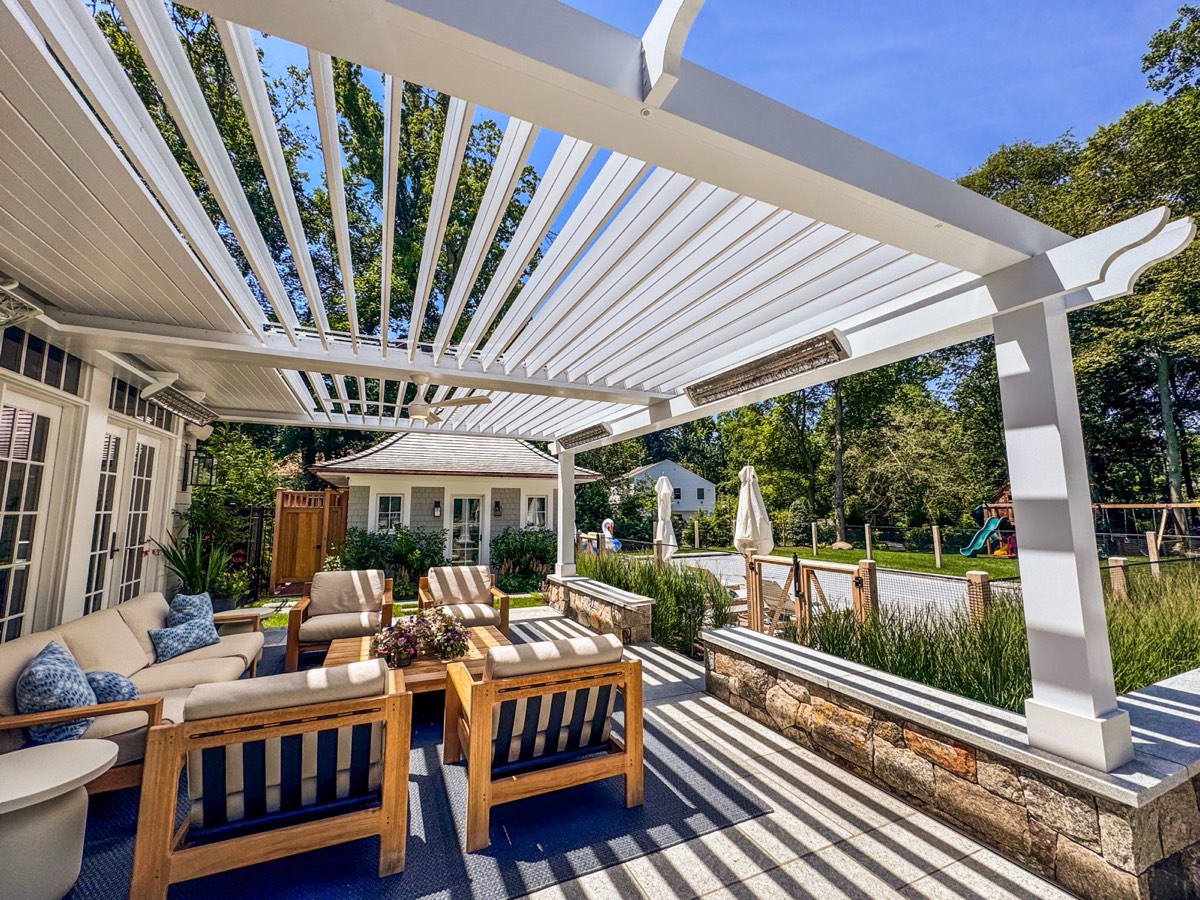
Breslow's Azenco R-Blade motorized louvered pergola can be equipped with a weather sensor that detects moisture and triggers the louvers to close automatically — no app, no remote, no one needing to be home. It's a mechanical response to actual conditions rather than a reminder that depends on a person checking a forecast. As this homeowner puts it, the default state is open, and the sensor is what steps in only when it's actually needed.
Closed, the louvers are engineered to shed water the way a solid roof would — the sensor's job isn't to change what "closed" does, it's to make sure that position happens on schedule with the weather instead of on whatever schedule a person remembers to check. That's the meaningful difference between an automatic system and a manual one: the protection doesn't depend on somebody being present.
It also holds up beyond a routine passing shower. The Azenco R-Blade is marketed as wind-rated up to 195 mph and Miami-Dade hurricane certified, which is a structural rating rather than a claim about the sensor itself — but it means the same system responding automatically to an afternoon drizzle is also engineered around real regional weather events, not just light rain. For a homeowner in Fairfield County, where a summer storm can move in fast off the coast or roll through the hills with little warning, that combination — automatic response plus a structure built for serious wind and water loads — is what actually gets tested over a few New England seasons, not just on a calm day during installation.
What This Means If You're Comparing Systems
If you're weighing a motorized louvered roof against a manual pergola or a fixed structure, it's worth asking directly whether weather response requires a person on-site. A manual system is only as reliable as whoever's around to operate it; an automatic sensor removes that dependency entirely, which matters more than it might seem the first time you come home to dry furniture after a storm you didn't even know happened while you were out.
It's also worth asking what happens with the structure itself in wind and heavy rain, not just whether the louvers close on cue. A designer should be able to speak to both the automation and the underlying engineering — for final design specifics, that always comes back to a licensed engineer reviewing the actual site conditions, not a generic spec sheet.
Seeing It for Yourself
Weather response, sensor placement, and how a system fits your specific roofline are exactly the kind of details a Breslow designer walks through starting with a free Zoom consultation, followed by 3D renderings on your actual home if it's a fit. Browse more real installations in the project portfolio, or hear more directly from homeowners at breslow.com/testimonials/.
Frequently Asked Questions
What happens to my louvered roof if it rains while I'm not home?
The Azenco R-Blade motorized louvered pergola that Breslow installs can be equipped with a weather sensor that detects rain and automatically closes the louvers, whether or not anyone is there to trigger it manually. Homeowners describe leaving the louvers open for the day and coming home to find the sensor already closed them.
Do I have to remember to close the roof myself before it rains?
No — that's the specific purpose of the rain sensor option. Instead of relying on a homeowner to check a forecast or be present when weather turns, the sensor detects moisture and closes the louvers automatically, so furniture and cushions underneath stay protected.
Is the louvered roof still watertight when closed?
Yes — closed, the R-Blade's louvers are engineered to shed water the way a solid roof would. The sensor's role is simply making sure that closed position happens automatically when rain starts, rather than depending on someone noticing in time.
Can I still get full sun and airflow when I want it, with a sensor installed?
Yes — the sensor only closes the louvers in response to rain. You can still open them fully by remote or app any time the weather is clear, and the automatic closing simply protects the space when you're not there to manage it yourself.