Key Takeaways
- An outdoor kitchen with no roof coverage limits usable days to whatever the forecast allows and accelerates wear on appliances, cabinetry, and countertops.
- A motorized louvered roof solves rain and smoke at once — closing fully to shed water, opening to vent heat and smoke during active cooking.
- Direct rain exposure, not ambient temperature, is what shortens the life of outdoor-rated appliances and electronics fastest.
- Overhead radiant heat and integrated lighting extend a covered kitchen's usable season well into spring and fall — options that depend on having a structure to mount them to.
The Uncovered Kitchen Problem
An outdoor kitchen with no roof over it is a bet against the weather, made fresh every time a dinner party gets planned. A grill island under open sky looks finished on the day it's installed, but the first hard rain sends everyone inside mid-cook, the first heat wave turns the counter into something too hot to touch, and every winter storm goes to work directly on cabinetry and countertop material that was never meant to sit fully exposed. Homeowners tend to discover the problem gradually — a warped cabinet door here, a grill that won't start on a damp morning there — long after the kitchen itself was finished and paid for.
The fix isn't a bigger umbrella or a retractable canvas patch. It's designing the roof and the kitchen as one project from the start, which is the exact use case a motorized louvered roof was engineered to solve.
It's also a scheduling problem as much as a materials one. A kitchen with no real coverage gets used on the days the forecast cooperates and sits idle the rest of the time — which, across a typical tri-state summer with its share of afternoon thunderstorms, can mean a meaningful fraction of the season goes unused despite the investment already made.
Louvers: Rain Protection Plus Smoke Ventilation
A fixed, solid roof solves rain and creates a new problem — smoke and grill heat with nowhere to go. A motorized louvered system solves both at once. Breslow installs the Azenco R-Blade™ system, which closes fully to shed rain directly off the structure and opens to vent smoke, steam, and heat straight up and out during active cooking. The same roof that keeps a dinner party dry during an afternoon thunderstorm opens back up an hour later so the grill doesn't turn the covered space into a smoke box.
That dual function is the entire argument for building a kitchen this way rather than under a plain fixed roof or no roof at all — weather protection and ventilation from the same structure, adjusted in seconds rather than chosen once and lived with.
A weather sensor closes the louvers automatically when rain starts, whether anyone is standing at the grill or not — a detail that matters more than it sounds, since an uncovered kitchen has no way to protect itself, and a plain fixed roof has no way to let smoke back out once it's trapped.
“We usually leave it here and then if we're gone for the day and it starts to rain, the sensors close it for us.”
— Homeowners, Fairfield County CT · watch real client clips
Appliances That Live Outside Year-Round
Coverage changes what an appliance package can be. A grill, refrigerator, or ice maker sitting fully exposed to rain and snow needs to be treated as seasonal and disposable in a way the same appliances simply aren't once they're under a roof that closes. Direct rain exposure is what shortens the life of electronics, seals, and finishes on outdoor equipment fastest — not ambient temperature, which most outdoor-rated appliances are built to handle without much trouble.
Counters, Storage, and Weather
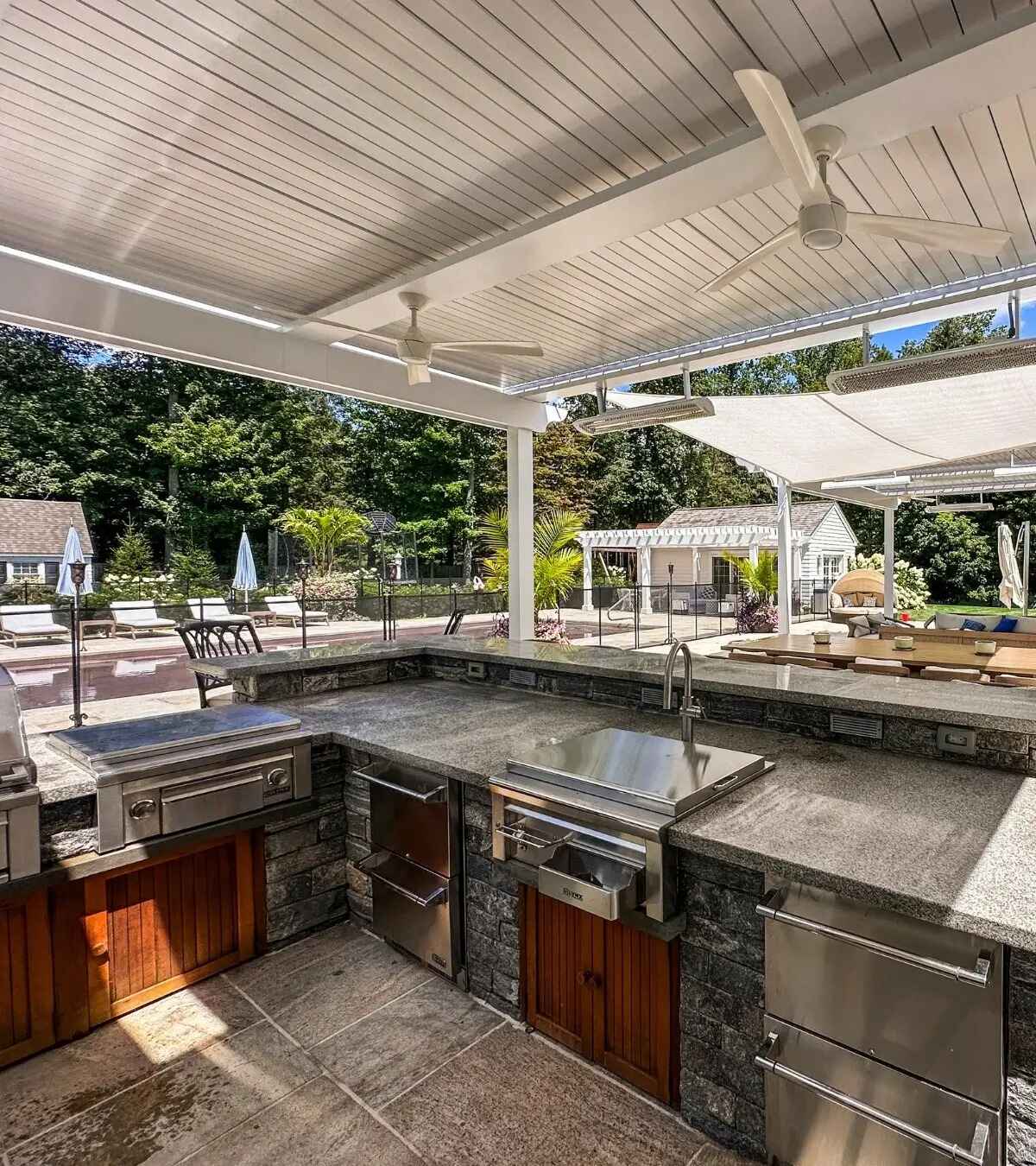
Cabinetry and countertop material chosen for a covered kitchen can be evaluated on durability and finish rather than on how much standing water and direct freeze-thaw cycling they'll have to survive every winter. Sealed storage stays sealed longer under a roof that closes in a storm; stone and engineered surfaces hold their finish longer without direct rain sitting on them for days at a time. None of this eliminates the need for materials rated for outdoor use — it just means those materials are working with the structure instead of against the weather alone.
The difference shows up fastest at the edges and seams — grout lines, cabinet door gaps, drawer seals — where standing water finds its way in first on an uncovered kitchen. Under a roof that closes before a storm even arrives, those same seams simply never see the water in the first place, which is a maintenance problem removed rather than merely delayed.
Lighting and Heat for Shoulder Seasons
A covered kitchen earns back the months on either side of summer that an open patio simply loses. Overhead radiant heat, mounted to the same structure as the roof, extends comfortable use into October and back into April. Integrated lighting turns the space into something usable after dark rather than a daytime-only station. Both upgrades depend on having a structure to mount them to in the first place — another reason the roof decision comes before the appliance list, not after it.
Layered lighting also does quieter work than most homeowners expect: task lighting focused on the grill and prep counter, softer ambient lighting over the seating or bar area, and the ability to zone or dim each independently once it's wired into a single structure rather than added piecemeal with string lights after the fact.
A Kitchen That Ignores the Forecast
The entire point of building a kitchen this way is removing the forecast from the entertaining decision. Rain closes the louvers instead of canceling the dinner. Smoke vents instead of settling. Heat and light stretch the calendar instead of shrinking it. It's a different kitchen than the one built under open sky, even with an identical appliance package, because the structure around it is doing real work rather than sitting there as decoration.
Every kitchen in the Breslow portfolio built this way started with that structural decision first, scoped during a Zoom consultation before a single appliance was chosen. Real project tiers and what drives the investment are broken down at breslow.com/cost — the roof is usually the single biggest factor in how the rest of the budget gets allocated.
Frequently Asked Questions
Does a covered outdoor kitchen need a fixed roof or can it use a louvered one?
A motorized louvered roof works better for kitchen applications specifically because it closes for rain protection and opens to vent smoke and heat, something a solid fixed roof can't do without a separate ventilation system.
Will rain damage outdoor kitchen appliances?
Direct rain exposure is one of the fastest ways to shorten the life of outdoor-rated appliances, electronics, and seals. Covering the kitchen with a structure that closes in a storm removes most of that exposure.
Can I use an outdoor kitchen year-round under a covered structure?
Coverage plus overhead radiant heat extends comfortable use well into the shoulder seasons. Deep winter use still depends on the specific climate and setup, but a covered kitchen recovers far more of the calendar than an open patio.
How much does a covered outdoor kitchen cost?
Pricing depends on the structure size, appliance package, and utility scope. Real published pergola pricing tiers are available at breslow.com/cost, and a design consultation scopes the full kitchen and structure together.