Key Takeaways
- Retractable awning pricing in New Jersey typically runs from a few thousand dollars installed to five figures for large, fully motorized systems.
- Motorization is usually the single biggest price jump over a manual crank awning — and the one most worth paying for on anything but a small window unit.
- Frame quality (extruded aluminum, powder coat) and fabric grade (solution-dyed acrylic) matter as much as size when you're comparing quotes.
- For larger openings or true year-round use, a louvered pergola is often the more durable long-term investment than a large awning system.
Ask three companies for a retractable awning quote and you'll get three different numbers, often for reasons that have nothing to do with quality. Before you can evaluate any quote, it helps to understand what actually moves the price — and where an awning stops making sense and a permanent structure takes over.
What Drives Retractable Awning Pricing
Five variables account for nearly all of the spread between a modest awning and a premium one. Width and projection come first — a 10-foot awning uses a fraction of the fabric, arms, and mounting hardware of a 20-foot span, and cost doesn't scale in a straight line as spans get longer and structural requirements increase. Motorization is the second-largest factor: a motor, remote, and control wiring add real cost over a hand-crank system. Fabric grade matters too — solution-dyed acrylic holds color and resists mildew far longer than printed or vinyl-coated alternatives, and it costs more per yard. Mounting complexity plays a role as well; a straightforward wall mount on solid masonry is simpler than a roof or soffit mount that requires additional structural reinforcement. Finally, integrations — LED lighting, wind and sun sensors, smartphone control — each add incrementally to the base price.
None of this is unique to New Jersey, but the state's mix of older homes, additions, and coastal-adjacent wind exposure means mounting and structural questions come up more often here than in a newer subdivision. A quote that doesn't ask about your wall construction, roofline, and wind exposure hasn't actually scoped the job.
Market Price Ranges by Tier (Hedged)
There's no single published price list for retractable awnings the way there is for a fully engineered structure — every home, every opening, and every fabric selection changes the number. As a general guide, motorized retractable awnings in this market typically run from a few thousand dollars installed for a smaller manual or lightly motorized system, up to five figures for a large, fully integrated system with sensors, lighting, and premium fabric. Where your project lands in that range depends on the factors above, not on which company you call.
| Tier | Typical Width | Control | General Cost Position |
|---|---|---|---|
| Entry manual | Under 12 ft | Hand crank | Lower end of the range |
| Mid-size motorized | 12–20 ft | Motor + remote, optional sensors | Middle of the range |
| Large, fully integrated | 20 ft+ | Motor, wind/sun sensors, lighting, app control | Upper end of the range |
Treat this as a framework for comparing quotes, not a substitute for one. Two companies quoting the same width can still land in different tiers depending on motor brand, fabric, and what's actually included in "installation."
“It adds tremendous value to the house… it's just been a really, really good purchase.”
— Homeowners, Norwood NJ · watch real client clips
Motorized vs. Manual: The Cost Difference
A manual, hand-crank awning is the least expensive way into a retractable system, and for a small window or door awning that gets opened a handful of times a season, it's often a reasonable choice. But motorization is where most of the value lives once you're covering a real patio. A motorized system with a wind sensor retracts itself automatically when gusts pick up — protecting the fabric and frame from damage while you're at work, asleep, or simply not paying attention. That single feature is the difference between an awning that lasts many seasons and one that gets torn apart in its second summer storm. Sun sensors add the inverse benefit, extending automatically as the afternoon sun crosses a west-facing patio. For anything wider than a single window, we treat motorization as the default, not the upgrade.
Fabric and Frame Quality
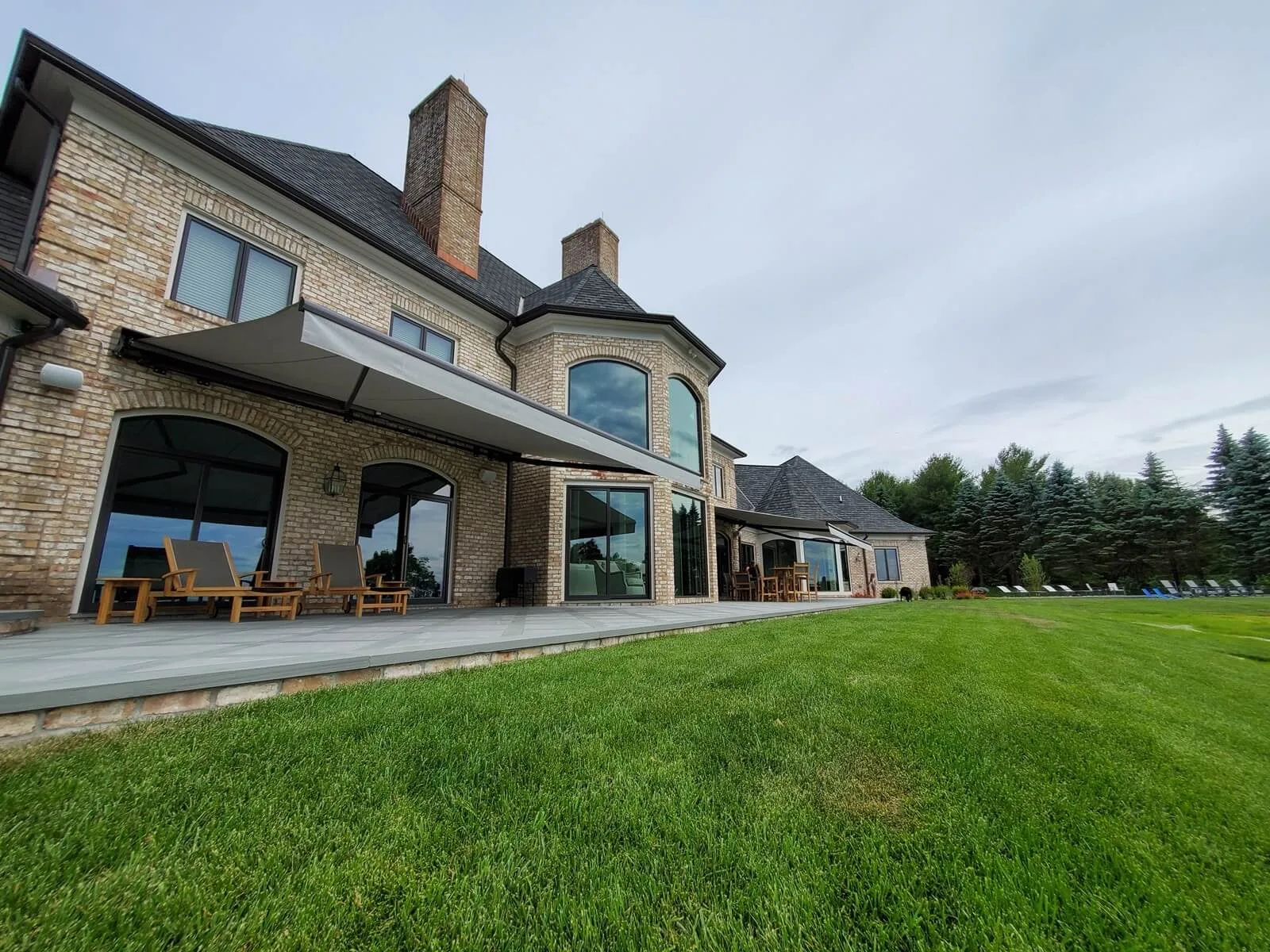
The frame is usually extruded aluminum, finished in a powder coat that should hold its color and resist chalking for well over a decade — cheap frames use thinner-gauge aluminum or inferior coatings that show it within a few seasons. Fabric matters just as much. Solution-dyed acrylics from mills like Sunbrella and Tempotest carry color all the way through the fiber, so fading happens slowly and evenly rather than in blotches. Breslow carries SummerSpace, Aristocrat, and NuImage systems, each built around this same standard of frame and fabric quality — the differences between them come down to arm style, cassette design, and projection range rather than a compromise on materials.
When to Consider a Louvered Pergola Instead
An awning is fabric on an arm — it retracts, and when it's out, it sheds sun but not much else. Once a project calls for a genuinely large covered area, year-round use, or real rain and wind protection rather than shade alone, the calculus shifts toward a permanent structure. Breslow installs the Azenco R-Blade, a motorized louvered pergola rated up to 195 mph and Miami-Dade hurricane certified, with published pricing that starts around $65K for a roughly 16x20-foot structure and scales from there depending on size and integrations — see the full pricing breakdown for the published tiers. For a large patio, a pergola often ends up costing less over its lifetime than replacing an oversized awning system every decade — see real examples in our project portfolio.
Ask your contractor: is this quote for the awning alone, or does it include the labor, the motor brand, and the fabric warranty? The numbers you're comparing should include the same things.
Getting an Exact Number
The only way to get a real number for your project is to have someone measure your specific opening, discuss your wind exposure and mounting surface, and walk through fabric and control options against your budget. Breslow starts every project with a free design consultation on Zoom — no obligation, and a realistic investment range before anyone visits your home. From there, most installations move from order confirmation to a finished project in four to six weeks, with three to five days of on-site work handled entirely by Breslow's own crews.
Frequently Asked Questions
How much does a retractable awning cost installed?
Installed retractable awnings in this market typically range from a few thousand dollars for a smaller manual or lightly motorized unit to five figures for a large, fully integrated motorized system with sensors and lighting. Width, motorization, fabric grade, and mounting complexity are the main factors that move the number.
Is a motorized awning worth the extra cost?
For anything wider than a single window, yes. Motorization adds wind sensors that retract the awning automatically in gusts, protecting the fabric and frame from the storm damage that ends most manual awnings early.
Does the size of the awning change the price significantly?
Yes — width and projection are the single largest driver of cost. A wider or deeper awning requires heavier arms, more fabric, and often additional mounting reinforcement, so price does not scale in a straight line as size increases.
Can I finance a retractable awning?
Breslow offers project financing through Synchrony and HFS. Ask your designer during your Zoom consultation whether financing makes sense for your specific project.