Key Takeaways
- Retractable patio awnings come in three basic housing styles — open, semi-cassette, and full-cassette — that trade a modest cost increase for meaningfully better weather protection of the folded fabric.
- Breslow installs SummerSpace, Aristocrat (Slim-Fit, Estate, and Manor), and NuImage systems — your Breslow designer can walk through the cassette style and projection range that fits your patio.
- Smart controls — Somfy motors, wind sensors, sun sensors, app and remote operation — turn a retractable awning into a system that manages itself rather than one you have to remember to operate.
- Correct sizing balances width, projection, and the arc of the sun across your specific patio — a measurement best taken in person rather than estimated from a photo.
A retractable patio awning is simple in concept — fabric on folding arms that extends and retracts — but the category covers a wide range of housing styles, mechanisms, and control systems. The right choice depends less on brand and more on how exposed the awning's folded fabric is when it's not in use, and how much you want the system to think for itself.
How Retractable Patio Awnings Work
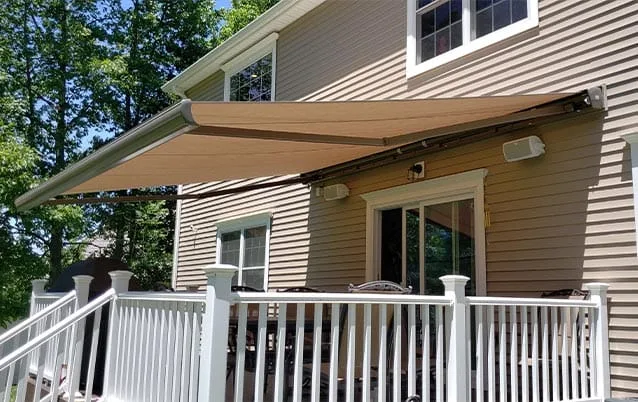
Most retractable patio awnings use a lateral-arm mechanism: a pair of folding arms, mounted to a wall or fascia, extend the fabric outward under tension and retract it by folding back on themselves. The arms do double duty — they hold the fabric taut against wind while extended, and when retracted, they fold the fabric up against or into a housing at the mounting point. That housing is where the real style differences begin.
Pitch matters more than most homeowners expect. The arms don't just extend flat — they set a slight downward slope from the mounting point to the front bar, and that slope is what actually sheds rain rather than pooling it in the middle of the fabric. Too shallow a pitch and water collects; too steep and the shade coverage drops off faster than you'd like as the sun gets lower in the sky. A properly designed system lets you adjust that pitch within a range, so the awning can favor either water shedding or maximum shade depending on how you use the space.
Open, Semi-Cassette, and Full-Cassette Styles
An open (or "monoblock") awning has no cassette — the fabric and arms simply fold up exposed against the mounting bracket. It's the least expensive style and works fine in sheltered locations, but the folded fabric has no protection from rain or UV when retracted, which shortens its life. A semi-cassette wraps the fabric roll in a housing while leaving the arms partially exposed, offering meaningfully better protection at a modest cost increase. A full-cassette awning encloses both the fabric and the arms completely when retracted — a sealed box that protects the entire mechanism from weather year-round, and the style we recommend for anything left outside through Northeast winters and shoulder seasons.
| Style | Fabric Protection When Closed | Best For |
|---|---|---|
| Open / monoblock | None — fabric and arms exposed | Sheltered spots, budget-first projects |
| Semi-cassette | Fabric roll housed, arms partly exposed | Most patios, moderate exposure |
| Full-cassette | Fabric and arms fully sealed | Year-round exposure, premium installations |
The Models Breslow Carries
Breslow installs SummerSpace, the Aristocrat family (Slim-Fit, Estate, and Manor), and NuImage. Each line spans a range of cassette styles and projection capacities, and the right model comes down to your patio's exposure, the width and projection you need, and how the space gets used — your Breslow designer can walk through the cassette and projection options within each line during your consultation. Across all of them, the frames are extruded aluminum with a durable powder coat, and fabric comes from Sunbrella or Tempotest — the two solution-dyed acrylic mills that hold up best against Northeast sun, humidity, and salt-adjacent air.
Smart Controls and Weather Sensors
Every system we install of meaningful size runs on a Somfy motor rather than a hand crank. That single choice unlocks the rest of the smart-control stack: a wind sensor that automatically retracts the awning when gusts exceed a set threshold, a sun sensor that extends it as direct light crosses the patio, and remote or app control for manual overrides. None of this is decorative — the wind sensor in particular is what keeps a motorized awning intact through a season of pop-up storms that a hand-crank system, left extended, simply can't survive.
Sizing for Your Patio
Width should cover the seating or dining zone you actually use, and projection needs to reach far enough to keep that zone shaded as the sun's angle changes through the day — not just at noon. Roofline height, the direction your patio faces, and any obstructions all affect the real answer, which is why sizing works best as an in-person conversation rather than a chart. Homeowners considering a larger footprint, or planning to eventually cover the space year-round, should also look at our project portfolio for examples of how awnings and structures scale across different patio sizes.
For patios wider than a single awning can reasonably span, two units mounted side by side — each with independent control — often outperform one oversized system. Splitting the coverage keeps arm length manageable, which helps both wind performance and long-term durability, and it lets you shade a dining zone separately from a lounge zone if the two areas get sun at different times of day. This is a sizing decision worth raising early, since it changes the mounting layout rather than something to bolt on after the fact.
Ask your contractor: is this a full-cassette system, and does the fabric ever sit exposed to weather when it's retracted?
What Installation Should Include
A correct installation confirms the mounting surface can carry the load, sets projection and pitch to match your sun angle, and calibrates the wind and sun sensors before handoff — not just bolting the bracket to the wall. Breslow's own crews handle every install start to finish, typically completing on-site work in three to five days once a project is confirmed, four to six weeks out from order. And because Breslow services every product it installs for the life of that product, a properly set-up system stays properly set up.
Starting the Process
Because style, model tier, and sizing all depend on your specific patio, every project starts with a free design consultation on Zoom — a chance to walk through your space, see the style and model options, and get a realistic sense of investment before anyone visits in person.
Frequently Asked Questions
What's the difference between semi-cassette and full-cassette awnings?
A semi-cassette awning houses the rolled fabric but leaves the folding arms partially exposed when retracted. A full-cassette awning encloses both the fabric and arms completely in a sealed housing, offering the best protection from rain, UV, and debris when the awning is closed — the style we recommend for systems that stay outside through Northeast winters.
Which awning brands does Breslow install?
Breslow installs SummerSpace, the Aristocrat line (Slim-Fit, Estate, and Manor), and NuImage retractable awnings, using Somfy motors and Sunbrella or Tempotest fabric across the range.
How long do retractable patio awnings last?
Lifespan depends heavily on cassette style, fabric grade, and how the system is used — a full-cassette awning with solution-dyed acrylic fabric and a motorized wind sensor holds up considerably longer than an open-style system left exposed to weather. Your Breslow designer can speak to expected performance for your specific configuration during consultation.
Can a retractable patio awning be used in the rain?
A retractable awning sheds light rain reasonably well while extended, but it isn't a substitute for a permanent roof. Motorized systems with sensors are typically set to retract automatically in heavier wind and rain to protect the fabric and frame.