Key Takeaways
- Retractable motorized screens convert an existing open porch into a bug-free room without the permanence or view-blocking of fixed screen panels.
- Because they roll away completely, retractable screens preserve the porch's open-air feel on the evenings you don't need them.
- Mesh options are matched to the specific problem — insects, wind, sun, or privacy — and can be mixed across a single porch's openings.
- Breslow measures and custom-fabricates mounting for existing framing, installs with its own crews, and services what it installs for the life of the product.
A porch that already has a roof over it is halfway to a genuinely useful three-season space. What's usually missing is the ability to close it off from insects and wind on the evenings that matter most, without turning it into a permanently enclosed room you have to commit to year-round. A retractable screen porch conversion solves exactly that gap.
Your Porch, Minus the Bugs
The problem with an open porch isn't the porch — it's the hour after sunset, when the space that was perfect for dinner becomes unusable the moment the bugs arrive. Retractable motorized screens close that gap without construction: no new framing, no permanent glass, no losing the porch's open character during the hours you don't need protection.
It's a common conversion for exactly this reason: the porch itself already works — the roof, the flooring, the sense of scale — and the only real limitation is the handful of evenings a season where insects or wind make it uncomfortable. A retrofit screen system addresses that specific limitation directly instead of triggering a larger renovation to solve a smaller problem.
Why Retractable Beats Fixed Screens
Fixed screen panels solve the insect problem but create a new one: they're always there, whether you want them or not, softening the view and the airflow every single day. A retractable system gives you both states on demand.
| Consideration | Fixed Screen Panels | Retractable Motorized Screens |
|---|---|---|
| View when not needed | Permanently screened, even on clear evenings | Fully open, unobstructed |
| Airflow | Reduced year-round by mesh | Full airflow when retracted |
| Control | None — one fixed state | Remote, switch, or app, opening in seconds |
| Weather response | Static regardless of conditions | Can retract automatically via wind/rain sensors |
The trade-off is upfront cost and installation complexity versus a simpler fixed frame — a fair trade for most porches used for more than storing bug spray.
“We usually leave it here and then if we're gone for the day and it starts to rain, the sensors close it for us.”
— Homeowners, Fairfield County CT · watch real client clips
Measuring and Mounting on Existing Porches
Every porch conversion starts with precise measurement of each opening: width, height, and whatever irregularity the existing framing has developed over the years, since few porches were built with a screen system in mind. Breslow custom-fabricates mounting brackets and track housings sized to that existing structure, keeping the hardware as unobtrusive as the framing allows even though it wasn't purpose-built with a concealment channel from the start. It's a more involved measure-and-fabricate process than a stock screen kit, and it's why the fit ends up matching the porch rather than approximating it.
Older porches especially tend to have posts and headers that are slightly out of square after years of settling, and a stock-size screen kit designed for a perfectly rectangular opening simply doesn't account for that. Custom fabrication measures the actual opening as it exists today, not the opening as originally drawn decades ago.
Wind-Rated Mesh Options
An elevated or exposed porch needs mesh rated to hold tension in real wind, not just still-air conditions. Wind-rated mesh, paired with a track system that keeps the screen under tension rather than billowing loose, is the difference between a screen that lasts and one that flogs itself apart in the first nor'easter. Sensor automation adds a layer of protection on top of the mesh itself: wind and rain sensors can retract the screens automatically ahead of weather that would otherwise stress the system, rather than depending on someone remembering to bring them in.
Porches facing open yard, water, or an elevated deck generally see more direct wind exposure than a porch tucked against the house on a sheltered side, and mesh selection should reflect that difference rather than treating every opening on the same house identically.
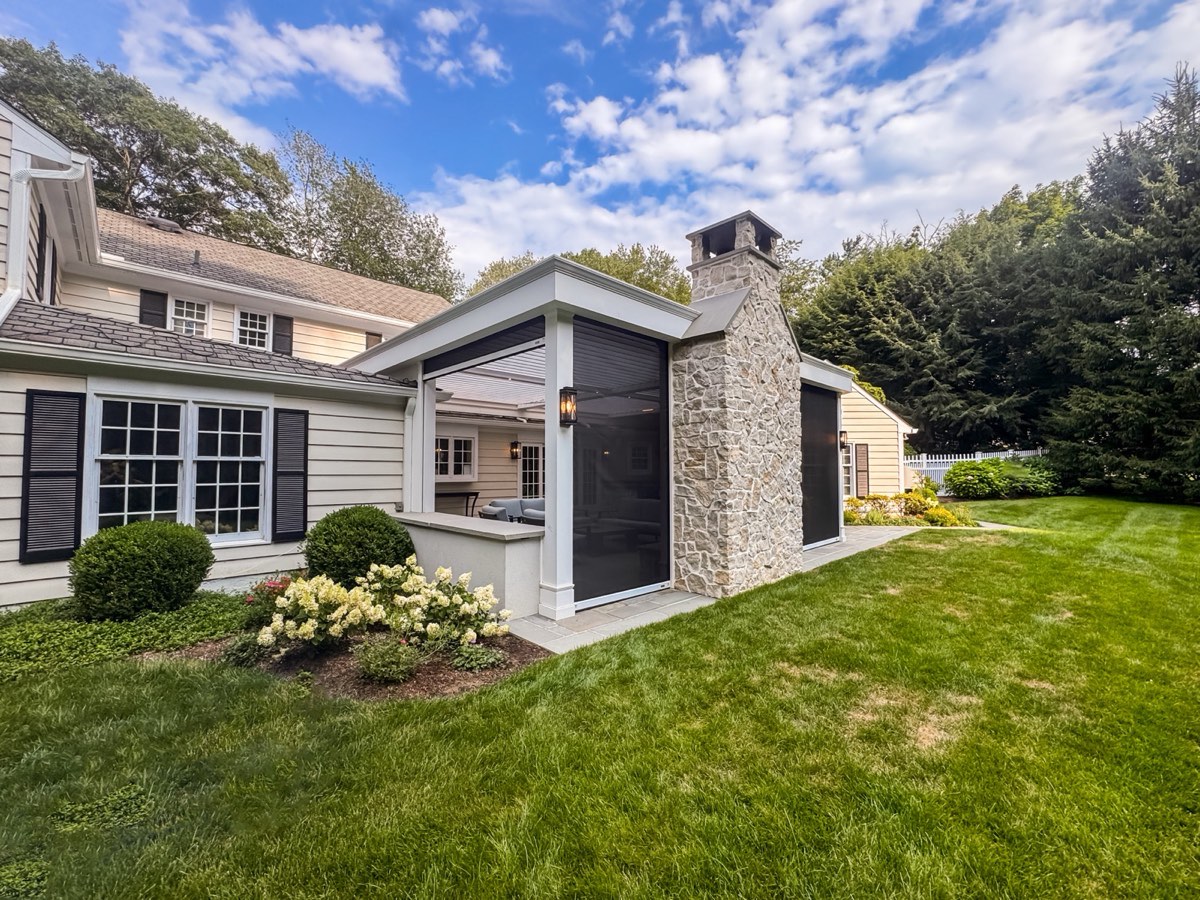
Keep the View, Lose the Insects
Mesh selection matters as much as the mechanics. A tighter insect mesh does the job at dusk but can dim the view slightly during the day; a more open solar or privacy mesh trades a bit of insect control for a clearer sightline. Most porch conversions mix mesh types across openings — tighter mesh facing the yard where bugs approach, a lighter option on a side that mostly needs privacy or glare control. The goal is a porch that still feels like a porch, not a screened box.
This is where a retrofit conversion genuinely outperforms a fixed screened porch built from scratch: because the mesh is retractable, there's no need to compromise on one mesh type for the whole space. Daytime use can run fully open with an unobstructed view, and evening use can close whichever specific openings actually need protection.
Scoping Your Porch
Every conversion starts the same way every Breslow project does: a free design consultation on Zoom to walk through your porch, discuss mesh and mounting options, and set a realistic range before any measurements are taken. If it's a mutual fit, a designer visits to measure precisely and confirm structural attachment points. Porch screen conversions typically fall outside major building permitting, though electrical work for motorization can still require a permit in some towns — where permits are needed, we handle or assist with the process, and your designer will confirm what applies to your specific porch.
Ask your contractor: what happens to the mesh and motor housing when it rains hard or the wind picks up unexpectedly?
Installation runs three to five days on-site once the project is scheduled, typically four to six weeks from order confirmation, handled entirely by Breslow's own crews. After that, the same company that installed it is the one you call for service for the life of the product.
Frequently Asked Questions
Can retractable screens be added to an existing porch?
Yes. Breslow measures existing porch openings precisely and custom-fabricates mounting brackets and track housings sized to the current framing, since most porches weren't built with a screen system pre-designed into the structure.
Are retractable screens as effective at keeping bugs out as fixed screens?
When deployed, retractable screens use the same mesh technology as fixed panels and are just as effective at blocking insects. The difference is that retractable systems only need to be closed when you actually want that protection, rather than permanently.
Do retractable porch screens need a permit?
Porch screen conversions typically fall outside major construction permitting, though electrical work required for motorization can trigger a permit requirement in some towns. Where a permit is needed, Breslow handles or assists with the entire process.
What happens to motorized screens in wind or rain?
Wind-rated mesh is designed to hold tension in exposed conditions, and many systems include wind and rain sensors that automatically retract the screens ahead of weather that could stress the mesh or the motor.