Key Takeaways
- Exterior solar shades intercept heat and glare before they reach glass or a seating area, which is inherently more effective than blocking sun after it's already indoors.
- Openness factor — how much of the mesh weave is actually open — is the spec that determines the tradeoff between view and light versus heat and glare rejection.
- West-facing rooms and patios see the harshest late-day sun and are the clearest use case for solar shades.
- Solar shades are motorized and retractable, so a room gets full sun when you want it and controlled shade when you don't, without a fixed awning or roof overhang.
Glare: the Underrated Problem
Heat gets all the attention in this conversation, but glare is usually what actually drives someone to do something about it. A west-facing living room or patio hits a point most afternoons where the TV washes out, a laptop screen is unreadable outside, and everyone in the seating area is squinting instead of relaxing. The reflexive fix is to close a curtain or blind, which solves the glare and eliminates the view in the same motion — the exact tradeoff nobody actually wants.
Exterior solar shades exist for precisely this gap: cutting the glare and the worst of the heat without giving up the reason you have the window or the patio in the first place.
There's a comfort-and-cost angle beyond glare itself. A room absorbing direct afternoon sun through unshaded glass runs noticeably warmer than the same room with that heat intercepted outside, which means cooling systems work harder to compensate and an outdoor seating area near that glass simply gets less use during the hottest part of the day. Cutting the glare and the heat load together solves both problems with one motorized system rather than two separate fixes.
How Solar Mesh Works
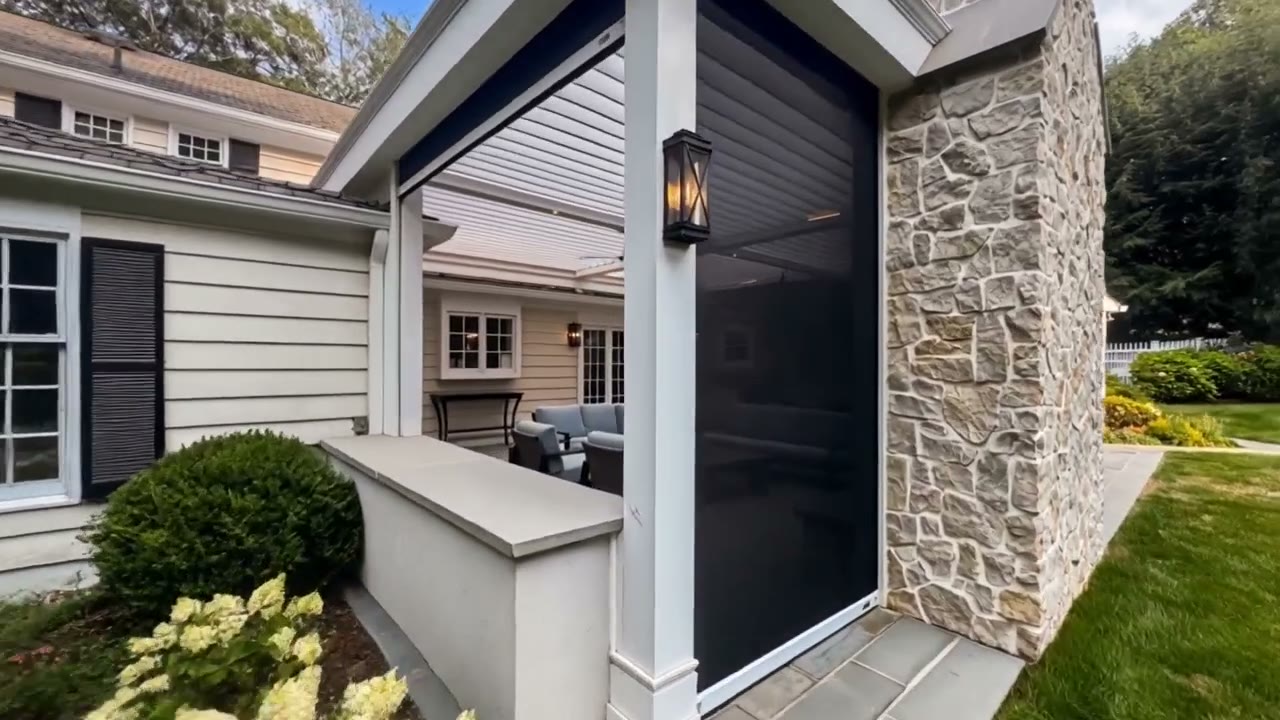
Solar mesh is a woven fabric, not a solid panel — a tight weave of coated yarns with small, consistent perforations running through it. Those perforations do the actual work: they block or absorb a meaningful portion of solar radiation and glare while still letting some light and a partial view pass through the weave. Mounted outside the glass rather than behind it, the shade is motorized like Breslow's other retractable screen products — lowered by remote, app, or a sun sensor when the angle gets harsh, and retracted fully when it doesn't.
Mesh color plays a role too, beyond the openness factor itself. Darker weaves tend to preserve more outward visibility while still cutting glare, since less light reflects back at the viewer; lighter weaves reflect more of the sun's energy but can make the shade feel more like something you're looking at rather than through. Matching color to the structure's finish, not just its function, is part of a proper design pass.
Openness Factor: the Spec That Matters
The single spec that actually determines how a solar shade behaves is its openness factor — the percentage of the weave that's physically open versus woven solid. A tighter weave with a lower openness factor blocks more heat and glare but reduces visibility through it more; a more open weave preserves a clearer view and more natural light but lets more heat and glare through with it. Neither end of that spectrum is universally correct — a home theater or a TV-facing patio might want a tighter weave, while a dining terrace that just needs the afternoon edge taken off benefits from something more open.
West-Facing Rooms and Patios
West exposures get the worst of it because late-day sun sits low on the horizon, coming in at an angle that a roof overhang or even a pergola's louvers can't fully block — the sun is coming from the side, not from directly overhead. That's exactly the scenario a vertical exterior shade is built to handle, cutting the low-angle glare and heat at the opening itself. As a secondary benefit, the same shade that's protecting your view is also protecting furniture, flooring, and fabrics from the UV exposure that fades them over a season.
On a covered patio, a solar shade and a pergola's roof louvers are solving two different angles of the same problem. The louvers manage direct, overhead sun; the vertical shade manages the low, sideways light that slips in underneath as the sun drops toward the horizon. Used together, the combination closes a gap that either system leaves open on its own.
Ask your contractor:
"Can I see this mesh's openness factor held up against direct afternoon sun, facing the same direction my room actually faces? A sample under indoor lighting won't tell you anything useful."
Exterior vs. Interior Shading
Exterior and interior shading solve related but different problems. An exterior solar shade intercepts solar heat before it ever transfers through the glass, which is inherently more effective than an interior blind trying to manage heat that's already trapped in the room. Interior treatments still have a role — added privacy, finer light control at night, a design layer that matches the interior — but for the specific problem of a hot, glary room, the exterior shade is doing the heavier lifting. Many homeowners end up using both, in the same way a home might have both a pergola roof and interior curtains: different layers for different jobs.
| Factor | Exterior solar shade | Interior shade or blind |
|---|---|---|
| Where heat is stopped | Before it reaches the glass | After it's already indoors |
| View while deployed | Partial, depending on openness factor | Reduced or fully blocked when closed |
| Furnishing UV protection | Reduces fade at the source | Some protection, after exposure through the glass |
| Typical control | Motorized — remote, app, or sensor | Manual, or motorized indoors |
Choosing Your Mesh
The right openness factor and mounting approach depends on the room's orientation, how it's used, and whether it's a standalone patio opening or part of a larger structure. Solar shades integrate the same way as Breslow's other motorized screens — concealed tracks and motors where they're designed into a structure from the start, or added to an existing opening as a standalone system. A Zoom design consultation is where a designer looks at your specific exposure and works out which mesh actually fits before anything is ordered.
Frequently Asked Questions
What are exterior solar shades and how are they different from blinds?
Exterior solar shades are motorized mesh screens mounted outside a window, patio opening, or under a structure, designed to block a portion of the sun's heat and glare before it reaches the glass or seating area. Interior blinds do their work after the heat is already inside, which makes them a comfort layer rather than the primary defense against a hot room.
Do solar shades block the view completely?
No — that's the point of the mesh weave. Depending on the openness factor chosen, you can see through a solar shade at varying degrees of clarity while it filters glare and heat, unlike a solid blind or curtain that blocks the view entirely when closed.
Are exterior solar shades better than interior shades for heat control?
Generally, yes, for heat specifically — intercepting solar heat before it transfers through the glass is inherently more effective than trying to block heat that's already trapped indoors. Many homeowners use both: exterior shades to manage the bulk of the heat and glare, interior treatments for additional light control and privacy.
Can solar shades be motorized and integrated with a pergola?
Yes. Solar shades use the same motorized, retractable approach as Breslow's other screen products and can be integrated into the vertical openings of a pergola or installed as a standalone system on an existing patio or window opening, controlled by remote, sensor, or app alongside the rest of the structure.