Key Takeaways
- The R-Blade™'s motorized louvers rotate from fully open to fully closed, so the same structure can let sunlight in or seal out rain entirely.
- Closed, the system is engineered to be weather-tight and is wind-rated up to 195 mph, Miami-Dade hurricane certified.
- The R-Blade™ (adjustable louvers) and the R-Shade™ (solid, fixed roof) are two different Breslow products — the right one depends on how the space will be used.
- Every project, including those in Fairfield County, CT, starts with a free Zoom design consultation.
“You get some sunlight in — as opposed to a fixed roof where it just blocks it off completely. But you're always rainproof too.”
— Homeowners, Fairfield County CT
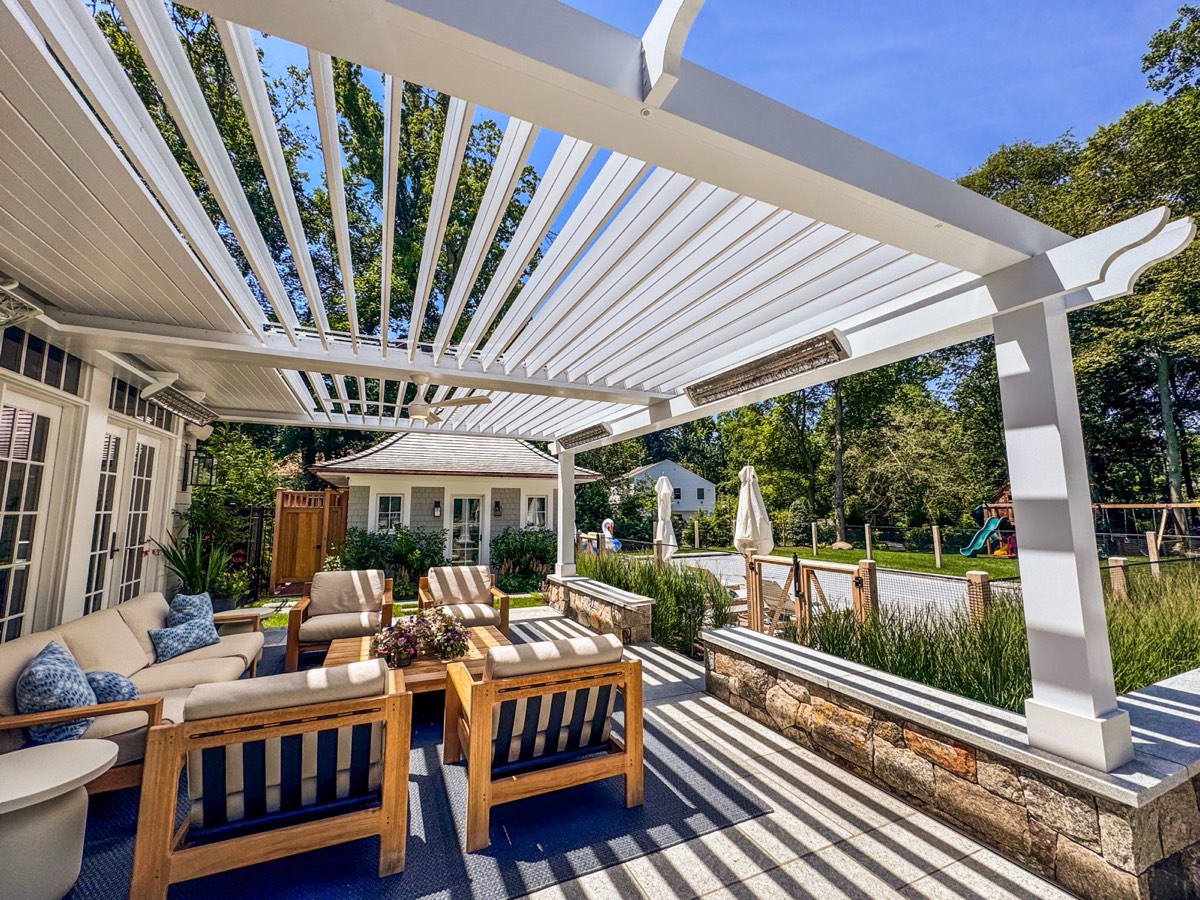
One of the most common comparisons homeowners make when researching an outdoor structure is louvered roof versus fixed roof. This Fairfield County, Connecticut client puts the difference in a single sentence in the clip above: with the louvers partially open, sunlight still gets through — "as opposed to a fixed roof where it just blocks it off completely." And when the weather turns, the same structure closes down and stays rainproof.
What This Client Is Describing
The homeowner is describing the R-Blade™'s core advantage over a solid roof: it isn't locked into one position. Left partially open, it filters light into the space and, by extension, into the house behind it through adjoining windows and sliding doors. Closed, it behaves like a solid roof — shedding water and blocking direct sun completely. The same structure delivers both experiences depending on how it's set, which is the point of a motorized louvered system rather than a fixed one.
That flexibility is exactly what a lot of homeowners underestimate when they start researching outdoor structures. Most people picture a roof as a single, permanent decision — open sky or full coverage, one or the other. A motorized louvered system removes that tradeoff, and this client's comparison to a fixed roof is a plain, first-hand way of describing what that actually looks like day to day rather than in a spec sheet.
The Engineering Behind It
The R-Blade™ rotates its louvers by remote control or automatic weather sensor across multiple positions — fully open, partially angled, or fully closed — rather than offering a single fixed state. Closed, the system is engineered to be weather-tight and is wind-rated up to 195 mph, Miami-Dade hurricane certified. That combination is what lets a homeowner leave the roof mostly open on a clear afternoon for light and airflow, then close it in minutes — by remote or automatically via sensor — before a storm rolls through.
How Much Weather the System Actually Handles
Beyond the marketing shorthand of "wind-rated up to 195 mph," the underlying spec table gets more specific depending on configuration: open louvers are rated up to 190 mph on standard sizes, and closed louvers range from 95 to 190 mph depending on louver length. Snow load capacity runs 25 to 100 pounds per square foot when open and 25 to 55 pounds per square foot when closed. Those numbers vary by the exact structure being engineered, which is why a licensed engineer signs off on the final design for every project — the marketing figure is a ceiling, not a guarantee for every configuration.
R-Blade™ vs. a Solid Roof
It's worth being precise about the two different Breslow products this comparison touches on. The R-Blade™ is the motorized louvered pergola described above — adjustable, with light passing through when open. The R-Shade™ is a separate product: a solid, insulated roof pergola built for homeowners who want permanent, fixed coverage rather than an adjustable one. Neither is a screen product, and the right choice between them comes down to whether you want a structure that flexes with the weather or one designed to hold a single, permanent condition. That's a conversation worth having directly with a Breslow designer, since the right fit depends on how the space is used and where it sits relative to the house.
See It for Yourself
Watching a louvered roof operate — hearing the motor, seeing the light change as the louvers rotate — communicates the difference better than any spec sheet. This client's clip is part of Breslow's client stories library, and the process video walks through how a project like this one moves from first consultation to a finished structure. From there, the project portfolio includes completed work across Fairfield County and the broader tri-state area, and every project begins with a free Zoom design consultation — a Breslow designer walks the space with you, discusses a realistic investment range, and only schedules an in-home visit with a Matterport scanner once there's a mutual fit.
Frequently Asked Questions
Does a louvered pergola actually keep rain out?
Yes — when the louvers are rotated to the closed position, the R-Blade™ is engineered to be weather-tight, similar to a solid roof. It's also wind-rated up to 195 mph and Miami-Dade hurricane certified.
Will the pergola block light from reaching my house?
With the louvers open or partially open, sunlight continues to pass through and reach windows or sliding doors behind the structure. A fully closed position behaves more like a solid roof and blocks more direct light, which is the tradeoff of closing the system down for weather protection.
What's the difference between the R-Blade™ and the R-Shade™?
The R-Blade™ is a motorized louvered pergola that adjusts between open and closed. The R-Shade™ is a separate, solid insulated roof pergola built for permanent coverage. Neither is a screen product — they're two different structures for two different goals.
How do we get started on a project in Fairfield County, CT?
Every Breslow project begins with a free design consultation on Zoom, where a designer walks through the space with you and discusses a realistic investment range. If it's a mutual fit, the next step is an in-home visit with a Matterport scanner for precise measurements.