Key Takeaways
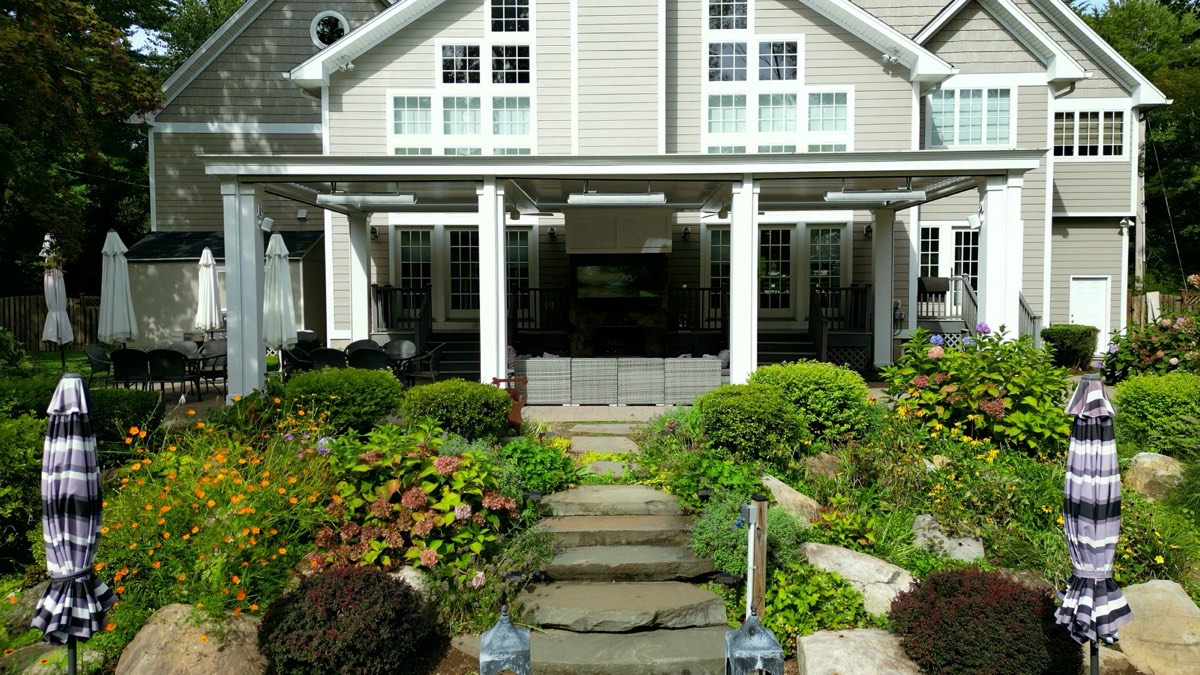
- This Norwood, NJ homeowner describes a patio footprint that used to be scorching and unusable in summer, now comfortable even on a really hot day.
- The Azenco R-Blade™'s louvers rotate to block direct sun on demand, which is the main driver of heat on an exposed, unshaded patio.
- Because the louvers are motorized rather than fixed, the same structure can open fully on milder days rather than casting permanent shade year-round.
- A design consultation can assess your specific footprint and sun exposure to estimate how much of the season a shaded structure would actually give back.
“This footprint used to just get scorching in the summertime — it was unusable. With the pergola, even on a really hot day, it's comfortable.”
— Homeowners, Norwood NJ
A Patio That Sat Empty All Summer
It's a common story: a patio or deck footprint that looked great on paper but, in practice, was too hot to sit on for most of the summer. Direct, unbroken sun exposure through the hottest stretch of the year turns a lot of outdoor spaces into something homeowners walk past rather than use — furniture that sits empty, a grill nobody wants to stand next to at 2pm, a space that only becomes usable again once the sun starts going down. That's exactly what this Norwood, NJ homeowner describes about their own footprint before installation: scorching, and effectively unusable, during the summer months.
It's rarely a design or build problem — the patio itself is often sized and positioned exactly right. What's missing is any way to control the one variable that actually drives outdoor comfort: hours of direct, unbroken sun with nothing overhead to interrupt it.
What Actually Changes the Temperature Underneath
Breslow installs the Azenco R-Blade™, a motorized louvered pergola whose blades rotate to control direct sun exposure to the space below. Blocking direct sun is the single biggest factor in how hot an outdoor surface and the air just above it actually feel — more so than ambient air temperature alone. Closing the louvers over a previously exposed footprint removes that direct sun load, which is the mechanism behind this client's account of a "scorching" space becoming "comfortable... even on a really hot day."
The advantage over a permanent fixed roof or a solid awning is that the same structure isn't locked into constant shade. On cooler, milder days, or in shoulder seasons when full sun is welcome rather than unbearable, the louvers can open fully, and the space reads as open-air again rather than permanently shaded. It's a structure that responds to what a given day actually calls for, rather than a single, unchanging condition.
That same control extends past summer. Paired with heating options like Bromic or Infratech, closing the louvers on a cool fall evening holds warmth in rather than blocking sun, which is why the same structure tends to stretch usable months at both ends of the season, not just through the hottest weeks.
What This Means for a Space You've Given Up On
If you have a patio, deck, or backyard footprint that's effectively written off for two or three months a year because of direct sun, that's precisely the scenario this client's account speaks to. The fix isn't necessarily a full renovation or a change of location — it can be shade applied specifically to the existing footprint, engineered to control exactly when and how much sun reaches it. Reclaiming a space you've already built, rather than starting over somewhere else, is often the more direct route back to using it.
See the Norwood Project
You can see more of this client's Norwood, NJ project in our portfolio, along with the R-Blade™ pergola that made the space usable again. More clients describe similar before-and-after accounts in our testimonials. If you have a footprint you've given up on for the summer, a free Zoom design consultation is the place to find out what changing that would actually look like.
Frequently Asked Questions
Can a louvered pergola actually make a hot patio usable in summer?
Yes, based on this Norwood, NJ homeowner's account — a footprint they describe as "scorching" and "unusable" in summer became comfortable, even on a really hot day, once the Azenco R-Blade™ louvered pergola was installed.
How does closing the louvers reduce heat if it blocks the sun like a solid roof?
The Azenco R-Blade™'s louvers rotate to block direct sun exposure on demand, which is the primary driver of surface and ambient heat on an unshaded patio. Unlike a permanent solid roof, the louvers can also open fully on milder days, so the space isn't shaded year-round when shade isn't needed.
Do I need extra cooling like fans or misters to make an outdoor space usable in summer heat?
Not necessarily — blocking direct sun exposure with closed louvers addresses the main source of heat on an exposed patio on its own. Fans, misting systems, and other add-ons can be discussed during a design consultation, but the shade itself is often the biggest single factor in comfort.
Is a louvered pergola worth it if my patio is only unusable during peak summer?
That's exactly the scenario this client describes — a space that used to be given up on entirely during the hottest stretch of the year and is now comfortable throughout it. A design consultation can walk through your specific footprint, sun exposure, and how much of the season you'd actually reclaim.