Key Takeaways
- Adjustable louvers rotate on a motorized axis — controlled by remote, app, or automatic sensors — rather than sitting fixed in one position.
- Three operating modes cover every condition: fully open for sun and airflow, tilted for partial light control, and sealed closed for maximum weather protection.
- Breslow's R-Blade™ is the adjustable flagship, wind-rated up to 195 mph and Miami-Dade hurricane certified; R-Breeze™ is a fixed-louver alternative built for ventilation, not Miami-Dade approved.
- You can preview how the louvers rotate and open before your first call using Breslow's 3D pergola configurator.
Ten years ago, a louvered pergola meant a fixed set of slats, angled once at installation and left that way for the life of the structure. The system that's taken over the category does something different: the louvers themselves rotate, on command or automatically, turning a static roof into a control surface for light, air, and weather. That single mechanical change is the entire reason "adjustable louvered pergola" has become the term buyers search for instead of just "pergola."
What "Adjustable" Actually Means
An adjustable louvered pergola uses individual aluminum blades mounted on a rotating axis rather than a fixed frame. Each blade turns through a set range of motion, and the blades move together, controlled by a single motor per bay. The result looks like a conventional pergola roof when closed, but functions closer to a set of oversized window blinds mounted overhead — one that happens to be engineered to carry snow and hold up in a coastal storm.
The blades themselves aren't cosmetic trim. Each one is an extruded aluminum profile engineered to carry its share of the roof's structural load in every position, whether the pergola is open to the sky or sealed shut against a storm. That's the meaningful difference between an adjustable system and something built purely for shade: the louvers are load-bearing components at all times, not fair-weather panels that happen to move.
The Mechanics: Louvers, Motor, Sensors
Breslow installs the Azenco R-Blade™, a motorized louvered pergola system available in 200+ RAL colors, where a central motor drives the rotation of every louver in a bay simultaneously through a linked arm system. Rain and wind sensors are standard on a properly specified system — not an upgrade — because the whole point of automation is that the roof responds whether or not anyone is standing outside to notice the sky changing. A remote handles day-to-day use; many owners pair the system with app or smart-home control for scheduling and away-from-home operation.
The motor itself is housed inside the structure's central beam rather than bolted on as a visible box, which keeps the sightline clean and protects the mechanism from weather. Wiring runs concealed through the posts, the same integrated approach used for the pergola's drainage system — nothing about a properly installed motorized pergola should look like hardware was added after the fact.
“We usually leave it here and then if we're gone for the day and it starts to rain, the sensors close it for us.”
— Homeowners, Fairfield County CT · watch real client clips
Open, Tilted, Sealed: The Three Modes
The louvers move through three functional positions. Fully open, the blades stand near-vertical, maximizing airflow and letting direct sun through — the summer-afternoon setting. Tilted, the blades sit at an angle that filters harsh overhead sun while still allowing light and air through, the setting most homeowners actually leave the system in for the majority of the season. Fully closed, the blades overlap and seal, shedding rain through an integrated gutter and drainage system built into the structure itself rather than dripping through gaps in the roof.
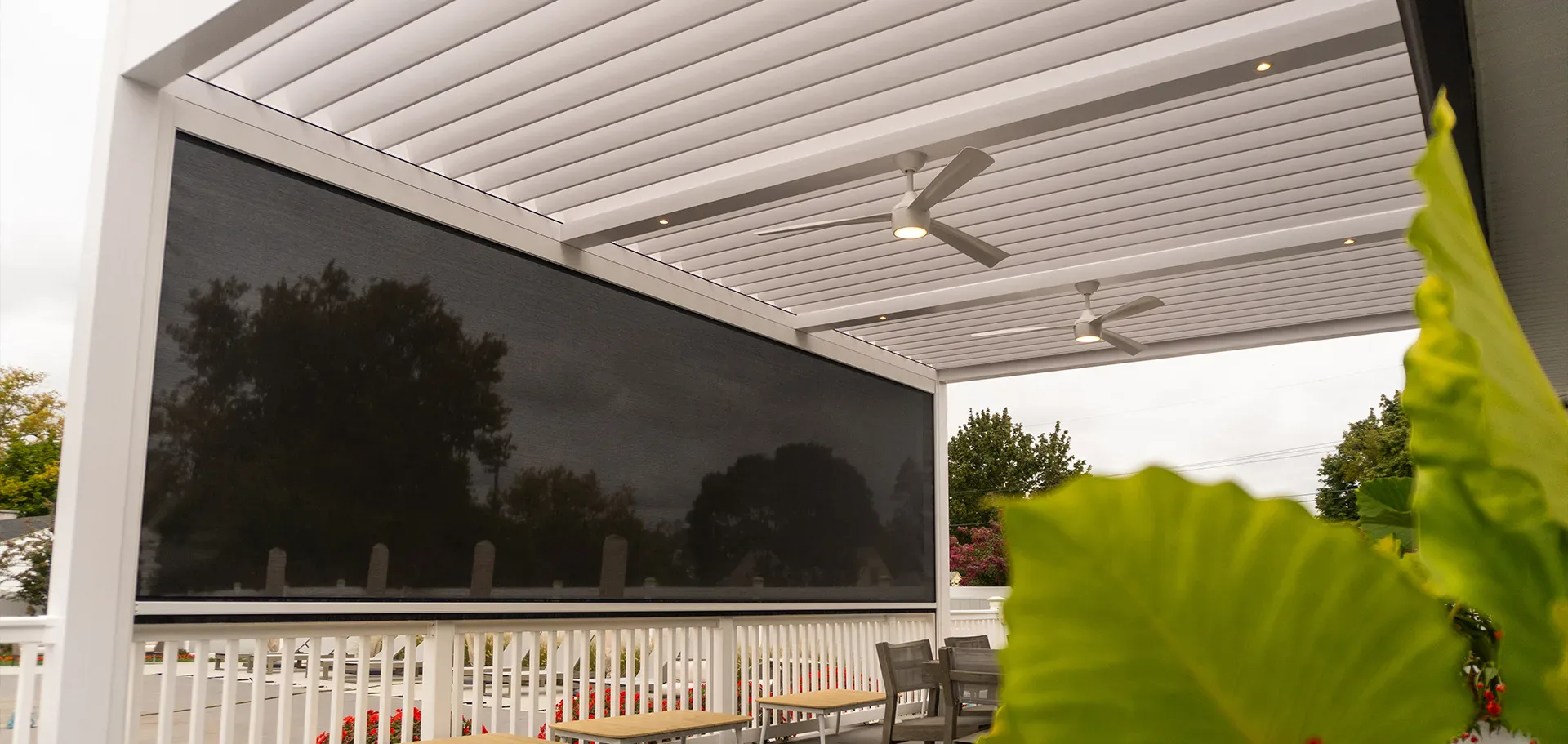
Adjustable vs. Fixed Louvers
Not every Azenco system Breslow installs adjusts. The R-Breeze™ is an open-frame, fixed-louver pergola built for ventilation rather than weather sealing — a legitimate, lower-cost option for covered spaces that don't need to seal against rain. The trade-off is real: a fixed system can't close in a downpour, and it isn't Miami-Dade approved the way the R-Blade is. The comparison below outlines where each system actually fits.
| Feature | R-Blade™ (Adjustable) | R-Breeze™ (Fixed) |
|---|---|---|
| Louver operation | Motorized, rotates open to closed | Fixed open-frame position |
| Rain sealing | Yes, closed position sheds water through integrated drainage | No — ventilation only |
| Wind rating | Up to 195 mph, Miami-Dade certified | Up to 175 mph on small spans; not Miami-Dade approved |
| Best fit | Year-round outdoor rooms, kitchens, entertaining spaces | Shade-focused, ventilation-first covered spaces |
In practice, the choice comes down to what the space is for. A covered porch used mainly for shade during the day, with no plans to eat or entertain through a downpour, can do perfectly well under an R-Breeze. A kitchen, a dining area, or any space meant to function through unpredictable Northeast weather is where the adjustable system earns its higher spec — see examples of both installed in our project portfolio.
Automation: Rain and Wind Response
The sensor package is what separates a genuinely adjustable system from a motorized novelty. A rain sensor triggers the louvers to close automatically the moment precipitation is detected, protecting furniture, a grill, or an open kitchen underneath without anyone needing to run outside. A wind sensor does the opposite job in a storm — moving the louvers toward a safer, closed or partially closed configuration when gusts exceed a set threshold, consistent with the closed-position wind ratings a licensed engineer specifies for the site. Together, they turn the roof from something you operate into something that protects itself.
That automation matters most exactly when no one's around to react to it — a sudden afternoon storm while the house is empty, or high wind overnight. A homeowner away for a long weekend doesn't have to guess whether they left the roof open; the sensors handle it the same way whether anyone's home or not. Many owners also layer in scheduling through app or smart-home control, closing the louvers automatically at dusk or opening them each morning without touching a remote.
Ask your contractor: are the rain and wind sensors standard equipment on the system they're quoting, or an add-on priced separately? On a properly specified motorized pergola, automation isn't an accessory — it's the point.
Configure One in 3D
Reading spec sheets only tells you so much about how a rotating louver roof actually feels on your own patio. Breslow's 3D pergola configurator lets you place a structure on a rendering of your actual home, adjust the size and color, and watch the louvers move between open, tilted, and sealed positions before you ever sit down for a consultation. From there, the process is the same as any Breslow project: a free design consultation on Zoom, a realistic investment range up front, and — if it's a mutual fit — precise measurements and full 3D renderings on your actual house, followed by an install that typically runs four to six weeks from order confirmation with three to five days of work on site.
Frequently Asked Questions
What does "adjustable louvered pergola" mean?
It refers to a pergola roof made of individual aluminum louvers that rotate on a motorized axis, rather than sitting fixed in one position. The louvers can open fully, tilt to filter light, or close completely to shed rain.
How do the louvers open and close?
A central motor drives a linked arm system that rotates every louver in a bay at the same time, controlled by remote, app, or automatic rain and wind sensors.
What's the difference between an adjustable and a fixed-louver pergola?
An adjustable system like the R-Blade rotates between open, tilted, and sealed positions and sheds rain through integrated drainage. A fixed-louver system like the R-Breeze stays in one open-frame position, built for ventilation rather than weather sealing, and is not Miami-Dade approved.
Can I see how an adjustable louvered pergola works before I buy one?
Yes. Breslow's 3D pergola configurator lets you place a structure on your own home and watch the louvers move between open, tilted, and closed positions before your first consultation.