Key Takeaways
- Motorized retractable screens lower only when needed — typically at dusk — and retract fully out of sight during the day, so the space never looks or feels like a boxed-in porch.
- Insect mesh is a fine, purpose-built weave that stops mosquitoes and no-see-ums while preserving airflow and sightlines — a different product than the denser mesh used for privacy.
- Concealed motors and tracks, recessed into the posts and beams of the structure, mean there's no visible hardware when the screens are open.
- Pairing screens with ceiling fans and layered lighting is what actually extends comfortable dining well past sunset, without adding a fixed room to the house.
The 7pm Problem
Every outdoor dining table in the Northeast hits the same wall around dusk. The light goes gold, the air cools, and the mosquitoes arrive on schedule — right as dinner is supposed to start. Homeowners near wooded lots, ponds, or anything with standing water know the drill: guests start slapping at their arms, someone reaches for a candle that does nothing useful, and the table empties out earlier than anyone planned.
The traditional fix is a screened porch, and it works — but it's also permanent. Fine mesh panels, visible framing, and a room that reads as a room whether or not it's actually closed. For homeowners who built an open, architectural outdoor space specifically to avoid that boxed-in feeling, trading it for a screened enclosure defeats the purpose.
There's a design cost to that fix that's easy to underestimate. A dining pergola built with clean sightlines to the yard, a pool, or a piece of landscaping loses exactly what made it worth building in the first place once it's wrapped in fixed screening year-round. The goal isn't just fewer bites at the table — it's keeping the architecture the reason people wanted to eat outside, screens or not.
Screens on Demand, Invisible by Day
A motorized retractable screen solves the actual problem — bugs at dusk — without solving it permanently. The mesh lowers by remote or app when you need it and retracts fully out of sight when you don't. During a sunny lunch, the space reads as completely open. By 7pm, the same space closes off in seconds, with no framing to install, no panels to store, and no compromise on the architecture the rest of the year.
Breslow's approach concentrates on where the mechanism lives. Tracks recess into the posts and beams of the structure itself, and the motor housing hides within the frame, so a retracted screen leaves nothing to see — no rail, no box, no seam. That's the differentiator worth asking about directly: a screen system that vanishes into the architecture rather than one that's bolted onto it. Full detail on the category lives at motorized screens.
Ask your contractor:
"When the screen is fully retracted, what am I actually looking at? Ask to see it in person, not in a rendering — a concealed system disappears; a surface-mounted one just gets out of the way."
“I love that it's so tall — it doesn't feel closed in at all. That was my biggest fear… you still feel open, and when you're in the house looking out, it's still open.”
— Homeowners, Fairfield County CT · watch real client clips
Mesh That Stops Insects, Not Views
Insect mesh is its own category, engineered differently than the mesh used for sun control or privacy. It's a fine, tight weave sized specifically to block mosquitoes and no-see-ums — the two insects that actually end an outdoor dinner — while staying open enough to preserve airflow and see straight through it. Sit at the table with the screen down and the conversation looks the same as it did with it up; you've lost the bugs, not the evening.
That's worth stating plainly, because a lot of homeowners assume any bug screen means a hazy scrim between them and the yard. It doesn't have to. The right mesh, sized and tensioned properly on a concealed track, holds flat and nearly disappears visually even while it's doing its job.
Mosquitoes and no-see-ums both do their worst work in the same narrow window — the hour or two around dusk when the air stills and the light fades, which is exactly when most dinner parties are just getting started. A mesh engineered specifically for that problem, rather than a generic all-purpose screen, is what keeps the difference invisible until you actually need it.
A Long Island Dining Room
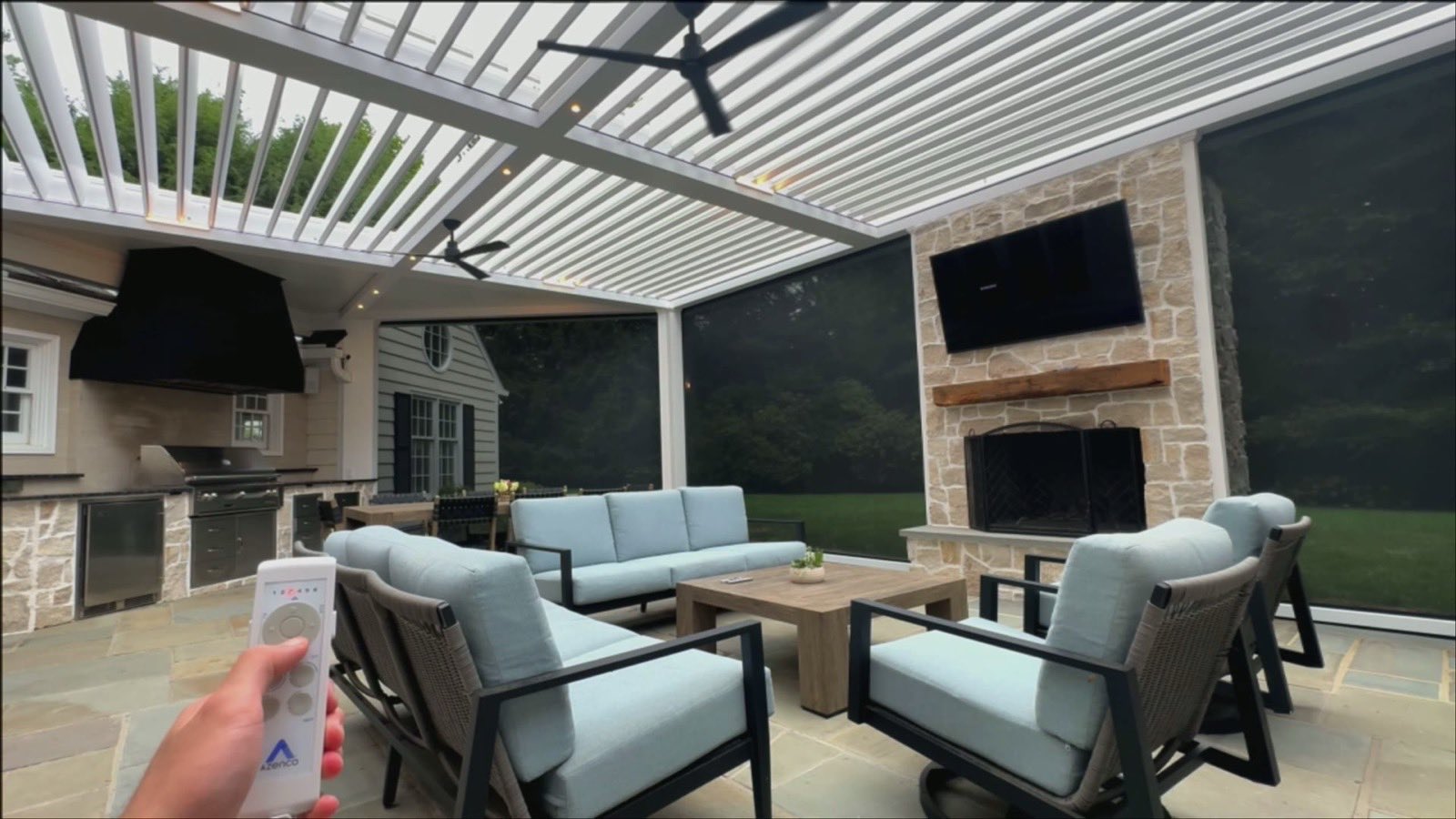
One of the clearer examples of this in practice is a project on an Old Westbury, NY property, where the outdoor dining area sits under a structure designed from the start to take motorized screens on its open sides. During the day, the room is fully open — no visible hardware, no sense that screens are even part of the design. At dusk, the mesh lowers in seconds, closing off the sides while the rest of the structure keeps doing its own job overhead — one coordinated system rather than two separate additions bolted on years apart. It's the kind of detail that only shows up when the screen was planned into the structure from the start.
Pairing With Ceiling Fans and Light
Screens solve the insect problem, but comfort after dark is a layered question. A ceiling fan keeps air moving under a closed screen so the space doesn't feel stuffy, especially on humid summer nights when there's little natural breeze. Lighting does the rest of the work — a mix of ambient overhead light, lower task lighting at the table, and something warmer at the edges keeps a screened dinner from feeling like it's lit for a stage rather than a meal.
None of this needs to be an afterthought. When screens, fans, and lighting circuits are planned alongside the structure itself, the wiring and controls end up hidden in the same places the screen tracks do — one coordinated design instead of three separate retrofits down the line.
Reclaim Your Evenings
The honest case for motorized bug screens isn't that they beat a screened porch in every way — a fixed porch still has its place on some properties. It's that they let an open, architectural outdoor room stay open by default and close only when the bugs show up, which for most of the season is a couple of hours a night, not all day. A design consultation, done over Zoom, is where a Breslow designer maps your specific openings, sun exposure, and dining setup to figure out exactly which sides need screens and which don't — before anything is priced or ordered.
Frequently Asked Questions
Do motorized bug screens actually keep mosquitoes out?
Yes — insect mesh is a fine, purpose-built weave sized specifically to block mosquitoes and no-see-ums while still allowing airflow and full visibility through it. It's a different mesh than the denser weave used for privacy or sun control, chosen specifically for the insect-blocking job.
Will bug screens make my outdoor dining area feel closed in?
Not when they're motorized and retractable. The mesh stays fully retracted and out of sight during the day, so the space reads as completely open, and only lowers when you actually need it — typically around dusk. Concealed tracks and motors, recessed into the structure, mean there's no visible hardware even when the screen is up.
Can motorized screens be added to an existing dining pergola or porch?
In many cases, yes, though the fully concealed integration Breslow prefers is easiest to achieve when the screens are designed into a structure from the start. Retrofitting an existing structure is possible but may involve surface-mounted hardware or some structural modification — a detail your designer can assess during a video or on-site consultation.
How is a motorized screen different from a permanent screened-in porch?
A screened-in porch is a fixed room — screens are always there, whether you need them or not. A motorized retractable screen is on-demand: it disappears completely when the space should feel open and lowers in seconds when insects become a problem, without permanently changing the architecture of the space.