Key Takeaways
- Breslow's commercial pergola projects average roughly six times the scale of a typical $75K–$150K residential installation, ranging from about $50,000 to multi-million-dollar rooftop builds.
- Covered outdoor seating extends usable patio season well beyond the four warm-weather months a bare deck typically captures.
- Public-occupancy structures require higher engineering scrutiny — Breslow's R-Blade system is wind-rated up to 195 mph and Miami-Dade certified, with PE-stamped engineering where required.
- Real commercial installs include Tommy's Tavern + Tap's 17-bay rooftop in Edison, three B2 Bistro locations, and Lake Success Country Club's member terrace.
Every restaurant operator with a patio has done this math without writing it down: how many tables sit empty on a 55-degree April evening that would be full in July? A pergola doesn't just add a design feature to the exterior — it adds weeks, sometimes months, of usable seating on either end of the season. For clubs, hotels, and multi-unit hospitality groups, that math scales into real revenue, and it changes what a commercial pergola is actually for.
The Cost of an Empty Patio
Uncovered outdoor seating is weather-dependent seating. A sudden shower closes it instantly; a cool evening thins it out; months of the calendar in the Northeast go largely unused outdoors. Every one of those closed nights is lost covers, lost bar revenue, lost private-event bookings. The operators who've solved this didn't add umbrellas — they added a structure that controls light, sheds rain, and keeps the space open on nights a bare patio would sit empty.
The same math shows up differently at a member club. A club isn't chasing walk-in covers, it's protecting the terrace time members already expect as part of their dues — a rained-out golf outing or a shortened rooftop happy hour is a member-experience problem before it's a revenue problem. Either way, the structure over the space is doing the same job: converting weather-dependent square footage into weather-independent square footage.
What a Commercial System Actually Costs
Residential R-Blade™ louvered pergolas that Breslow designs, engineers, and installs typically run $75,000 to $150,000 for a well-appointed single-family project. Commercial engagements operate on a different scale entirely — from roughly $50,000 for a compact bar addition up into the multi-million-dollar range for full rooftop build-outs at hospitality groups and country clubs. On average, a Breslow commercial project runs about six times the scale of a comparable residential one, because the variables multiply: larger spans, multiple bays, structural integration with an existing building envelope, commercial electrical and life-safety code compliance, and, for rooftop work, crane access and roof-deck engineering that a backyard project never touches.
None of that is a reason to guess at a number. It's a reason to scope the project properly before pricing it, starting with a design consultation.
The Covers-Per-Season Math
Operators think in covers, not square footage. A multi-bay rooftop pergola over a restaurant's outdoor dining room doesn't just look better than a bare roof deck — it turns a fair-weather asset into a near-year-round one. Motorized louvers open on the good nights and close ahead of a storm mid-service, without a staff member running outside to drag furniture indoors. For a member club, the calculation is different but the same shape: extended terrace hours mean more dining minutes captured, more events hosted rain-or-shine, and a member experience that doesn't end when the sky changes.
The revenue case for a commercial pergola isn't abstract. It's the difference between a patio that works four months a year and one that works nine, and for a high-volume dining room, those extra months carry the same margin structure as the months already on the books — no seasonal staffing ramp-up, no menu changes, simply more nights the room is sellable.
Engineering for Public Spaces
Public-occupancy structures carry a higher bar than a backyard build, and that's appropriate — more people, more liability, more scrutiny from building departments. Breslow's R-Blade system is wind-rated up to 195 mph and Miami-Dade hurricane certified, with snow-load engineering considered for both open and closed louver positions on every project. Where required, we provide PE-stamped structural engineering specific to the site — rooftop wind exposure, occupancy load, and attachment to the existing building are never assumed, they're calculated. And where permits are needed, from building department review to fire-marshal sign-off on egress, we handle or assist with the process rather than leaving an operator to navigate it solo mid-renovation.
Rooftop projects add a layer most backyard installations never touch: verifying the existing roof deck can carry the additional structural load, planning crane or hoist access through a dense urban site, and coordinating installation hours around an operating business below. None of that is guesswork on Breslow's projects — it's scoped during the design and engineering phase, before a contract is signed.
Ask your contractor: "Who stamps the engineering for a rooftop installation, and have you built at this scale before?" If the answer is vague, that's your answer.
Projects That Prove the Math
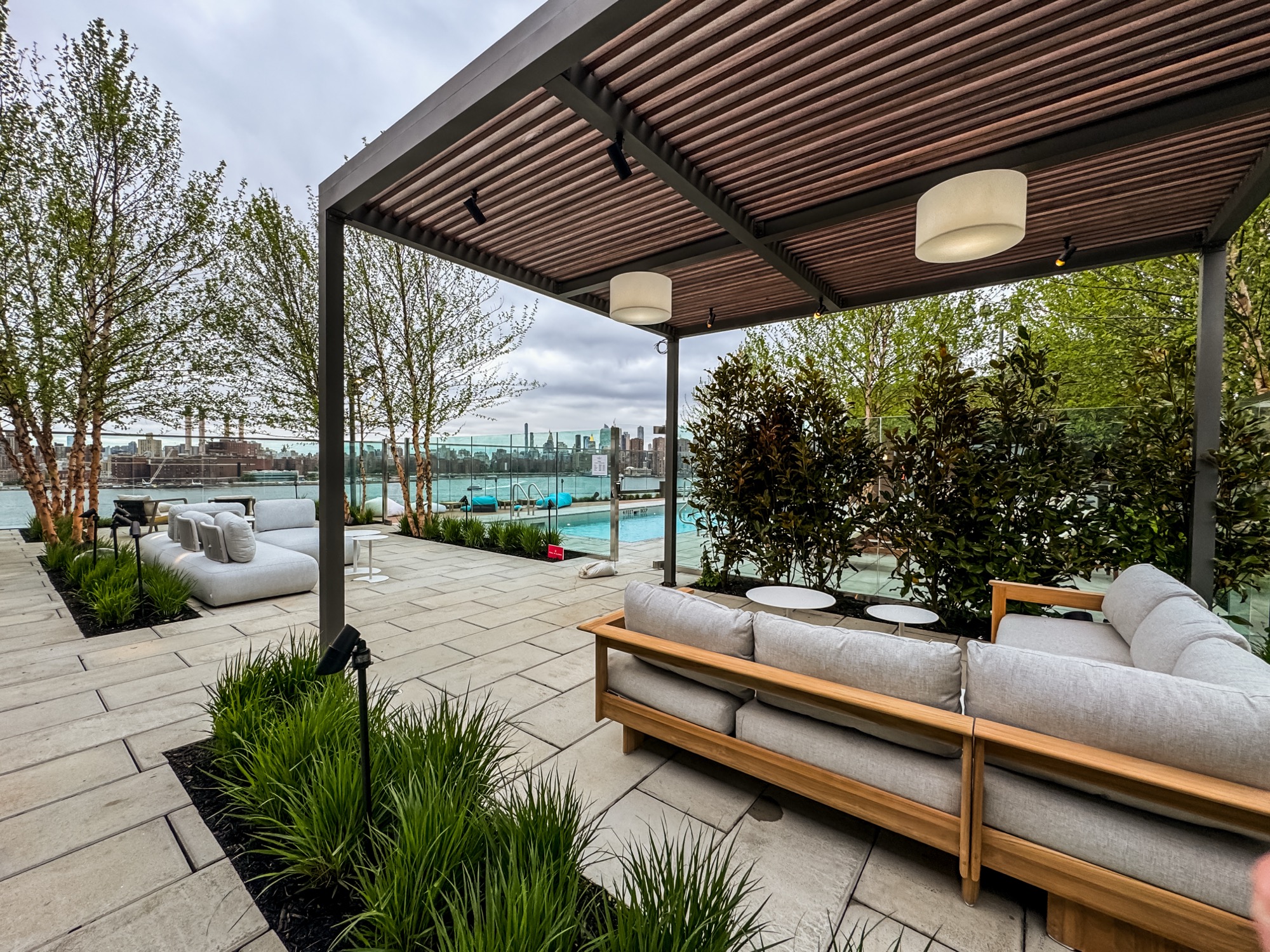
The numbers hold up against real work. Breslow's commercial portfolio includes Tommy's Tavern + Tap's 17-bay rooftop installation in Edison, along with its Clifton, Bridgewater, and Sea Bright locations; three B2 Bistro locations across North Brunswick, Point Pleasant, and Reading, PA; the outdoor terrace at Lake Success Country Club in New York; and rooftop and street-level installations at Grain & Cane, Lotus Rooftop, Urban Top, 100 Connell Drive, and 32 Oakland. Each one is a different building, a different occupancy load, and a different structural challenge — solved by the same in-house team from design through installation.
| Project | Type | Location |
|---|---|---|
| Tommy's Tavern + Tap | 17-bay rooftop dining | Edison, NJ (plus Clifton, Bridgewater, Sea Bright) |
| B2 Bistro | Patio dining, multi-location | North Brunswick & Point Pleasant, NJ; Reading, PA |
| Lake Success Country Club | Member terrace | New York |
| Grain & Cane | Outdoor bar/dining | Bridgewater, NJ |
Scoping a Commercial Project
Commercial projects start the same way residential ones do — with a design consultation on Zoom, not a cold quote. We walk the space digitally, discuss the realistic investment range for the scale you're building, and confirm mutual fit before a designer ever visits the property with a Matterport scanner for precise measurements. From there it's 3D renderings against your actual building, engineering where required, and a schedule most projects meet within 4–6 weeks of order confirmation, with 3–5 days of on-site installation by Breslow's own crews — no subcontractors. After that, Breslow services every product it installs for the life of that product.
Frequently Asked Questions
How much does a commercial pergola cost?
Commercial pergola projects typically start around $50,000 and can extend into the multi-million-dollar range for large rooftop or multi-bay hospitality builds. As a benchmark, Breslow's typical residential louvered pergola runs $75,000 to $150,000, and commercial projects average roughly six times that scale depending on size, structural complexity, and site conditions.
What makes commercial pergola engineering different from a residential one?
Commercial projects generally involve public occupancy, larger spans, multiple structural bays, and integration with an existing building envelope, sometimes at rooftop height. Where required, Breslow provides PE-stamped structural engineering specific to the site, accounting for wind exposure, snow load, and attachment conditions that a backyard project doesn't face.
Can a commercial pergola actually pay for itself?
The return comes from extended usable season rather than a guaranteed formula. Covered, motorized-louver seating stays open through weather that would close a bare patio, capturing more covers, bar revenue, and event bookings across more of the calendar. The right way to evaluate it for your property is during a design consultation, where the specific case can be scoped against your space.
How long does a commercial pergola installation take?
Most projects install within 4 to 6 weeks of order confirmation, with on-site work typically completed in 3 to 5 days by Breslow's own installation crews. Larger or more structurally complex commercial builds, particularly rooftop installations, are scoped individually during the design and engineering phase.