Key Takeaways
- R-Blade is Breslow's motorized louvered roof — adjustable light and rain control, wind-rated up to 195 mph and Miami-Dade certified.
- R-Shade is a solid, insulated fixed roof pergola — never a screen product — built for households that want maximum coverage without daily adjustment.
- The two systems share the same aluminum engineering platform and can be combined in a single multi-bay structure.
- Both product lines follow the same process: Zoom consultation first, PE-stamped engineering where required, and 3–5 days of on-site installation.
Every outdoor structure decision comes down to a single question: how much sky do you want to control, and how much do you want to give up entirely? A louvered roof and a fixed roof pergola solve that question in opposite ways — one keeps the sky adjustable, the other removes the variable altogether. Both are legitimate answers. The right one depends on how a family actually uses the space, not on which looks better in a rendering.
Two Philosophies of Shelter
Breslow installs the Azenco R-Blade™ motorized louvered pergola and the Azenco R-Shade™ solid insulated roof pergola — sister products built on the same aluminum engineering platform, aimed at two different outcomes. R-Blade is a system of individually motorized aluminum louvers that rotate open, closed, or anywhere between, controlled by remote or a weather sensor. R-Shade is a solid, insulated roof — not a screen product, not a canopy, a genuine architectural roof — built for households that have already decided they want maximum coverage, every day, without adjustment.
Neither system is a compromise version of the other. They're engineered for different daily behaviors, and the mistake most buyers make is picking one based on price or appearance alone rather than on how the space actually gets used across a full year.
The Louvered Case: Light on Demand
A louvered roof earns its keep on the days in between — the ones too bright for full sun and too nice to stay fully covered. Rotate the louvers open for filtered light over a lunch table, tilt them to block low afternoon sun without losing the breeze, or seal them flat ahead of a summer storm and keep the patio dry. That range is the entire argument for R-Blade: one structure that behaves differently depending on the day, the season, and the hour. It's also the platform Breslow builds most custom outdoor kitchens and dining rooms around, because louvers double as ventilation — closed against rain, cracked open to vent grill smoke on command.
The tradeoff for that flexibility is a system with moving parts: a motor, a weather sensor, and louvers that need to be engineered to close tightly enough to actually seal against rain rather than just gesture at coverage. That's a meaningful engineering distinction between systems on the market, and it's part of why Breslow specifies Azenco's integrated water management rather than a simpler pivoting-louver design that lets water find its way through.
“It doesn't block the light with the louvers open — you don't notice any difference of any consequence.”
— Homeowners, Norwood NJ · watch real client clips
The Fixed-Roof Case: Set-and-Forget Protection
Not every household wants a decision to make every time they step outside. R-Shade removes the variable: a solid insulated roof overhead, full coverage, every day, with no motor to run or louver position to consider. It suits households that have decided the patio is an all-weather room first and a sun deck second — insulated performance also tempers heat gain in summer and retains warmth better in shoulder seasons than an open-louver system left closed. The tradeoff is honest: you give up the adjustability, and you gain simplicity and consistent, maximum weather protection.
R-Shade also tends to suit spaces with a single, settled purpose — a permanent outdoor kitchen, a bar, a lounge area where the activity underneath doesn't change with the light. Where the use case is fixed, a fixed roof is often the more honest structural answer than paying for adjustability that never gets used.
Comparison Table
| R-Blade™ (Louvered) | R-Shade™ (Fixed Insulated Roof) | |
|---|---|---|
| Light control | Adjustable — open, tilted, or sealed | Fixed — consistent shade year-round |
| Rain response | Seals closed on demand or via weather sensor | Always sealed — no adjustment needed |
| Ventilation | Louvers vent smoke and heat when open | Insulated roof, no adjustable airflow |
| Wind rating | Up to 195 mph, Miami-Dade certified | 98–176 mph depending on configuration |
| Best for | Households that want daily flexibility | Households that want maximum, consistent coverage |
The Hybrid Answer: Both in One Structure
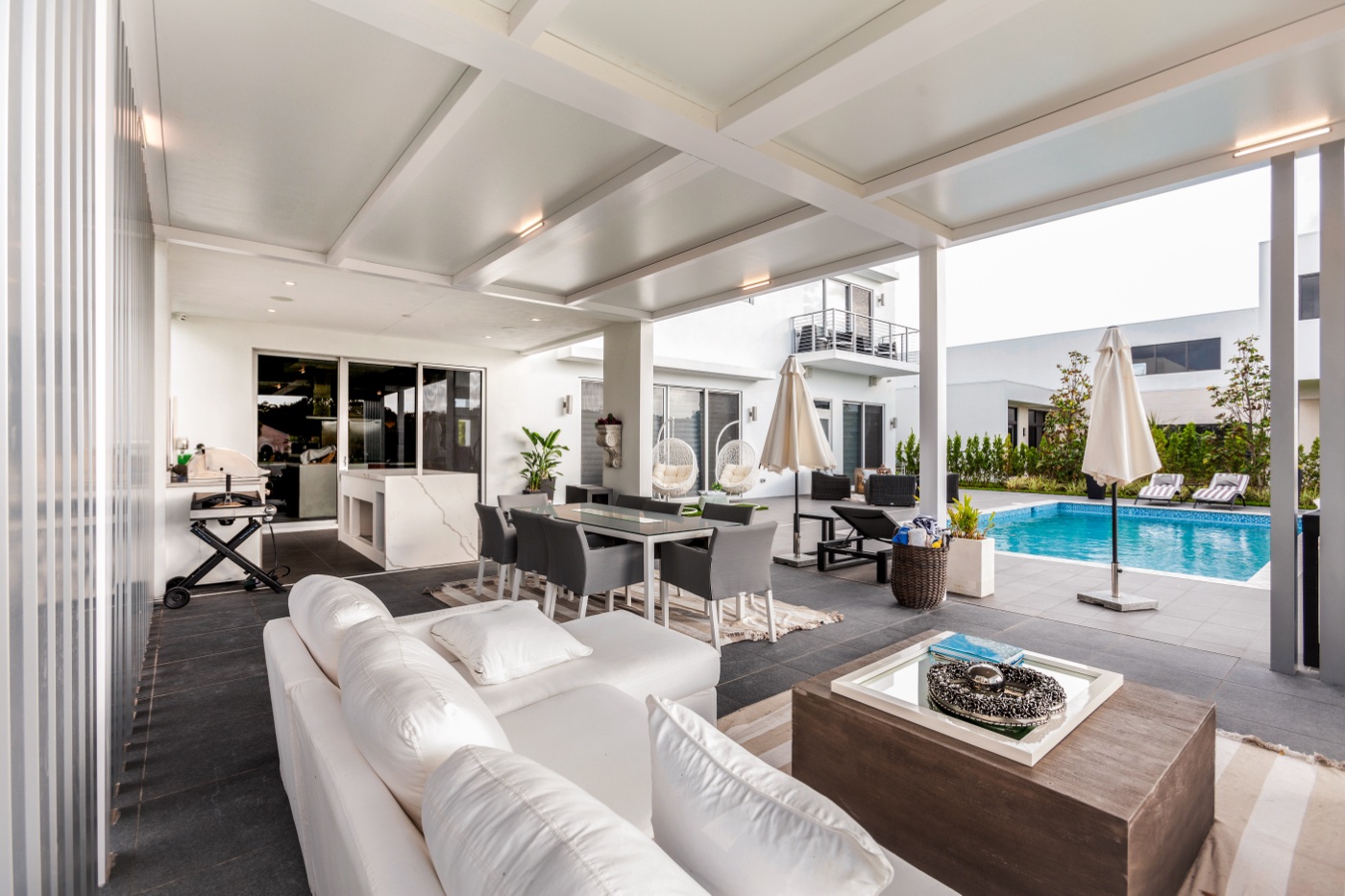
The two systems aren't mutually exclusive on a single property, and on larger multi-bay projects, they're often combined deliberately — an R-Shade bay over a permanent outdoor kitchen or lounge that never needs adjusting, paired with an R-Blade bay over a dining or pool-adjacent area where flexible light matters. It's the same engineering family, the same aluminum finish palette, integrated into one continuous roofline rather than treated as two separate purchases. Browse Breslow's project portfolio to see both systems built on real Northeast homes.
Choosing by How You Live
There's no wrong answer between the two — only a mismatched one, where a household buys adjustability it never uses or buys fixed coverage and wishes it could open the roof on a perfect October afternoon. The honest way to decide isn't by browsing photos, it's by describing a week. A family that grills often, entertains at dusk, and wants shade that shifts with the sun typically lands on R-Blade. A family that wants the patio simply always covered, no remote, no thinking about it, often prefers R-Shade. Either way, both product lines get the same design-through-installation process: a Zoom consultation first, a Matterport-measured home visit if there's mutual fit, 3D renderings on your actual house, PE-stamped engineering where required, and installation in 3–5 days on site once the project is scheduled.
Ask your contractor: "Can I see both systems built side by side, and can you show me the engineering documentation for each?" A firm that installs only one product line has an obvious incentive to answer that question for you.
Start with a consultation and bring the honest answer to the "how do you actually use the space" question — the right roof follows from there.
Frequently Asked Questions
What's the difference between a louvered roof and a fixed roof pergola?
A louvered roof, like Breslow's Azenco R-Blade system, uses individually motorized aluminum louvers that rotate open, tilt, or seal shut on demand. A fixed roof pergola, like the Azenco R-Shade system, is a solid, insulated roof that provides consistent full coverage every day with no moving parts to adjust.
Is a louvered roof pergola worth the extra cost over a fixed roof?
It depends on how the space will be used. A louvered roof earns its value from flexibility, including adjustable light and ventilation plus the ability to seal against rain or vent grill smoke. A fixed roof earns its value from simplicity and maximum, consistent weather protection. Neither is objectively worth more without knowing how a household actually uses the patio.
Can you combine a louvered roof and a fixed roof on the same structure?
Yes. On larger multi-bay projects, Breslow frequently combines an R-Shade bay over a permanent kitchen or lounge area with an R-Blade bay over a dining or pool-adjacent zone, using the same aluminum finish and engineering platform across the whole roofline.
How wind-rated are louvered roofs compared to fixed roofs?
Breslow's R-Blade louvered system is wind-rated up to 195 mph and Miami-Dade hurricane certified. The R-Shade fixed insulated roof is rated from 98 to 176 mph depending on configuration and span. Final ratings for either system depend on site-specific engineering.