Key Takeaways
- Salt-laden air accelerates corrosion at joints and fasteners far faster than an equivalent inland structure — finish and hardware grade matter more at the shore.
- Wind off open water runs unobstructed, which is why wind sensors on retractable systems do real, load-bearing work at shore-front homes.
- Solution-dyed acrylic fabrics like Sunbrella and Tempotest are chosen for coastal projects specifically for fade and salt resistance.
- Many shore homeowners move from a retractable awning to a louvered roof rated up to 195 mph and Miami-Dade certified, so they stop managing the structure before every storm.
A shore house asks more of every outdoor structure than an inland property ever will. Salt-laden air, near-constant humidity, and wind with an unobstructed run off open water turn ordinary wear-and-tear into an accelerated stress test — and not every awning or shade system is built to pass it. After building and servicing outdoor structures along the Jersey Shore and the East End for decades, we've seen exactly what holds up and what fails first. It's also where the gap between a well-built system and a merely adequate one shows up fastest, often within a single season rather than after years of gradual wear.
What the Shore Does to Outdoor Structures
Salt in the air doesn't just sit on a surface — it works into joints, fasteners, and any finish with a weak point, accelerating corrosion far faster than an equivalent structure fifteen miles inland. Humidity keeps fabric and hardware damp longer between dry spells, and reflected sun off water, sand, and light-colored decking often delivers more UV exposure than a shaded suburban patio ever sees.
Salt fog can travel well over a mile inland on a steady onshore breeze, which is why even homes set back from the water benefit from the same coastal-grade specification as a true beachfront property. Add the higher humidity that keeps everything from fully drying between uses, and the same materials that perform for decades in a typical suburban backyard can show real wear within just a few seasons at the shore.
Frames and Finishes That Resist Salt Air
Powder-coated aluminum is the baseline for coastal performance — it handles salt exposure far better than untreated or lower-grade finishes. Just as important is the hardware at the moving joints: stainless steel or marine-rated fasteners and pivots resist the corrosion that causes cheaper systems to seize or fail first at exactly the points that carry the most load.
Anodized aluminum is another option worth asking about for the most exposed installations, since the anodizing process bonds a protective layer into the metal itself rather than coating over it. Whatever the finish, the fasteners and pivot hardware deserve the same scrutiny as the frame — a beautifully finished arm with a standard-grade bolt at the pivot point is only as durable as its weakest connection.
Wind: The Shore's Real Test
Open water gives wind a straight run at shore-front homes, with none of the tree lines or neighboring structures that break up gusts inland. A retractable awning's wind sensor is doing real work here, automatically pulling the fabric in before gusts stress the frame — but there's a level of exposure at which the smarter move is a structure engineered for it from the start. That's the case for many of our shore clients who move to the Azenco R-Blade louvered pergola, which is wind-rated up to 195 mph and Miami-Dade hurricane certified.
Engineers describe this kind of unobstructed coastal exposure as a higher exposure category than a typical inland lot, which is part of why a system designed for average suburban wind loads can be genuinely undersized once it's sitting a few hundred feet from open water. Wind sensors that trigger automatic retraction are a meaningful safeguard for a retractable system in that environment, but they're a mitigation, not a substitute for a structure engineered for the exposure from the start.
Fabric Choices for Coastal Sun
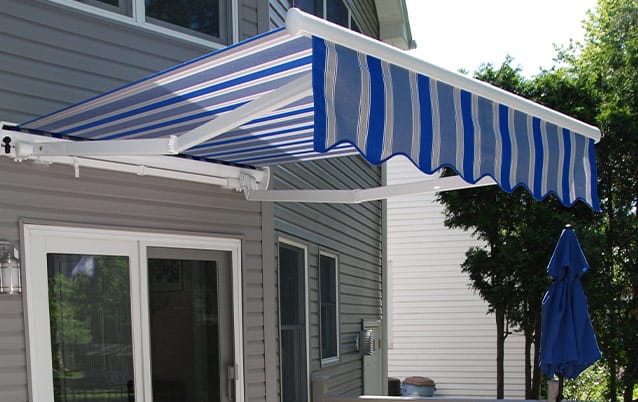
Solution-dyed acrylics — the Sunbrella and Tempotest lines we carry across our retractable awning lineup — are chosen specifically for fade and salt resistance, which matters more at the shore than almost anywhere else. Glare reflected off water and light-colored surfaces adds UV exposure beyond what a standard fabric rating accounts for, which is part of why coastal projects lean toward the most UV-stable options available.
Tighter weaves and higher openness-factor fabrics both have a place here depending on whether the priority is shade or airflow, and color retention under the shore's combination of salt, humidity, and reflected UV is worth asking about directly rather than assuming every solution-dyed fabric performs identically.
Darker colors and bold patterns can hide early fading better than pale, solid tones, which is a small but real consideration when a shore home's fabric is getting more sustained sun exposure than an equivalent inland installation over the same number of seasons.
When Shore Homes Step Up to Louvered Roofs
Many of our shore clients start with the idea of a retractable awning and, partway through the design conversation, land on a louvered roof instead — not because the awning was the wrong product, but because they'd rather stop thinking about retracting fabric before every storm. A permanently engineered structure removes that decision entirely, opening and sealing on its own schedule rather than yours.
Pairing a louvered roof with motorized screens is common in these conversations, too — the roof handles overhead sun and rain, while side screens add wind and privacy control without the homeowner having to think about retracting anything before a forecast turns.
Shore Projects We've Built
Our shore work spans the Jersey coastline, including projects in Monmouth Beach, Deal, Long Branch, and Barnegat Light — each engineered around the same salt, wind, and sun exposure a shore-front property faces every season. Each carries the same underlying engineering approach, even where the architectural style differs from house to house — coastal-grade hardware and finishes aren't an upgrade option at the shore, they're the baseline.
Ask your contractor: what hardware grade is specified at the pivot points, and is it rated for a marine environment? That answer tells you more about a system's long-term performance than anything in the brochure.
Frequently Asked Questions
Do regular retractable awnings hold up at the beach?
With the right frame finish, hardware grade, and fabric, retractable awnings can perform well at the shore. Ongoing salt exposure does ask more of the system over time, and wind sensors matter more here than almost anywhere else.
What frame finish holds up best in salt air?
Powder-coated aluminum paired with stainless steel or marine-rated hardware at the joints and fasteners is the baseline for coastal durability. Lower-grade finishes and hardware tend to corrode first at exactly the points carrying the most load.
Should I choose a louvered pergola instead of an awning for a beach house?
It depends on how you want to live with it. Homeowners who would rather not retract fabric before every storm, and who want a structure engineered to a high wind rating, often choose a louvered roof. A retractable awning remains a sound, lower-investment option for simpler seasonal shade needs.
How often should awnings at the shore be cleaned?
More often than an inland home. Regular fresh-water rinses to clear salt buildup, in addition to standard fabric cleaning, help protect both the finish and the hardware over a shore property's full season.