Key Takeaways
- Restaurant patio cover options range from market umbrellas to fixed roofs to motorized louvered roofs, each with different weather protection, light control, and lifespan.
- A motorized louvered roof is the only option among these that seals fully in a downpour and opens fully on a clear night, without staff intervention.
- Commercial installations at operating restaurants can be scoped and scheduled around slow-service days, with most on-site work complete in 3–5 days.
- Breslow's own commercial builds — including Tommy's Tavern + Tap's four New Jersey locations — show what a properly engineered patio cover looks like at scale.
Every restaurant with outdoor seating eventually asks the same question: what goes over it? The answer ranges from a folding umbrella to a fully engineered, motorized structure, and the gap between them isn't really about price — it's about how much weather the space can actually shrug off on a given Tuesday night.
The Patio Cover Options, Ranked
Market umbrellas are the lowest-commitment option: cheap, quick to deploy, and useless the moment wind picks up or rain turns sideways. Retractable fabric awnings cover more ground and can retract for storage, but they're still a fabric membrane — effective against sun and light rain, less so against sustained wind or a hard downpour, and typically built from solution-dyed acrylics like Sunbrella or Tempotest that resist fading and mildew but remain the system's weak point in coastal wind or heavy snow years. A fixed, insulated roof structure, like Breslow's solid-roof pergola systems, gives full, permanent weather protection but no light control — the space is either shaded or it isn't, every day of the year. A motorized louvered roof sits above all three: full protection when closed, full sun when open, and the ability to change between them from a switch mid-service.
| Cover Type | Weather Protection | Light Control | Investment Level |
|---|---|---|---|
| Market Umbrellas | Low | Fixed shade only | Low |
| Retractable Awnings | Moderate | Adjustable, manual/motorized | Moderate |
| Fixed Insulated Roof | High | None — always covered | Substantial |
| Motorized Louvered Roof | High, on demand | Fully adjustable | Substantial |
Why Louvered Wins for Restaurants
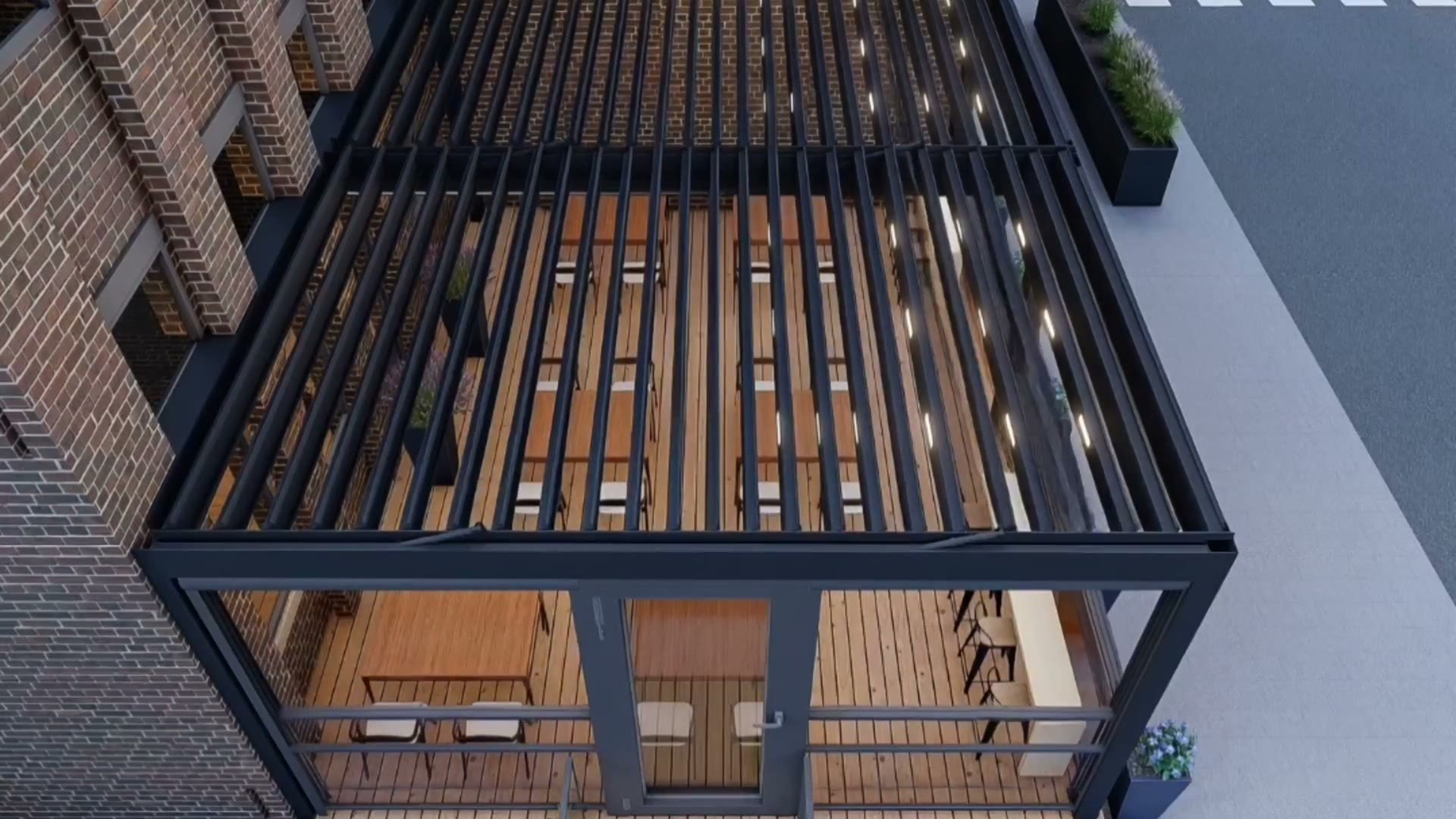
A restaurant's outdoor room needs to do two contradictory things well: stay bright and open on a perfect evening, and seal completely the moment a storm interrupts service. A motorized louvered roof is the only option built to do both, opening and closing on remote or weather sensor without a server running outside to move furniture. Breslow's R-Blade system is engineered and marketed at wind-rated up to 195 mph, Miami-Dade hurricane certified — a standard that matters just as much through a Northeast nor'easter as it does anywhere else, with PE-stamped structural engineering where required.
Codes and Approvals (General, Hedged)
What triggers a permit, a health-department review, or a fire-marshal sign-off varies by municipality and by what's being built — attaching a structure to the building, adding electrical for motors and lighting, and occupancy considerations for a covered dining area can all factor in differently from one town to the next. There's no universal answer here worth guessing at. Where permits are needed, we handle or assist with the entire process, and the specifics for your address get scoped during the design consultation rather than assumed in advance.
Restaurants often carry a second layer of review that a residential pergola never touches — health-department sign-off on covered service areas, and fire-marshal review of egress paths, occupancy limits, and clearances around any heating elements installed under the structure. Whether a space is fully open-air or partially enclosed with screens can change how it's classified, so these requirements get addressed specifically for your location rather than assumed from a generic checklist.
Installing Without Closing
A restaurant can't afford a multi-week shutdown for a patio project, and it shouldn't have to plan for one. Breslow's own crews — no subcontractors — complete on-site installation in 3–5 days once a project reaches that stage, and scheduling is typically built around your slowest service days rather than your busiest ones. The heavier lift — design, engineering, permitting, fabrication — happens before a crew ever sets foot on your patio, so the disruption an operator actually feels is compressed into the smallest possible window. Site work like footings and electrical rough-in can often be scheduled ahead of the visible build-out, so the most disruptive portion — setting the frame and mounting the louvers — is what actually falls inside that 3–5 day window.
Ask your contractor: "How many days will your crew be on-site, and can you work around our peak service hours?" A vague answer usually means a longer disruption than advertised.
What It Costs (Scale Framing)
Commercial pergola projects generally range from about $50,000 for a compact bar-patio addition up into the multi-million-dollar range for full rooftop build-outs at larger hospitality groups. As a benchmark, Breslow's typical residential project runs $75,000 to $150,000, and commercial installations average roughly six times that scale, depending on size, span, structural complexity, and integrations like heating, screens, or lighting. None of that is a reason to guess at a number for your restaurant — it's a reason to scope it properly before pricing it.
Commercial projects at this scale are also financeable. Breslow offers financing through Synchrony and HFS for qualifying projects, which lets an operator spread a capital expense expected to extend the property's revenue season for years, rather than funding the entire build out of pocket in one cycle.
Restaurant Projects We've Built
The clearest way to judge a patio cover system is to see it in operation. Tommy's Tavern + Tap has installed Breslow's louvered roof system across four locations — Edison, Clifton, Bridgewater, and Sea Bright — including a 17-bay rooftop build in Edison. B2 Bistro carries the same standard across North Brunswick, Point Pleasant, and Reading, Pennsylvania, and Grain & Cane in Bridgewater rounds out a portfolio of restaurant operators who chose one system rather than reinventing the outdoor space at every location. In each case, the same in-house team handled design, engineering, permitting, fabrication, and installation — the same accountability an operator gets on a single-location project, repeated at scale.
Frequently Asked Questions
What's the best type of patio cover for a restaurant?
It depends on how much weather protection and light control the space needs. Market umbrellas and retractable awnings offer partial, lower-cost coverage but still leave service exposed to wind and heavy rain. A motorized louvered roof, like Breslow's R-Blade system, is the only option that seals fully in a downpour and opens completely on a clear night without staff intervention, which is why it's the standard choice for restaurants planning to use the space year-round.
Do restaurant patio covers require permits?
Permit requirements vary by municipality and by the type and scale of structure, particularly for anything attached to the building or involving new electrical work. Where permits are needed, Breslow handles or assists with the entire process; specific requirements for your location are scoped during the design consultation rather than assumed in advance.
Can a patio cover be installed without closing the restaurant?
Yes, in most cases. Installations are typically scheduled around slower service periods, and Breslow's own crews complete on-site work in 3 to 5 days once a project reaches that stage, minimizing disruption to ongoing operations.
How much does a commercial patio cover cost?
Commercial pergola projects generally range from about $50,000 to multi-million dollars depending on scale and structural complexity, averaging roughly six times the scale of Breslow's typical $75,000 to $150,000 residential project. An exact figure depends on size, site conditions, and integrations, and gets scoped during a design consultation.